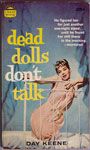
Somehow, the other day when I was going on and on about Day Keene and how much I dig him as a writer of the pulps and pulpy and mysteries and noirs and their ilk, and dropped down a Martini quote from the fine once-fit-in-your-pocket-book now part of a worthy three-novels-in-one-book collection from Stark House called Dead Dolls Don’t Talk, well, I meant to put in two quotes. And that, friends, is what’s called a long sentence. And a mistake I mean to rectify by putting in the second quote right now (cause I don’t want you to miss it. And want you to read the book. So, go on, do both).
Coe put a cigarette in his mouth and offered the package to his employer. “The hell of it is we haven’t any way of knowing for how long you may be stuck.”
Hart lit his first cigarette of the day and enjoyed it. “That’s the hell of it,” he agreed. “But if I’m not back in a couple of days you might try sending out a Saint Bernard with a keg of dry Martinis.”
Day Keene is one of my favorite pulp-ateers. And by that I don’t mean someone who does puppet shows with puppets made of fruit. Though that would be, um, interesting, too. No, I mean one of the writers who wrote in the middle of last century, and who wrote books that usually fit in your pocket and stories in magazine with vaguely lurid names. Both genres tended to be about crimes, criminal, down-on-their luckers, drinkers, back-alley brawlers, just-in-troublers, and anyone who’s run into, or looked for, trouble. Day Keene wrote a whole giant bar full of tales featuring those kind of folks, with tight plots that keep you on the edge and wondering how it’ll all end in a manner that’s not quite bleak, but close enough to call out to bleak without a raised voice. Anywho, his characters usually need a stiff drink, and Dead Dolls Don’t Talk (which is part of an amazing collection of three Day Keene novels reprinted by Stark House) isn’t any different. As this quote shows us:
As he sipped his second drink Hart gave the girl her due. Peggy made good Martinis, albeit they were a trifle strong and she served them in Old-fashioned glasses. The date, if it could be called that, was proceeding according to pattern. Peggy had made the usual announcement that she wanted to change into something cooler and more comfortable. However, instead of donning the usual filmy negligee, she’d put on a smart red shantung coolie coat that ended halfway down her thighs, creating the illusion that there was nothing by flesh and girl under the provocative garment.
The newest episode of the Cocktail to Cocktail Hour is here, and this time, we’ve gone international with another Everyday Drinking segment, where I solve the drinking problem of an everyday person. But this time, that everyday person is someone who has come all the way from the United Kingdom! Amazing, isn’t it? A fine British gentleman by the name of Alastair Edwards (really!) is the star of this episode, where I teach him how to make the Sweetie-Pie cocktail from Good Spirits, so he can delight his American gal pal with it. There are also many hijinks, of course, as we wade into the waters of American/British differences and erupting hats – over drinks.
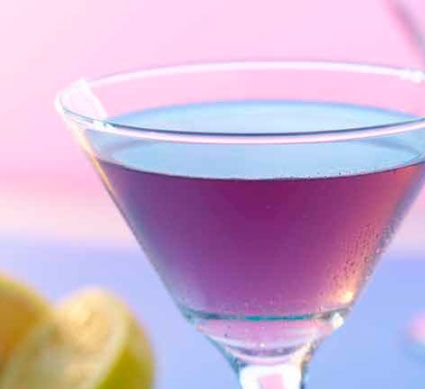
There’s another drink also called The Blue Train (as happens, cause people are creating drinks all the time. Like ten were created as I typed “ten”), or the Blue Train Special, which shakes together 1-1/2 ounces brandy and 1 ounce fresh pineapple juice over ice, and then tops it with Cap Classique or other sparkling wine and a pineapple chunk in a flute glass. This is not that Blue Train. The Blue Train is in Wine Cocktails. This one is in Ginger Bliss and the Violet Fizz. Both drinks are awesome. This just happens to be the one I’m drinking today. But tomorrow? Who knows?
The Blue Train
Ice cubes
1 ounce gin
1/2 ounce Cointreau
1/2 freshly squeezed lemon juice
1/2 ounce crème de violette
1. Fill a cocktail shaker halfway full with ice cubes. Add the gin, Cointreau, lemon juice, and crème de violette. Shake briefly.
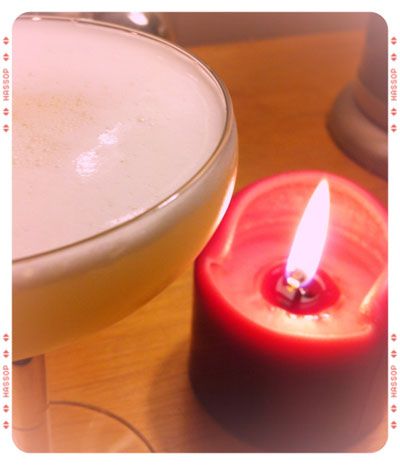
Back when I was younger (this was before things like cocktail blogs – really, before electricity. Ba dump bump), there was a drink called The We Have to Be at Work by 10 A.M. It was all about mornings and how sometimes you need to pack breakfast, juice, and a pick-you-up into one glass, and was printed first in that award-winning cocktail cuddler, Good Spirits. Recently, though, I re-visited the drink, thinking about how it’s more often now that I’m thinking of a pre-going-to-bed drink, and that I now have to go to work much earlier than 10 A.M. I didn’t want to change its nature too much, cause it’s a fun drink. First, I thought I’d make the switch from vodka to gin, cause gin’s a bit more of a refined evening number. Then, though, to make things a bit easier (it’s evening, remember, and we’re winding down) and because it’s tasty, I moved to the Bitter Truth’s new Pink Gin, which is a gin-aromatic-bitters mix, served in a beautiful bottle (if you don’t see it in your store, try Astor Wine & Spirits). It has a florally-juniper-y taste underlined by and mingled with spice notes. Yummy. I also, when, updating the recipe, added a little simple syrup, because before bed one likes some sweetness. I kept the orange juice and part of the egg (the white), though, because healthiness is good any time of day.
The We Have to Be in Bed by 10 P.M.
1-1/2 ounces Bitter Truth Pink Gin
1 ounce freshly squeezed orange juice
1 egg white
1/2 ounce simple syrup
1. Fill a cocktail shaker halfway full with ice cubes. Add the Pink Gin, orange juice, egg white, and simple syrup. Shake really well (it’ll wear you out for bed).
2. Strain (through a fine strainer if you have one) into a cocktail glass. Drink. Sleep. Dream dreamy dreams.
The time is now! This is the time! This time it is time for the time being now! All of which is to say, the sparkling new season of A.J. Rathbun’s Cocktail to Cocktail Hour (starring me, A.J. Rathbun) starts today. And what a start it is: in this first episode I’ll teach you how to make the Supersonic cocktail, named after my favorite NBA team of all time, The Seattle Supersonics. Yeah! It’s a delicious mix, which should be enough to woo you to watching and making, but to make things even more exciting, the episode has a very special guest: the Glove, the best defensive point guard in history, Gary Payton! You have to watch it to believe it folks. So what are you waiting for – hit play already!
PS: As always, the Cocktail to Cocktail Hour was directed, co-wrote, edited, produced, and gaff’d by Dr. Gonzo and is an Artificial Khaos production.
It’s weird, but I don’t think I’ve had a Cocktail Talk post featuring a quote or quotes from a Donald E. Westlake book. Or, I just can’t track one down. Or maybe it’s not so weird — I haven’t read a ton of Westlake, but it feels like I’ve enjoyed enough books here and there. And now I’m meandering. Bank Shot is a caper book, one of like 100 books by Westlake (oh, he also wrote the screenplay for The Grifters, which is rad), and probably the only book where the not-always-so-smooth criminals rob a bank by actually stealing the whole bank building. It also was the basis for a movie. They also do a lot of their planning in the back of a bar, which is if not the safest at least the most congenial spot I can think of to plan a robbery. And you can have a drink while planning. They drink a fair amount in Bank Shot, too, and now I have drawn everything full circle, which means it’s time for the quotes:
Victor said, “I’m drinking tonight.” He sounded very pleased. Dortmunder ducked his head a little more and looked at Victor under his fingers. He was smiling, of course, and holding up a tall glass. It was pink. Dortmunder said, “Oh, yeah?” “A slow-gin fizz,” Victor said.
He had planned his menu with the greatest of care. The cocktails to begin had been Negronis, the power of the gin obscured by the gentleness of vermouth and Campari.
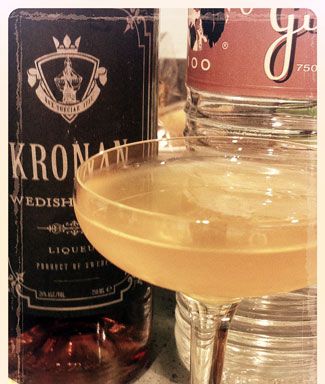
For many moons, our country has been deficient. I’m not sure what we did, exactly (though I can guess—thank you very much Kermit the Frog), but for years we irritated the find people of Sweden. This led to many sad things: a lack of tall blonds, a distinct problem with meatballs, and, most tragically, the complete absence of Swedish Punsch in every single bar from east to west. Swedish Punsch once was a staple of bar shelves and cocktails and home liquor cabinets. With a base of the sugar-cane based spirit Batavia Arrack combined with other flavorings, it had a taste all its own and a devoted following (I’m sort-of guessing on this last point, as most who had it when it was available way back when are sadly now at that big bar in the afterlife). And then some time after Prohibition it vanished. Why! Why! Why!
Well, I certainly don’t know. But, the main point, and what’s causing me to not shake my fist at the sky, is that it’s back and you should become a fan. I’ve recently been dipping into a bottle of Kronan Swedish Punsch and it’s darn delicious. It boasts a seriously yummy toffee-molasses-and-spice taste, with some smokiness smudged in for good measure. The story is that in Sweden it’s had warm with pea soup. Hmm, sounds great (please, everyone agree—we don’t want to irritate the Swedes again). It’s also great in cocktails, including one called the Astor that I found first in the rightly revered Old Waldorf Astoria Bar Book by Albert Crockett. Try it whydontcha.








 Somehow, the other day when I was going on and on about Day Keene and how much I dig him as a writer of the pulps and pulpy and mysteries and noirs and their ilk, and dropped down a Martini quote from the fine once-fit-in-your-pocket-book now part of a worthy three-novels-in-one-book collection from Stark House called Dead Dolls Don’t Talk, well, I meant to put in two quotes. And that, friends, is what’s called a long sentence. And a mistake I mean to rectify by putting in the second quote right now (cause I don’t want you to miss it. And want you to read the book. So, go on, do both).