Not but a few mysterious weeks ago, I had a Cocktail Talk featuring a book called The American Who Watched British Mysteries, a cozy mystery whose title vaguely sounds like me (as I watch and love British television mysteries incessantly). And now, today, I’m having a Cocktail Talk for that book’s follow-up, called Ballgame. In the second American Who Watched British Mysteries book, all those quotes and references to favorite shows again spring up like clues alongside the clues to the mystery itself.
Levelheaded police detective Marlowe is back, summoned to a suspicious death that happened at a kid’s baseball field – while a game was taking place. And it turns out that mystery-television enthusiast John Arthur, who ended up helping Marlowe solve an earlier case, and brindled bouncy dog Ainsley were in the bleachers when it happened.
Marlowe and his partner-in-solving-crime Detective Morven, along with newly promoted Detective Nelson, discover that though the victim, pastor Pat Brown, died in front of a crowd during the game, seemingly no-one saw anything suspicious. Not even John Arthur. But he does have a number of British mystery quotes – and a few from a New Zealand town called Brokenwood – that he assures Marlowe will help.
It’s another fun read, and in it like the first book they spend time in one of my favorite fictional bars, Gary’s. Which is where the below quote comes into play.
“How about a Garibaldi?”
“Remind me?”
“Simple but delicious. And nutritious. Old compadre Campari with fresh OJ over ice. Campari taking the edge off and stimulating the brain, orange juice for vitamins and sweet citrus, ice to chill it out. Named for Giuseppe Garibaldi, the general who was one of those behind the wheel unifying your beloved Italy. National hero. Led his Redshirt army, shirts as red as Campari. Ideal for leaders and for the vitamin C deficient. Horses for courses and all, but you’ll enjoy.”
“I will. Hit me.”
Gary grabbed a glass and a bottle of Campari and started making the drink, saying, “Interestingly, the redshirts kicked off when Garibaldi was helping the Uruguayan civil war. A military leader with national independence and republican ideals, our Giuseppe.” He placed the drink in front of Marlowe with a flourish. “Must dash. Duty calls bartenders too.”
Sometimes, I sit and think, “what a world we’re living in.” Sometimes I think that for sad reasons, but I try to balance it out by thinking that for happy reasons – one of those reasons being the widely, wildly, available amount of cocktail bitters we have available today. Even when I started this blog like 10,000 years ago (or early at the turn of the millennium), there weren’t many bitters at hand outside of standbys (delicious standbys) Angostura and Peychaud’s, and if you could get them, the Fee Brothers line (which wasn’t all that get-able in many places). Now, we have an abundance of bitters, and that allows me to make drinks like this, which uses two bitters from the wonderful Seattle-based Scrappy’s bitters. I can’t – though I’ve certainly tried! – sing the Scrappy’s praises enough, and I’m so glad to be able to bring this drink to another layered level of flavor by including both Scrappy’s Grapefruit and Scrappy’s Orange bitters, which delivery different delicious expressions of herbal and citrus goodness, taking the drink to righteously royal levels with a few other key ingredients helping out as well Drumshanbo Sardinian Citrus Gin, Grand Marnier, and Prosecco. All together they deliver a combo any monarch (even if they’re just regal to their pets) would be happy to have at a June brunch or evening party. Just remember to toast the bitters, which truly make it better.
Well, here’s a jolly good mystery read, if I do say so myself (hehe). In The American Who Watched British Mysteries, by the book police Detective Marlowe is investigating the strangulation death of Lucy Dixon, beginning the case by interviewing recent widower John Arthur, who, with his brindled bouncy dog Ainsley (what a wonderful name for a dog!), found the body early on a Saturday morning next to a tree-filled community center. Mysterious, right? The detective soon discovers that John is a massive fan of British mystery television series (hey, I am too), to the point that he keeps going on tangents about the two Detective Barnabys from Midsomer and quoting French – or is it Belgian? – private investigators. As Marlowe and his team begin to dig into the case, John keeps showing up. He knew the victim, calls the neighborhood a village, and arrives at the station with a map of the block she lived on, detailing everyone who was at the party attended the night before her murder. As the officers investigate, John’s TV-driven insights and attention to detail become surprisingly helpful. But Marlowe’s eyebrows keep raising as he wonders if the man, who he starts to think of as a friend, is a curious and lonely television obsessive, or could he actually be involved with the murder? And is it, as John brings up, a one-murder show, a two-murder show, or an even-more-murders show?
It sorta hits all my boxes: British TV mysteries, British mysteries in general, cozy mystery books, good characters, neat references, there’s a dog, it breezes along while still having a good mystery going, and, perhaps most of all, there’s a very good bar featured, Gary’s, with an English bartender named Gary! And, as you might expect from a book here on the ol’ Spiked Punch, there is lots of Cocktail Talking, lots around Italian drinks. Including the below quote.
Marlowe had fallen for the Italian Negroni way back when introduced to it on his first visit to the country, loving the ideal balance between gin, sweet vermouth, and Campari—bitter and sweet and herbal mingling. When he’d first ordered one back home after that long-past Italian trip, the bartender he’d ordered from had no idea what he was talking about. He’d had to walk him through the drink construction step by step. Now, Gary had told him that there’s a whole Negroni week bars around the country take part in. The world, it had gotten smaller.
Before his musing got any further down the global gully, Gary set the drink in front of him with a minor flourish. “Ta-da. One country-trotting Negroni, made with Italian Campari, Spanish vermouth, and British gin. And an orange twist from Florida, I surmise. And local water in the form of ice. Cheers.”
This is another Cocktail Talk found in an older mystery story featured within one of the wonderful British Library Crime Classics collections (you can read more by perusing past British Library Crime Classic Cocktail Talks, a phrase rather fun to say). In this case, the collection is Final Acts: Theatrical Mysteries, so, as you might gather but in case you didn’t, all mysteries circling around the theater in one way or the other, some closer to the stage, so farther away. The collection was put together by the indefatigable writer and editor Martin Edwards, and contains works by lesser-known and widely-known UK authors from the late-1800s, early-1900s. Somewhat in the middle of the “known” ranges falls the writer Anthony Wynne – aka Robert McNair Wilson – who penned both with this penname and under his own a whole bunch of books, while also being a surgeon and politician and probably more things, too. Quite popular I believe in his time, if not as well known today. The beautiful below wine quote (and the inclusion in the British Library Crime Classics collections) will hopefully re-balance his rep.
He raised his glass to his lips and sipped the exquisite wine, which it contained, very slowly. It was white Clos Vouget, the pale sister of the immortal red Burgundy of that name. Golden points of light shone from its clear depths. He set the glass down again and once more turned to Lalette; in some mysterious fashion she resembled the wine. It might even be possible to call her insipid if one had developed a taste for more exuberant gaiety. Men who drank red wine habitually, he reflected, were ignorant as a rule of the profound simplicity of white, that quality which transcends all the vintners’ descriptions.
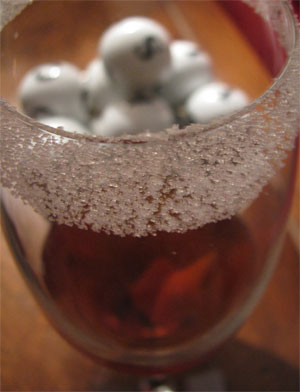
I tend not to be a big fan of sugar, salt, spice, etc. on the rim of a cocktail glass when I’m drinking a cocktail. I don’t get all upset about it if I have such, cause drinking oughta be fun, not upsetting, but it’s not my favorite, cause really, I wanna taste the drink and its ingredients and not be overwhelmed by whatnots on the glass. I realize others take a different take on this, and that’s just okay with me! Again, drinking oughta be fun! However, there is one (maybe more, but that wouldn’t make such a good transition) drink I am okay with a sugared rim on, and that’s Mrs. Solomon Wears Slacks. Because it’s from Crosby Gaige’s Cocktail Guide and Ladies Companion, published in 1941, and I don’t want the ghost of bon vivant Gaige haunting me. Unless ghosts are all-of-a-sudden able to become corporeal enough to shake cocktails; if that’s the case, haunt away Mr. Gaige! And start the haunting by serving up this amazingly-named drink.
Mrs. Solomon Wears Slacks
Ice cubes
Super-fine sugar
2 ounces brandy
1/2 ounce orange curaçao
3 dashes Angostura bitters
Lemon twist
1. Put a good helping of sugar on a saucer. Wet the outside rim of a Champagne flute (I used a lemon slice, but you could also rotate it through water on a saucer–just don’t get any water in the glass). Carefully rotate the outside rim of the glass through the sugar–but you don’t want to get any sugar on the inside.
2. Fill a cocktail shaker or mixing glass halfway full with cracked ice. Add the brandy, curaçao, and bitters. Stir well.
3. Strain the mix into the flute. Garnish with the lemon twist. Now, dance!
The Blue Train cocktail recipe below, had me thinking of Cointreau (hey, that sounds like the first line in a sweet swing-style song, one of the sadder ones, probably all about lost love and travel and reading Charles Williams books), which then led to me thinking of the below quote from the Charles Williams’ yard The Wrong Venus. Even though the lead in said book doesn’t get to drink Cointreau, instead shifting to crème de menthe, well, it’s still a dandy quote and scene and I thought I’d better post it here for all to enjoy (and speaking of enjoying things, read all the past Charles Williams Cocktail Talks to learn more about this swell detective/mystery/thriller writer from days of yore).
‘Do you have any Cointreau?’
‘Cointreau?’ It was obvious she thought he was crazy.
‘You do sell liquor on these flights, don’t you?’
‘Yes, of course . . . But with this turbulence, naturally we couldn’t bring the cart through. And we don’t have any Cointreau anyway.’
‘Then crème de menthe?’
‘Y-e-e-s, I think so. But I’m afraid only the white . . .’
He was conscious again of time hurtling past him, but managed a reassuring smile. ‘It’s all right. I only drink in the dark.’
The Blue Train can refer to a number of things. There’s the seminal album by jazz master John Coltrane. There’s the Poirot-featuring mystery novel by Agatha Christie (and to follow the literary theme, I believe a Blue Train bookstore in GA). There’s the actual train that’s called the Blue Train in South Africa (and there used to be a Blue Train in France, too, where the Christie took place). And then there are at least two drinks (I’ve featured them both), and my guess is there are probably like 10 more Blue Train cocktails I don’t know off the top of my head. That’s a lot of Blue Trains, and I’m sure I’m missing something (and I’m guessing there are Blues Trains galore, too). Whew, it’s enough to make one need a drink. Today, I’m going with the gin, Cointreau, lemon juice, and crème de violette version. Without the latter and with an egg white, depending on your egg-white-ness, that’s a White Lady of course, who probably rode a Blue Train once, but see, it’s not a White Lady cause of the crème de violette, which is really why I’m having this today, as I had a hankering for a crème de violette cocktail, and have a fondness for that flowery liqueur. Also, without the Cointreau and with maraschino, it is of course the high-flying Aviation cocktail. But I was feeling orange-y, and that gets to my typing less and drinking more. So, all aboard? I’d hope so.
The Blue Train
Ice cubes
1 ounce gin
1/2 ounce Cointreau
1/2 freshly squeezed lemon juice
1/2 ounce crème de violette
1. Fill a cocktail shaker halfway full with ice cubes. Add the gin, Cointreau, lemon juice, and crème de violette. Shake briefly.
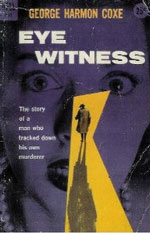
We’ve had a number of brandy drinks here lately (just see the last few posts!), and they reminded me of the below quote from the George Harmon Coxe book Eye Witness, featuring photographer/mystery-solver Kent Murdoch, who can throw punches, talk smoothly with the ladies, drink it up, and snap memorable pics. All at once! Even with all that, I wouldn’t say George H. Coxe is like at the top echelon of Spiked Punch posted authors, but he can spin a swell yarn, as they say. And one with brandy!
Murdock asked Leone if she would have a brandy. She thought a B&B would be fine so he had the brandy. Only then, when the waiter took the other things away, was Murdock able to sit back and give his attention completely to his companion.
‘That was all right,’ he said.
‘Marvelous.’
She was watching him now, the faint flush in her cheeks giving her a new radiance that was attractive and promising. The cocktails had apparently done their work well for she seemed relaxed and at ease, content; it seemed to leave the next move up to him.