December 3, 2011
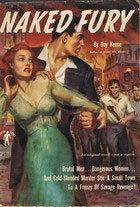 I probably shouldn’t start off by lying, so I’m going to tell the truth (which happens at least 69.7% of the time): even if the book I’m quoting wasn’t written by Day Keene, I probably would have picked it up if I saw it in the pocket book section of the mystery section of a bookstore, cause it’s called Naked Fury. That’s tough stuff. But since it was by Day Keene, and since I’ll purchase anything by him, well, the choice was easy. Keene’s oneof the classic (in my mind) hardboiled pulpy writers, who turned out books that slapped the pavement as hard as it needed to be slapped, usually outside of a bar that we modern folks can only dream about in our lurid dreams. Naked Fury is no exception, as it follows around a big-in-size-if-not-in-smarts party/neighborhood boss who is being set up and such around his boozing. Good stuff, I think. And the fact that I know pretty well how he feels in the below quote (even though I might sub in something for the lobster) makes me like him even more.
Morning was hot and slightly sour in Big Dan Malloy’s mouth. He lay on his back for long minutes listening to the intimate feminine splashing in the bathroom, wondering why he ever combined Champagne and Lobster Thermidor.
–Day Keene, Naked Fury
November 19, 2011
 It’s rare, in the mystery book genre, to find a protagonist that drinks. Oh, wait, you see that all the time. What’s really rare is a protagonist that writes poetry, or reads poetry, or reads at all, really. However, in Qiu Xiaolong’s wonderful Death of a Red Heroine, the main character, Chief Inspector Chen is a writer as well as a cop, and is always sprinkling in lines from classic Chinese poems into his conversations and thoughts. And, the mystery itself is good, while the setting and surroundings (late 80s China) are describing in a manner that’s both poetic and immersive. Add in a sidekick (Detective Yu) who’s got some sass in him and a whole host of intriguing surrounding characters (there’s even one called Overseas Chinese Lu) and intricate food descriptions and the following quote and you’ll be able to guess that I strongly suggest you read the book, for gosh sakes.
Behind him, across Zhongshan Road, stood the Peace Hotel with its black-and-red pinnacled roof. He had fantastized about spending an evening there in the jazz bar, in Wang’s company, with the musicians doing a great job with their piano, horns, and drums, and the waiters, starched napkins over their arms, serving Bloody Marys, Manhattans, Black Russians . . .
—Death of a Red Heroine, Qiu Xiaolong
October 18, 2011
 Peter Lovesey is an English mystery writer, perhaps most famous for his barrel-shaped and brusque Bath detective Peter Diamond and for his Sergeant Cribb books that take place in the Victorian era. I dig both. Lovesey isn’t all flashy, and isn’t perhaps as well-known as he should be over on this side of the pond, but his plots are always incredibly well thought out, his characters are real and motivated, and once you dive into one book featuring one of his two main characters, you tend (or I did, at least) to want to read more. They don’t hit the cocktails as much as other crime solvers of the police-and-non kind, so I haven’t mentioned him much here on the Spiked Punch blog. And, funny enough when considering the above, the quote below comes from the book Rough Cider, which doesn’t contain either of the fictional gentlemen mentioned above. But Rough Cider does has a fine mystery/story, and lots of cider talk (a murder happens at a cider farmer’s, if that makes sense), and I like cider, and so now it all makes sense, right? I did learn a few things from the book, too. First (and this is gross), cider makers at one time would put legs of mutton in the cider to give it a bit of body. Hmm. Second, cider that was bad would be termed “ropy” as in the below quote. Third, never put a human skull in your cider, or it will turn it ropy (unlike if you put mutton in I guess). Did these learnings turn me off cider? Nah. But they have given me a few more things to talk about when drinking it. This quote also features one of my favorite words (hogshead) and talks about drinking from jam jars, which I’m a fan of, even outside of wartime.
One evening in October, 1944, almost a year after the tragic events I’ve been describing, a man in a public house in Frome, the Shorn Ram, ordered a pint of local cider, a drink strongly preferred in wartime to the watered-down stuff that masqueraded as beer. People didn’t object to drinking from jam jars in those days of crockery shortages, but they were still choosy about what went into the jam jars. So when a customer complained that the cider was “ropy,” it was a serious matter. The publican had just put a new barrel on, a large one, a hogshead, from Lockwood, a reliable cider maker. He drew off a little for himself and sampled it.
—Rough Cider, Peter Lovesey
September 13, 2011
 Before you even accuse me of repetitiveness, I already know that I just did a Cocktail Talk post containing an Anthony Trollope quote (the one from The Three Clerks below). Or just a few weeks ago. But, but, but I also just read a different Trollope book, Castle Richmond, and it also had a few worthy quotes, one of which is below. See, I’ve run into a little Trollope luck lately, finding a few of the less-easy-to-find books, and so have been reading my Trollope-loving-heart out. Usually when browsing a bookstore, you’re only going to find a book from the Chronicles of Barsetshire (probably Barchester Towers or The Warden) and maybe something from the Palliser novels (usually, for reasons unknown to me, The Eustace Diamonds, which pales in my mind to Phineas Finn). The lesser known Trollope numbers? Not so much. Which is why, since I recently did find a few of these, A: I’m pretty excited, B: I’ve been reading so much Trollope, and C: why you, lucky people, get another quote about booze and boozing from a Trollope book. This may be, by the way, the finest whiskey punch quote ever. Castle Richmond itself is a darn fine read, an Irish tale which takes place during the potato famine with Trollope’s usual keen observing of politics, both personal and public. And with whiskey punch:
But the parlor was warm enough; warm and cosy, though perhaps at times a little close; and of evenings there would pervade it a smell of whisky punch, not altogether acceptable to unaccustomed nostrils. Not that the rector of Drumbarrow was by any means an intemperate man. His single tumbler of whisky toddy, repeated only on Sundays and some rare other occasions, would by no means equal, in point of drinking, the ordinary port of an ordinary English clergyman. But whisky punch does leave behind a savour of its intrinsic virtues, delightful no doubt to those who have imbibed its grosser elements, but not equally acceptable to others who may have been less fortunate.
—Castle Richmond, Anthony Trollope
September 7, 2011
 Alibi Baby, by Stewart Sterling (who I’ve never read before, as far as I know. Which may not be too far, as the old pulp writers played pretty fast and loose with nom de plumes and such) falls into the perhaps sparsely populated genre of hotel detective story. It has nothing to do with the 1945 adoption drama movie (another sparsely populated genre). Our hero here is operating in a snazzy New York hotel, where a number of murders occur around an oil scheme. Or something like that. His name is Gil Vine (great name, really), and he’s hardboiled enough to say things such as, “Don’t play me for a sap!” without batting an eye. The murders begin after a night of drinking, which I like, though the drugged drinks don’t do much for me (they mess with the taste, if nothing else). But the party sounds like it was loads of fun (before the drugging, that is). Just read over the list of drinks:
He began to dress, reluctantly. “If there was any dope in Monsieur’s wine, I had nothing to do with it. He was mixing cocktails and Champagne, vodka and dessert wine; it was enough to put anyone under the table.”
“The Tokay was drugged,” I said. “Heinz had some of it; it put him out, too. You were paid to load the wine. The man who paid you hoped you’d be the one to help Lejourd up to his room after he passed out.”
—Alibi Baby, Stewart Sterling
August 30, 2011
 Everyone (and I mean everyone) knows that I like reading Anthony Trollope. Heck, I’m the president of the “Bring Back Trollope in Zombie Form to Write More Books” club. And I’ve had some Trollope quotes on here before, cause he likes to slip in some drinks and pubs and such into his books. Or, I should say, liked (at least until Zombie Trollope). He wrote loads of books, and I’m slowly reading them all (and re-reading some). Recently, I picked up a lesser known ear;y-ish Trollope number called The Three Clerks, and liked it plenty. Especially because it was about three, well, clerks, of a youngish age, and so as they were living la vida loca circa 1874, they imbibed quite a bit. The book has mention of three kinds of gin (regular, Hollands, and Old Tom), rum, brandy, the Bishop, and even the Mint Julep (and more that I don’t have space to mention). Amazing. It was hard to pin down what quotes to post here, but I went with the below two, the first cause seeing a Mint Julep mentioned in an 1800s English novel is rare and the second cause I like the word “hogshead.” Just know that if you read the book (which I suggest) you’ll find many, many others.
One man had on an almost new brown frock coat with a black velvet collar, and white trousers. Two had blue swallow-tailed coats with brass buttons; and a fourth, a dashing young lawyer’s clerk from Clement’s Inn, was absolutely stirring a mixture, which he called a Mint Julep, with a yellow kid glove dangling out of his hand.
In person, Captain Cuttwater was a tall, heavy man, on whose iron constitution hogsheads of Hollands and water seemed to have no very powerful effect.
—The Three Clerks, Anthony Trollope
PS: One more great non-booze quote from the book (cause I like you, reader): “He is as vulgar as a hog, as awkward as an elephant, and as ugly as an ape.”
August 13, 2011
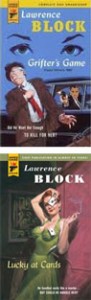 There is something about a good con-man noir that keeps me coming back for more (actually, I wish I knew about more con-man noir books–let me know if you know any). Which is why I recently went on a three-day reading jag of Lawrence Block Hard Case Crime reprints. Hard Case not only has sweet covers, but has done a sweet job re-printing hard-to-get books from the mid-last-century, including some fine reads from Lawrence Block that just so happen to fall into the con-man noir area (that’s what I’m calling them at least). They also tend to have main characters who aren’t shy about drinking lots when passing the time between cons-and-or-murders, which is why I’m bringing them up here on the Spiked Punch blog. Cause we like our criminals a bit, or a lot, tipsy. In Grifter’s Game, the con is a gigolo of sorts who gets into trouble over a woman (as you might expect) and who likes both brown liquors (as you might also expect) and clear ones (which isn’t so expected), as evidenced in the following two quotes:
One hotel had a terrace facing on the Boardwalk with umbrella-topped tables and tall drinks. I found an empty table and sat under the shade of the umbrella until a waiter found me, took my order, left me and returned with a tall cool vodka Collins. It came with a colored straw and I sipped it like a kid sipping a malted. I lighted a cigarette and settled back in my chair. I tried to put everything together and make it add up right.
It was a panic, in its own quiet way. I picked her up in a good bar on Sansom Street where the upper crust hobnob. We drank Gibsons together and ate dinner together and caught a show together, and we used her car, which was an expensive one.
In the next Lawrence Block I read, Lucky at Cards, the con is an ex-magician turned card shark, who wanders into a mid-sized Midwestern town just looking to get his teeth fixed, but who runs into trouble thanks to a random card game and a random meeting with a curvy lady (hmm, I sense a trend). Here (as in many other books from the time) they’re not shy about having some serious drinks with lunch, including scotch and sodas and Martinis (it was a better time in some ways, people):
We had Martinis first. Then I ordered a ham steak and he ordered an open turkey sandwich. He told the ancient waiter to bring us another pair of Martinis. The drinks came, then the food. We ate and drank and made small talk. We were working on coffee before he said the first word about business.
The final quote for today (also from Lucky at Cards) isn’t a booze one, but seemed so apropos after three days of con noir that I wanted to end with it (and if it leads you to drink, well . . .):
Life is a hellishly iffy proposition from beginning to end.
July 19, 2011
 Ayala’s Angel sounds a bit like a not-tawdry-enough romance novel that you’d find in the quarter bin of a bookstore specializing in romance trade-ins and the occasional “art” book. While it does have a bit of romance, if you decided not to read the book solely because of the connotations involved with the title, you’d be one sad reader, pal. Cause it’s an Anthony Trollope number, and while it has its fair share of yucks and laffs (perhaps it is as gently witty towards its main characters as any Trollope I’ve read), they’re surrounded by that eye for everyday detail that makes Trollope (along with the fact that his characters are memorable, his prose is sweet, etc, etc) so enjoyable to read. And the fact that it contains the following quote that references a particular vintage of claret (Trollope was so fond of this winery he bought–as the book’s notes tell us–24 bottles in one go) makes the book even better. Any reverence for a particular booze bears repeating:
But before the end of the first fortnight there grew upon her a feeling that even bank notes become tawdry if you are taught to use them as curl-papers. It may be said that nothing in the world is charming unless it be achieved at some trouble. If it rained ’64 Leoville–which I regard as the most divine of nectars–I feel sure that I should never raise it to my lips.
—Ayala’s Angel, Anthony Trollope