March 16, 2012
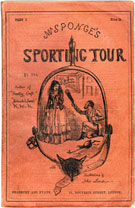 Much like Mr. Sponge himself, the Sporting Tour has lounged around the Spiked Punch couches and guest rooms and breakfast buffets for awhile (read the first Mr. Sponge Cocktail Talk post here for more background), but we need one or two more quotes to round out the experience. And the following, dear reader, are them:
He exclaimed in a most open-hearted air, ‘Well, now, what shall we have to drink?’ adding, ‘You smoke of course–shall it be gin, rum, or Hollands–Hollands, rum, or gin?’
‘O! Liquor them well, and send them home to their mammas,’ suggested Captain Bouncey, who was all for the drink. ‘But they won’t take their (hiccup),’ replied Sir Harry, holding up a Curaçao bottle to show how little had disappeared.’ ‘Try them with cherry brandy,’ suggested Captain Seedeybuck, adding ‘it’s sweeter.’
–Cocktail Talk, R.S. Surtees, Mr. Sponge’s Sporting Tour
Tags: cherry brandy, Cocktail Talk, curaçao, Gin, Hollands gin, Mr. Sponge’s Sporting Tour, R.S. Surtees, Rum
Posted in: Cocktail Talk, Gin, Liqueurs, Rum
March 14, 2012
I liked the first round of Mr. Sponge cocktail-talking so much that I’ve decided to extend his run on the Spiked Punch with two more quotes, one today and one the next time I decide to post (which should be later this week, but who knows, really? I could be called off to battle Gamera. That stuff happens). This time, there’s a bit of a party and Mr. Sponge is invited. And you are too (at least through this quote):
Sir Harry and party had had a wet night of it, and were all more or less drunk. They had kept up the excitement with a Champagne breakfast and various liqueurs, to say nothing of cigars. They were a sad, debauched-looking set, some of them scarcely out of their teens, with pallid cheek, trembling hands, sunken eyes, and all the symptoms of premature decay.
–Cocktail Talk, R.S. Surtees, Mr. Sponge’s Sporting Tour
March 12, 2012
You know, I like to think I know my mid-1850 literature. And thereabouts. I mean, Dickens and I are tighter than Cher’s pants. And Trollope and I are close as two beers in a six-pack. But up until very recently when I came across it in a big pile of books at the Library Book Sale, I’d never heard of Mr.Sponge’s Sporting Tour, or its author R.S. Surtees. I’m going to guess he didn’t hang that much with the earlier authors, as he seems a bit more, um, sporting, in that English kind of way (think foxes and horses and billiards). The book follows the Pickwick Papers in a sort-of romping adventure style, tracking its main very sponge-y character as he hunts with the hounds and, well, sponges off of people. At first, you think, this Mr. Sponge is too spongey (hah! Can I really say that?), but then I, at least, just started wondering why I was slaving every 8 to 5:30 instead of just selling horses and abusing lame-o’s hospitality. Heck, I may end up doing that yet.
Spigot presently appeared with a massive silver salvar, bearing tumblers, sugar, lemon, nutmeg, and other implements of negus. ‘Will you join me in a little wine-and-water?’ asked Jawleyford, pointing to the apparatus and bottle ends,’ or will you have a fresh bottle?—plenty in the cellar,’ added he, with a flourish of his hand, through he kept looking steadily at the negus tray. ‘Oh–why–I’m afraid–I doubt–I think I should hardly be able to do justice to a bottle single-handed,’ replied Sponge. ‘Then have negus,’ said Jawleyford; ‘you’ll find it very refreshing; medical men recommend it after violent exercise in preference to wine.
–Cocktail Talk, R.S. Surtees, Mr. Sponge’s Sporting Tour
February 27, 2012
 It’s Friday! Which means you should be thinking kick-up-my-heels and not clean-up-my-kitchen. But, but, but, with work schedules that are so packed, and weekdays that don’t seem to have a stitch of free time, often the weekends end up being a time to only shepherd the house back from chaos and into shape for the next week. Well, here’s an idea–track down a copy of Phyllis Diller’s Housekeeping Hints and get some advice on how to keep a house clean with minimal effort. Or, no effort at all. Cause Madam Diller is much more about the yuks than the sweeps, being a famous comedian from back a-ways. So, the book is full of suggestions like, “leave your sink full of dirty dishes. It’s a good way to cover up the dirty sink.” Which are perfect for Friday, when you should be thinking young, wild, and free and not detergent, elbow grease, and bleach. She also talks a lot about her penny-grasping husband Fang, which leads to the below line, which I love for some odd reason, and which ties the book in to the booze blog.
When we have guests, he puts a cherry in a glass of beer and calls it a Manhattan.
— Phyllis Diller, Phyllis Diller’s Housekeeping Hints
February 20, 2012
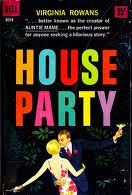 I suppose I should in the below attribution attribute this quote to Patrick Dennis, as he wrote the book House Party under the nom de plume Virginia Rowans. And Dennis was an interesting chap, the author of the fabulously successful novel (and then film) Auntie Mame and the only author to have three books on the New York Times bestseller list at once. And then his books stopped selling and he ended up being a butler (partially by choice, as I guess he liked to buttle) for Ray Kroc, the founder of McDonalds. Really–as I said, interesting chap. And as his real name was actually Edward Everett Tanner III and as he decided to write the effervescently fun House Party as Mrs. Rowans, I’m sticking with her as the attributed author. He’d probably appreciate it.
Darling, would you run out and buy a bottle of Champagne? I can’t entertain as shabbily as this and I’ve spent everything I have buying vulgar things like Scotch and gin. I daren’t even cash another check.
–Virginia Rowans, House Party
February 13, 2012
 I’ve talked a bit about English detective-y writer Peter Lovesey in a past Cocktail Talk post, so I’ll gloss over the backstory mostly here (if you need more, head back in time), and just remind you, dear reader, that Mr. Lovesey is best known for two characters, heavyweight-but-huggable modern police detective Peter Diamond and under-appreciated Victorian police detective Sergant Cribb. The book I’m quoting today, Mad Hatter’s Holiday, features the latter and both has a good crime story and impeccable period details. A worthy read. And the below is a worthy quote, especially because I understand how sometimes a night “of gin and song” isn’t planned and then does, indubitably, take its toll.
Saturday night at the Canterbury was about to take its toll. He had not planned his night of gin and song. A visit to the Canterbury was not indelibly inspired in his social diary, like evenings at the dome and the Theatre Royal.
—Peter Lovesey, Mad Hatter’s Holiday
February 6, 2012
 Okay, I feel I’ve extended Alexis Soyer week long enough (though I didn’t even get to the fountain in his Universal Symposium where a living Ondine frolicked among jets of curaçao, maraschino, and liqueur d’ amour), even though this sadly-not-as-well-known-as-he-should-be chef, bon vivant, celebrity, inventor, and philanthropist deserves much more. You’ll just need to get out there and read Relish by Ruth Cowen and then help me spread the Soyer mythology around. Most of the quotes from the book that I’ve reproduced here have a drinky angle, as you might expect on a blog called Spiked Punch. But for this final quote, I wanted to dish up a tasty food number, and have decided on a quote that details one of his famous menus from his days as head of the Reform Club’s kitchen. It seemed a fitting end, as Soyer definitely like the big productions. This one was a dinner in honor of Imbrahim Pasha, the regent of Egypt.
The meal began, according to custom, with a selection of exquisite soups–considered by all epicures to be the essential health-giving aperitifs of any great dinner. They included consommés such as Potage à la Victoria, a delicate veal broth garnished with blanched cockscombs; Potage à la Colbert, a vegetable soup flavored by glazed Jerusalem artichokes laboriously cut into pea-sized balls, and Potage à la Comte de Paris, a sherry-colored, intensely flavoured meat soup filled with macaroni ribbons and delicate chicken quenelles. As the tureens were cleared, and as the noise levels rose to compete with the band, the members moved on to the most delicate dishes, the hot fish. Turbot à la Mazarin, light poached and served with a delicately beautiful pink cream sauce made with butter and lobster roes; pan-fried trout in a sherry sauce; a pyramid of whitings, deep friend and served à la Egyptienne in tribute to the guest of honor, and wild salmon from the river Severin–which Alexis considered the very best–line caught that morning and brought in on the afternoon train, to be pounced on by the kitchen staff and immediately scraped, gutted, washed, and prepared in a simple cream gratin. Then came the dishes for the main service, carefully arranged on the crisp white damask cloths–two, four, or six platters of each item laid out in perfect symmetry. These included a choice of róts, such as young, tender turkeys, no bigger than chickens, their necks skinned but heads left intact, tucked under their wings. There were also hares in a red-currant sauce, capons with watercress, plump white ducklings, spit-roasted and served with the juice of sour bigarade oranges. The first relevés were also waiting: an almighty baron of beef; haunches of mutton roasted à la Soyer and saddle of lamb à la Sévigné, served with veal quenelles, stewed cucumbers, and asparagus puree. There were also more elaborate removes, such as Chapons à la Nelson, a complex dish which involved gluing truffle- and mushroom-stuffed capons into pastry croustades shaped like the prow of a ship–complete with sails, portholes, and anchor–and fixing them into waves of mashed potatoes. Soyer adored these elaborate culinary trompes l’oeil, and at the same banquet produced for the first time his Poulardes en Diadem, this the time pastry croustade resembling a jeweled crown, stuffed with roasted chickens, boiled ox tongues, and glazed sweetbreads. He adorned them with attelettes–another Soyer innovation–newly commissioned gold and silver skewers with carved tops representing fantastical animals, birds, shells, and knight helmets. The attelettes, or hatelets as the popular electroplated copies were called, were the equivalents of culinary jewelry, and would be strung with crawfish, truffles, and quenelles before being stuck into the dish as the ultimate sparkling garnish.
Okay, that’s only about half of this dinner. But what a half! To get the full menu (and to read the full story of Soyer), pick up or download Relish. And give a toast to Soyer!
PS: Missed the other Soyer Cocktail Talks? Read up on Soyer Cocktail Talk I, Soyer Cocktail Talk II, and Soyer Cocktail Talk III.
February 1, 2012
 In our first Alexis Soyer Cocktail Talk post, I talked more about the celebrated (though not celebrated enough today) celebrity chef, bon vivant, and charitable Frenchman who lived in London in the mid-1800s. And about the worthy and needed biography of him by Ruth Cowen, called Relish, which I just read and liked lots. The following quotes are from said book, as are those in the other Soyer posts, in hopes that I can spread the Soyer legend around (as well as convince you to search out more about him). Here are more quotes to give you any idea of Soyer, starting with two about Soyer’s Nectar, a branded drink he came up with that was a bubbly-lemon-cinnamon mix that happened to be blue–he was a bit colorful, after all.
He did not have to wait long for yet another bundle of ecstatic reviews. On 13 July The Sun declared: ‘It beats all the lemonade, orangeade, citronade, soda-water, sherry-cobbler, sherbet, Carrara-water, Seltzer, or Vichy-water we ever tasted.” The Globe dubbed Soyer the ‘Emperor of the Kitchen,’ and duly recommended the addition of a tot of rum.
The Nectar was particularly popular as a mixer, and Alexis, who with some justification could be called the pioneer of the English cocktail, published a variety of recipes for ‘Nectar Cobblers’ and other glamorous boozy compounds.
Cowen’s Soyer biography is packed with descriptions of the almost impossible to believe dinners he made, sometimes for groups by the hundreds and thousands. Whenever, going forward, I hear people talk about their decandent dinners, I’ll laugh and point them to Relish. The following quote is part of one of the more restrained meals in the book, one Soyer created for the Grand Dinner of the Royal Agricultural Society festival:
The bill of fare included–on top of a whole Baron and Saddleback of Beef à la Magna Charta–33 dishes of ribs of beef, 35 dishes of roast lamb, 99 galantines of veal, 29 dishes of ham, 69 dishes of pressed beef, two rounds of beef à la Garrick, 264 dishes of chicken, 33 raised French pies à la Soyer, 198 dishes of mayonnaise salad, 264 fruit tarts, and 198 dishes of hot potatoes. It also included 33 Exeter puddings, which Soyer had invented especially for the occasion. There were essentially an alcohol-steeped reworking of his boiled Plum Bolster, for which, in The Modern Housewife, he had applied the alternative name of ‘Spotted Dick’ for the first time in an English cookbook. They were big, rich, doughy balls of suet and sugar, to which Alexis added rum and ratafias and then smothered with a sweet, shining blackcurrant and sherry sauce.