In the post below this one, I introduced a book that I was destined to like (and had a long story about why—go read it why dontcha, if you haven’t), called The Man with a Load of Mischief, by Martha Grimes. What I didn’t say (cause I was going on and on too much) was that the title actually refers to a local pub in a small English village, and that a murder takes place at said pub along with three other murders at other local pubs. It’s a pub-murder-a-thon (which, on the page, I’m all for), and as you might expect with that set up has more than one quote that needed reproducing, which is why there is a Part II in the title above. But hey, just read and love the quotes, don’t worry about semantics.
Since Mrs. Withersby’s oracular powers were somewhat dimished by gin, not many people listened
In the meantime, Twig had shuffled in and taken their order for drinks. A pink gin for Agatha, a martini for Melrose. She leaned her ample bosom on folded arms and said, “Now, my dear Machett, let’s have Murch in here.”
Jury wasn’t used to such etherealized cup and china. His cup was shaped like a conch shell, the handle an airy spindle of green. He was almost afraid to pick it up. On a plate were tiny cakes, prettily iced.
“And were you in the Jack and Hammer on that Friday evening?”
“I popped in about six-ish for a Campari and lime, yes.”
Sometimes, it doesn’t take long to know you’re gonna like a new book. I’m talking about a completely new book here, by an author you don’t know, and not say the 32nd book in a series by your all-time favorite writer (which I’m guessing is Garth Marenghi). Sometimes, it takes a few pages, but sometimes, rarely, sure, but sometimes by the end of the second sentence you know the book’s gonna snag you. Or at least has serious potential. I recently had this very phenomenon happen, with a book called The Man with a Load of Mischief, by Martha Grimes, who I’d never read word one from before. As this blog isn’t one of serious literary merit (wait, are any?), you probably have guessed that there’s some boozy mention in said second sentence. And you’re right. But what you probably couldn’t guess is that the boozy mention is of an English beer, one that’s not prevalent in the U.S., but one whose distillery I’ve actually been to! Amazing. It was a few years back, and I was traveling the U.K. with wife Nat and pals Markie B and Leslie P and we were in the Yorkshire region tooling around before seeing the Mighty Boosh, and ended up in a village called Masham, where the famous Theakston Brewery resides, which we visited. And, to bring it all full circle, at Theakston they make a renowned beer call Old Peculiar, which we had (and which Markie B has since lobbied to get in Seattle—successfully I might add) and loved, and which is mentioned in the second sentence of the book, which I talked about like an hour ago at the top of this paragraph. But hey, you wouldn’t want me to leave the story unfinished, right? The payoff is the quote itself, which is right here:
Outside the Jack and Hammer, a dog growled. Inside, his view of the High Street obstructed by the window at his shoulder, Melrose Plant sat in the curve of the bay drinking Old Peculiar and reading Rimbaud.
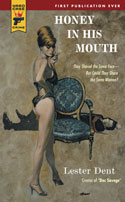
First, happy Friday the 13th. Live it up, walk under ladders, toss salt. And then go read some Doc Savage. Or some of Honey In His Mouth. Both of which were written by a guy named Lester Dent. The latter, which I’ll be quoting from once I stop rambling around, features a protagonist that’s nowhere near a superhuman scientist and adventurer. But, said protagonist does look identical to an almost-deposed South American dictator. And so a book is born (the book in this case of course called Honey In His Mouth). In the book, there’s a lady with the pulpy name of Vera Sue. She’s just what you’d think, except that she has a jones for Benedictine. Which leads to this awesome quote:
‘Kiss me honey.’
She kissed him and he discovered her mouth tasted of eight-dollar-a-bottle Benedictine. So she had gotten her hands on more than just what it took to buy the new dress and the new hat. The Benedictine was a giveaway, because on special occasions she would buy a bottle and carry it around in her purse and nip at it. He suspected that someone had told her Benedictine was the liqueur of quality folks, but had neglected to tell her it was supposed to be sipped out of thimble-sized glasses after dinner.
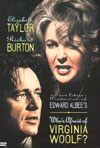
So, there’s love. And that’s a good thing. But even when in love, there sometimes has to be a line of what you just won’t do, even for someone who you love (and I’m talking the love gamut here, from friend to significant other and all). And I think that old drinker-now-gone Richard Burton says it best (in a very specifically Spiked Punch kind of way) in the below quote, from the 1966 movie version of the Albee play, Who’s Afraid of Virginia Wolf:
Now, I will hold your hand when it’s dark and you’re afraid of the boogeyman and I will tote your gin bottles out after midnight so no one can see but I will not light your cigarette. And that, as they say, is that.
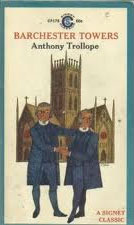
Barchester Towers (which has had a Cocktail Talk entry already) is of course the best known book by Anthony Trollope. Well, at least I believe it is. You can disagree if you’d like–I won’t hoot about it if you have a different favorite or think another of his remarkable novels has more reknown. If you don’t know who Anthony Trollope is, then, well, I don’t think you’re human. Heck, I’ve written a whole slew of Anthony Trollope posts, so you should at least know him through this here blog (and if you don’t, well, I’m not going to hoot, but I am going to wonder what it is, exactly, that’s wrong with you). But that’s as much as I’m gonna stew about it, cause instead I want to get to this little quote that I love so well, cause it is a quote from one of the greatest authors containing a shout out to another great author (if you don’t know who the second is after reading the below quote, then really, go back to watching bad TV). Many authors (like many people in general–outside of rap stars, who give shout outs to tons of contemporaries, often) are afraid of this type of behavior. Not my man Trollope, though. So, check this out, and think about how giving props to those who may, actually, be in the same game as you isn’t a bad thing.
The bishop did it, and a very pleasant day indeed he spent at Ullathorne. And when he got home, he had a glass of hot Negus in his wife’s sitting-room and read the last number of the Little Dorritt of the day with great inward satisfaction.
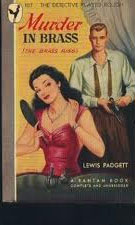
First and foremost, before the murder-and-drink-talk starts, let me apologize for the lack of posts last week and for probably the next couple. Things, as they say, have come up. Fun things, and things I may tell you about later (well, except the part about me running in a grass skirt through grass fields. Cause you probably don’t want that image). Anyway, excuse time=over. Now, on to Murder in Brass, by Lewis Padgett. Who I don’t know a lot about, except that he was two guys. I do know that the protagonist of this book, retired-ish detective Seth Coleman is (as the back of the book tells us): Rough! Tought! Terrific! The book has something to do with a guy who may or may not be running around knocking folks off. The “Brass” part has to do with his pops, who is dead and who was obsessed by brass. It was upstate New York and gold hadn’t been invented yet. Perhaps the best part of the book is when Mr Coleman (Rough! Tough! Terriffic!) goes into a diner with his alcoholically-minded sidekick to get a drink and finds out this spot doesn’t serve booze:
‘Take it easy,’ Bedarian said, seizing a menu. ‘Jesus. The place is dry.’
A bitter voice voice said, ‘Listen, bud, you know what a liquor license costs?’
The thin, sour man in the white apron stood over us, a pad and pencil ready. Wilma Bird said, ‘Mike doesn’t have to serve liquor. He’s got the best food in town.’
Mike made an unpleasant noise in his throat. ‘So what? I don’t have Martinis and Manhattans and Zombies and Pink Women–’
‘Pink Ladies,’ Bedarian corrected, touched in a sore spot.
‘Pink tootsie-rolls for all I know,’ Mike said somberly. ‘Fine name for a drink. A man ought to drink rye. Then he knows where he’s at. Women shouldn’t ought to drink at all. What’s yours?’
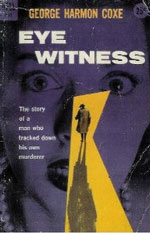
My last post of a book from George Harmon Coxe was in 2008. Jaysus. I wonder how many drinks you’ve had since then? Who do you think’s had more, you, me, or Barack Obama? I only ask cause when that last post went up, it was August 26th, 2008, the same day he was nominated for Pres. Anyway, I digress. Much like that that last Cocktail Talk post way back when, this GHC (that’s what he wanted to be called after two rye shots) quote is from a book featuring mystery-solving photographer Kent Murdock. That sounds like a career path every kid should aspire to. This pocket-book is called Eye Witness, and in it Kent roughs up and gets roughed up, uncovers the clues, charms the ladies, and has a fair number of drinks. In the below quotes, it’s actually both the charms and the drinks:
She laughed aloud. The third sidecar had begun its work, and the reserve, the slight touch of haughtiness that had once marker her speech and manner, slide away. The flush that brushed her cheeks was becoming and her voice was more throaty and somewhat less cultivated.
Murdock asked Leone if she would have a brandy. She thought a B&B would be fine so he had the brandy. Only then, when the waiter took the other things away, was Murdock able to sit back and give his attention completely to his companion. ‘That was all right,’ he said. ‘Marvelous.’ She was watching him now, the faint flush in her cheeks giving her a new radiance that was attractive and promising. The cocktails had apparently done their work well for she seemed relaxed and at ease, content; it seemed to leave the next move up to him.
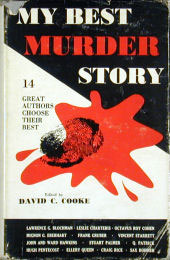
Okay, honesty time. Raise your hand if you’ve had a broken, or even a fairly seriously cracked, heart. You, in the back, without your hand raised? Quit lying, we’re all friends (or at least boon bar companions) here. That’s what I thought. Turns out, even in short story collections from the 1950s, people have broken hearts. Even in mystery short story collections from the ‘50s, such as Murder by 14 (here and there called My Best Murder Story), which is a collection shading pretty seriously to the “want-to-be-Agatha” side of the mystery section (as opposed to the “want-to-be-Dashiell” section—both of which are sections I like). One of the stories that doesn’t shade too much is A Matter of Life and Death by John and Ward Hawkins, which is pretty much one long hangover for the main character, after a night of heartbreak (somewhat mitigated by the inducer of said heartbreak trying to help him out of what looks like a pretty murderous situation). Really, I know little about John and Ward, the authors, but the story was good enough that I’m gonna look for more. And I certainly understand the sentiment and set-up of the below quote, all about bourbon and heartbreak.
‘Look,’ he said. ‘I got loaded in the bar across the street from the office. Straight bourbons. I got full of bourbon clean up to here. I rubbed it in my broken heart. I cashed my paycheck. And then I went riding in taxi-cabs. I went pub-crawling. I met this guy–this big guy with the crew hair-cut and the tough face and the little scar on his chin. We were a couple of ex-sergeants and that made us buddies. He bought some drinks and I bought some drinks, and we really pinned one on–the Giant size.’








 In the post below this one, I introduced a book that I was destined to like (and had a long story about why—go read it why dontcha, if you haven’t), called The Man with a Load of Mischief, by Martha Grimes. What I didn’t say (cause I was going on and on too much) was that the title actually refers to a local pub in a small English village, and that a murder takes place at said pub along with three other murders at other local pubs. It’s a pub-murder-a-thon (which, on the page, I’m all for), and as you might expect with that set up has more than one quote that needed reproducing, which is why there is a Part II in the title above. But hey, just read and love the quotes, don’t worry about semantics.