June 21, 2011
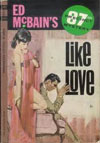 I’ve hit up Ed McBain quotes before (a couple from his boozirific The Gutter and the Grave), and talked a bit more about him there, so I’m going to skip too much intro here, and just say that the cover for this book, Like Love, is very tantalizing, and the two quotes below are also very tantalizing, especially if you like Rob Roys and Martinis (hey, wait a minute, I like both of those!). The Rob Roy sadly isn’t mentioned very often in books outside of those tomes focused specifically on cocktails and cocktail lore, which made it even nicer to see it in this police procedural-y book. Also, the Martini isn’t really thought of (enough, anyway) as a romantic drink enough anymore, which made it even nicer to seen in in a romantic scene here.
I worked until about four-thirty. Howard came in and said he was knocking off, and would I like a drink. I said yes, I would. We went to the bar on the corner, it’s called Dinty’s. I had two Rob Roys, and then Howard and I walked to the subway. I went straight home.
He was glad to be away from Kling and away from the squad room. He was glad to be with Christine Maxwell who came in from the kitchen of her apartment carrying a tray with a Martini shaker and two Martini glasses. He watched her as she walked toward him. She had let her blond hair grow long since he’d first known her, and it hung loose around the oval of her face now, sleekly reflecting pin-point ticks of light from the fading sun that filtered through the window.
–Ed McBain, Like Love
June 13, 2011
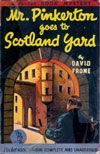 Ah, Mr. Pinkerton. Not a member of the celebrated detective agency at all, but a portly British chap (and yes, this is one of those occasion where “chap” is necessary) who falls into a humdinger of a mystery out of a combination of chance and boredom. That is, though on the outside it looks harmless, a deadly combination. I, myself, have gotten into mischief through it (though never coming close to a Scotland Yard-worthy entanglement). And you know what much of this mystery hinges on (well, really, how could you, unless you’ve read the book, and as it’s fairly obscure I’m guessing you haven’t)? A cocktail party where they bring out one of those “new-fangled American contraptions for mixing spirits.” I’m guessing they mean a cocktail shaker, but they aren’t that new-fangled, are they? Maybe it was an invention I don’t even know about? For shame, if so.
Mr. Paget had brought along with him one of the new-fangled American contraptions for mixing spirits, and he, Linda Darrell, and Hugh Ripley had brought some mint from the garden, sent Gaskins to the fish monger’s for six pennyworth of ice, and mixed it up with lemon juice. They made what they call a cocktail out of it.
–David Frome, Mr. Pinkerton Goes to Scotland Yard
May 16, 2011
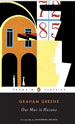 First, an apology for the lack of posting. Moving back to Seattle from the I-tal has been a process, and has left me with little umph for blogging. Or, after reading (re-reading really, as I’ve read it at least once, and probably twice, before) Graham Greene’s somewhat funny/somewhat serious Cuban spy-and-not novel Our Man in Havana, I’ve been too inclined to have a daiquiri at noon for blogging. I like that take on things much better, so let’s go with that excuse, and start a rumor of me being a two-daiquiris-at-noon fella. Heck, maybe I’ll even inspire you to start. If I don’t, hopefully this quote does (or starts you collecting miniature bottles of whiskies):
‘Eighteen different kinds of scotch,’ the stranger said, ‘including Black Label. And I haven’t counted the Bourbons. It’s a wonderful sight. Wonderful,’ he repeated, lowering his voice with respect. ‘Have you ever seen so many whiskies?’
‘As a matter of fact I have. I collect miniatures and I have ninety-nice at home.’
‘Interesting. And what’s your choice today? A dimpled Haig?’
‘Thanks, I’ve just ordered a daiquiri.’
‘Can’t take those things. They relax me.’
—Our Man in Havana, Graham Greene
April 26, 2011
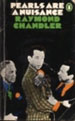 The following two quotes, the last of those from the Raymond Chandler book Pearls Are A Nuisance, which I talk about more in Take 1, below Take 2, which is below this post right here and now. These quotes are from the final story in the collection, “The King in Yellow” and include one about drinking light and one about drinking heavier. Not a bad way to end up, though I think Mr. Chandler would be more happy with the latter, were he still around to drink with (sadly, not the case).
The red-haired girl said: ‘The drink’s on me. I was with him.’
Steve said: ‘Coke with a dash of bitters,’ to the waiter.
The waiter said, ‘Madame?’
‘Brandy and soda. Light on the brandy, please.’ The waiter bowed and drifted away. The girl said amusedly: ‘Coke with a dash of bitters. That’s what I love about Hollywood. You meet so many neurotics.’
The maid came back with a copper ice bucket. She pulled a low Indian-brass tray-table between them before the davenport, put the ice bucket on it, then a siphon, glasses, and spoons, and a triangular bottle that looked like good Scotch had come in it except that it was covered with silver filigree work and fitted with a stopper.
Dolores Chiozza said: ‘Will you mix a drink? in a formal voice.
He mixed two drinks, stirred them, handed her one. She sipped it, shook her head. ‘Too light,’ she said. He put more whisky in it and handed it back. She said, ‘Better,’ and leaned back against the corner of the davenport.
—Pearls Are A Nuisance, Raymond Chandler
April 22, 2011
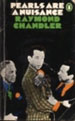 You can read a little Raymond Chandler screed below, as well as more about the book this quote is take from, or you can just slip down a little less and get straight to the goods. This is from the second story in the collection, “Finger Man,” a story that stands as one of the first appearances of a well-known hard-boiled detective, Mr. Philip Marlowe, and may be the only time (that I can remember) he’s drinking tequila. Which I heartily approve of, by the way.
‘You don’t play?’ the bartender asked me.
‘Not on Tuesdays. I had some trouble on a Tuesday once.’
‘Yeah? Do you like that stuff straight, or would I smooth it out for you?’
‘Smooth it out with what?’ I said. ‘You got a wood rasp handy?’
He grinned. I drank a little more of the tequila and made a face.
—Pearls Are A Nuisance, Raymond Chandler
April 20, 2011
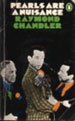 I like (as maybe detailed before on this blog) Mr. Raymond Chandler, though some noir revisionists aren’t as high on him as, say, Dashiell Hamnett. I say pooey on them—why not read both authors, as well as the many others writing in the pulpy pulp era (at least the other good ones, of which there are many). I’ll admit there are one or two Raymond Chandlers that don’t rise as high as, say, The High Window, but I’ve gotten at least a kick and usually more from every book of his, which is why I was jazz’d recently to find, in Italy of all places, a copy of a Chandler book called Pearls Are A Nuisance, which collects three short stories of his that I hadn’t read (at the time this paperback was published, the book was only available in this British version). In honor of the find, and of Mr. Chandler’s usually hard-drinking leading men, I’m going to have three Cocktail Talks with quotes from the book, one day for each story in the book. These first two are from the title story, with one being the beginning of a drinking bout (around the narrator getting his, um, tail kicked), and the next a charming description of the after-effects.
A wet towel began to slap at my face. I opened my eyes.
‘Listen, kid. You got two strikes and no balls on you. Maybe you ought to try a lighter bat.’
‘Brandy,’ I croaked.
‘You’ll take rye.’ He pressed a glass against my lips and I drank thirstily. Then I climbed to my feet again.
At five o’clock that afternoon I awoke from slumber and found that I was lying on my bed in my apartment in the Chateau Moraine, on Franklin Avenue near Ivar Street, in Hollywood. I turned my head, which ached, and saw that Henry Eichelberger was lying beside me in his undershirt and trousers. I perceived that I was also as lightly attired. On the table near by there stood an almost full bottle of Old Plantation rye whisky, the full quart size, and on the floor lay an entirely empty bottle of the same excellent brand. A cigarette had burned a hole in the brocaded arm of one of my easy chairs.
—Pearls Are A Nuisance, Raymond Chandler
April 12, 2011
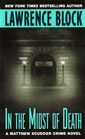 Lawrence Block is one of those crime/mystery/thriller who I have a strange relationship with, in a way. I’ve read a number of his books, and probably three-quarters of them have left me thinking I probably wouldn’t need to read another. They weren’t bad, but neither were they good, or original, or full of characters bursting with life. However, the other quarter of his books that I’ve read are everything opposite, and quite good. The number of good has been high enough that if I run into one of his books at a sale, or on the shelves of a country home in Italy that I’m staying in, I’ll probably give it a whirl. Which was the case with In the Midst of Death. Sadly, it didn’t rock my reading world. But it was okay, and did feature this nice quote about lunchtime (or shortly thereafter drinking):
I went over to Johnny Joyce’s on Second and sat in a booth. Most of the lunch crowd was gone. The ones who remained were one or two Martinis over the line now, and probably wouldn’t make it back to their offices at all. I had a hamburger and a bottle of Harp, then drank a couple shots of bourbon with my coffee.
–Lawrence Block, In the Midst of Death
April 4, 2011
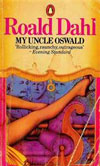 When we think of Roald Dahl, we (and here, I’m talking for the world, like an old tottering professor type) tend to think of him as not being ripe for Cocktail Talk posts, cause he’s probably best known for books in the Children’s section (fantastical, imaginative, adults-read-them-too books, though), such as James and Giant Peach, Charlie and the Chocolate Factory, and more. However, he started as a short story writer, and wrote non-Children’s-section books as well, including a silly-ly naughty one supposedly pulled from the journals a fictitious Uncle Oswald. Oswald was supposedly the greated fornicator of all time, thanks in part to the Sundanese Blister Beetle (which when ground up was a sex bomb of sorts). Oswald’s adventures start, however, listening to a description of whiskey on a hot day:
‘One evening,’ he began, ‘I was sitting on the verandah of my bungalow way upcountry about fifty miles north of Khartoum. It was hot as hell and I’d had a hard day. I was drinking a strong whiskey and soda. It was my first that evening and I as lying back in the deckchair with my feet resting on the little balustrade that ran round the verandah. I could feel the whiskey hitting the lining of my stomach and I can promise you there is no great sensation at the end of a long day in a fierce climate than when you feel that first whiskey hitting your stomach and going through your bloodstream.’
–Roald Dahl, My Uncle Oswald