March 25, 2011
 In the post below, I mention my theory on the Bronte sisters as wild wing-ding women, and while some might disagree, those disagreers are probably also the people who no one invites to parties, and who sit at home chewing their cud and cursing their mealy-minded lonesome parched existences. The below quote, also from Charlotte’s underappreciated Shirley, is one of my favorite short, one line quotes that utilize drinks in a way of describing a facet of existence. It’s almost a maxim, in a way, to live by—or at least can be applied to life. If you don’t agree, well, it’s probably because you’re boring. But if you want to argue, let me call up those bubbly Bronte sisters–do you really want to argue with the ghosts of three famous English writers? I mean, who’s more dangerous than that?
Adventure is to stagnation as Champagne is to flat porter.
—Shirley, Charlotte Bronte
March 23, 2011
 When they’re talked of (which is a lot, one hopes), the Bronte sisters (Charlotte, Emily, and Anne) aren’t usually referred to as party animals. This is, of course, a crying shame. As their books are filled with well-rounded characters, and usually contain a wee tipple or tippling, or a bar, and mostly entertaining writing that pulls you in, as opposed to pushing you out, my thought is that for the years they lived within the sisters were a rollicking good time, and probably were thought of somewhat in the same way we think of modern party animal writers like J. Robert Lennon and Andrew Greer (at least when those two modern scribes are wearing hoop skirts). In any case, the Spiked Punch is going to dwell for two posts on quotes from Charlotte’s novel Shirley, published in 1849 and as worthy a read (I think) as her much more fawned over Jane Eyre (though admittedly I like me the Jane Eyre, too). This first quote falls into the “bar” shelf in the Cocktail Talk kitchen, and describes lovingly a 1800s watering hole (and I have a confession–I think longingly of whisky-and-water myself on occasion):
He looked for certain landmarks–the spire of Briarfield Church; farther on, the lights of Redhouse. This was an inn; and when he reached it, the glow of a fire through a half-curtained window, a vision of glasses on a round table, and of revelers on an oaken settle, had nearly drawn aside the curate from his course. He thought longingly of a tumbler of whisky-and-water.
—Shirley, Charlotte Bronte
March 17, 2011
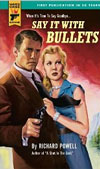 Okay, first, apologies for the lack of posts recently. Living in Italy (as detailed on my Italy blog) lately has included lots of jolly visitors, which leaves little time for blogging (but lots of time for wine, amaros, art, and eating, if you were feeling sad for me). So, if you’ve been crying over a lack of Spiked Punch, forgive me. At least you weren’t shot in the back by one of your own posse while finishing up the war, then (after surprisingly living with no-one knowing) having to go on a Treasure Trip tour around the west to track down said war posse to find out who and why. Which is what happens to the main character in Richard Powell’s Say It With Bullets, another of the rad reprints from Hard Case Crime (the book was originally published 50 plus years ago). Touring around with vengeance in your heart does make you thirsty, however, and vengeance needs refilling—what better drink for both than the reliable Tom Collins. Read on:
The town of Winnemucca was about six gas stations long by four taprooms wide. But the place had quite a hotel. It was sleek and modern and had a tiled patio decked with gay umbrellas around a swimming pool. He relaxed in his air-conditioned bedroom and studied the play of light on the swimming pool below his window and on the Tom Collins glass in his hand. Things were going to look brighter as soon as he got outside the Tom Collins and inside the swimming pool.
—Say It With Bullets, Richard Powell
February 22, 2011
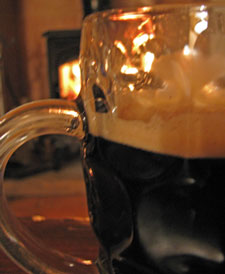 If you’ve read this blog longer than, well, last week, or have read any of my books, you probably know that I dig Dickens (Charles, that is. I don’t like Pudgie Dickens at all). I’ve had a quote or two on here from his books, and probably have rambled enough that if he were here, he’d say “shut yr yap Rathbun.” Or, he’d buy me a drink. I like Dickens so much that I even have posts about his up on other worthy blogs—well, at least one. See, I recently wrote about have drinks with Dickens on Michael Green’s blog. Head on over to learn more about drinks in Dickens time, why you should be toasting him, and how to make a few drinks mentioned in his book: the Dog’s Nose (pictured left) and the Purl. So, head on over and get your Dickens on.
February 16, 2011
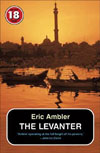 Another from Eric Ambler (following up the Coffin for Dimitrios below), from another of his political thrillers. Now, the political thrillers don’t get me all giddy as much as other books that sometimes share the same shelves (no-one says “dame” in a political thriller for one thing), but the Amblers (as I’m affectionately calling them) are written well, and, well, the characters tend to have lots of cocktails, drinks, and booze (in various forms). And the plots are never that bad, either. The Levanter‘s all Middle East terrorist business, and tends to roll heavy on the brandy. Much like this quote, which also demonstrates how to use cocktails to your advantage in serious discussions:
I gave him a champagne cocktail with plenty of brandy in it, which he drank thirstily as if it were water. I gave him a cigar and lit it for him. He sat back in his chair and looked around. Though he was clearly impressed, he seemed perfectly at ease. This suited me. I wanted him relaxed and in as expansive a mood as possible. All the stiffness was going to be on my side. I continued to address him respectfully as Comrade Salah, and fussed a little. As soon as he had finished his first cocktail I immediately gave him another in a fresh glass.
—The Levanter, Eric Ambler
February 1, 2011
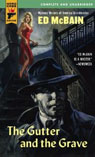 It’s hard to believe that there could be two more beautifully booze-y quotes from this Ed McBain book, quotes as good as those below, but I’m going to say, drink in hand raised to the sky, that these may be as good. At least, they manage to mention a whole array of classic mixes—and both mention the Zombie. Is there another book (outside of drink books, duh) that mentions the rum’d out Zombie twice? I have my doubts (but would be happy to be pointed in the direction of another one). Does this mean you should be sure to have rums on hand when you read the Gutter and the Grave? Well, of course.
It was Park Avenue mixed with the slums, it was cocktail parties and pool parlors, theater openings and all-night movies on Forty-Second Street. It was her world and mine, mixed like a Zombie, four thousand kinds of rum, but blended because underneath the exotic name it was all rum.
The man handling our table wondered back. ‘Sir, the bartender says he is not equipped to make hot rum toddies, sir. He suggests, if you care for rum, a Planter’s Punch, or a Cuba Libre, or a Zombie.’
‘I’ll have a rye and soda,’ I said. ‘Toni?’
‘A whiskey sour,’ she said.
—The Gutter and the Grave, Ed McBain
January 28, 2011
Ed McBain is one of those mystery, noir, hard edged, cop story, suspense, and pretty much every other word related to the genre where drinks are had more often than not writers (he writes enough that he has to write under a variety of names, even). He’s had a whole little library of books, many of which I could read anytime I had a shot of whiskey alongside me. This particular book was re-released by the genius back-alley folks at Hard Case crime, and has more drinking (and much more interesting conversation) than the parking lot at the college football game. Heck, there’s enough that I’m going to break the quotes into two parts, starting with these two boozy gems, the first a drinking manifesto (which hopefully will bring back the term “ossified”) and the second a dreamy drinkers dream:
I drink because I want to drink. Sometimes I’m falling down ossified, and sometimes I’m rosy-glow happy, and sometimes I’m cold sober—but not very often. I’m usually drunk, and I live where being drunk isn’t a sin, though it’s sometimes a crime when the police go on a purity drive.
I was sitting in the park thinking of cool civilized drinks, like Tom Collins and Planter’s Punches and then thinking about what I’d drink—an uncool, uncivilized pint of cheap booze.
—The Gutter and the Grave, Ed McBain
January 14, 2011
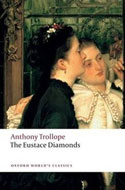 People who know me, know that I dig the Trollope (the Anthony Trollope, that is, and not some other author trying to ride the coattails of his last name—and not the trollops this time, though I don’t have anything against a hooker with a heart of gold). I have pretty much (I’m missing one) the complete Trollope collection of novels and sometimes think I could subside on a reading diet of Trollope, Dickens, and Mosley (and maybe a couple pocket books for balance). Especially fine, and worth reading and re-reading, are the Palliser novels, where he takes on a combination of politics and upper crust foibles in the age when everyone had a ladies maid, had tongues sharp as Wustofs, and wore really puffy outfits. The Eustace Diamonds is the third of six Palliser novels, and while not my fav of the bunch is pretty darn fine. Especially fine is this quote where the drink of choice is Negus, the party hit of the late middle 1800s.
‘My dear, Mr. ‘Oward’ he said, ‘this is a pleasure. This is a pleasure. This is a pleasure.’
‘What is it to be?’ asked Gager.
‘Well;–ay, what? Shall I say a little port wine Negus, with the nutmeg in it rather strong?’ This suggestion he made to a young lady from the bar, who had followed him into the room. The Negus was brought and paid for by Gager, who then requested that they might be left their undisturbed for five minutes.
That’s not the only quote, though, cause on the very same page is this gem:
‘Six penn’orth of brandy,–warm if you please, my dear,’ said the pseudo-Howard, as he strolled easily into an inner room, with which he seemed to be quite familiar. He seated himself in an old-fashioned wooden arm-chair, gazed up at the gas lamp, and stirred his liquor slowly.
–Anthony Trollope, The Eustace Diamonds