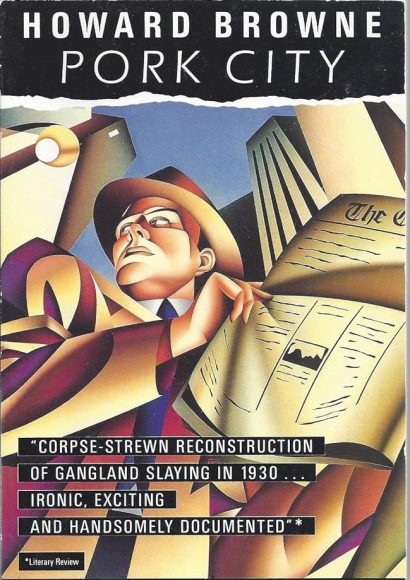
If you haven’t yet read the Pork City Part I Cocktail Talk, don’t hesitate (or you may get gunned down by gangsters – I’m kidding!), so you can learn more about this Howard Browne should-be classic re-telling of a murder that happened during prohibition-era Chicago. It’s a rollicking read, and if you’ve always wanted to get an eye into booze smuggling and selling during the grand failed experiment, well, this book has you covered. The below quote focuses on the bootleggers, and mentions a car that spawned a band, too!
The ’27 REO Speedwagon lurched steadily ahead, its cargo of forty cases of Old Overholt bourbon covered with alfalfa bales under a black tarpaulin. Cotton woods and elms met overhead to for a leafy tunnel. This was corn, wheat, and hog country, level as a billiard table, dotted with small white farmhouses, large red barns and an occasional silo. The sun shone, the air smelled of new-mown hay, birds sang and swooped and crapped on the windshield.
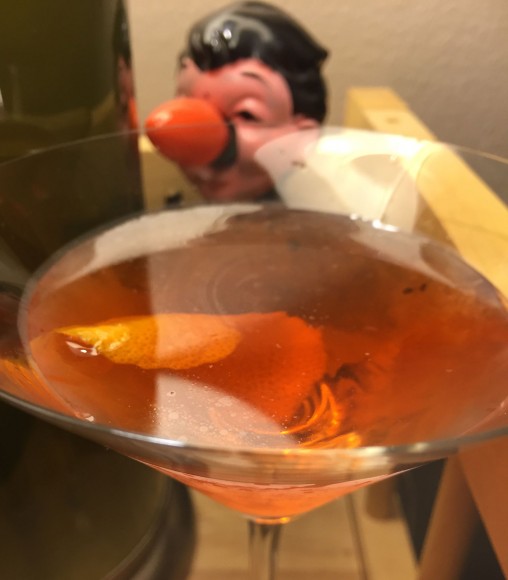
I believe there are people, industrious, good people, who garden well all year round, and have yards and gardens in much better shape than mine. For me, the gardening starts soon, usually late April/early May. And even then, to be honest (as we are here), I’m not a stupendous gardener, and find myself putting it off more than putting on the gloves to get everything in order. However! I have found that one of these here drinks helps make the gardening more palatable. Pull a weed, take a sip! You should try it. One warning: this here cocktail, when you look at it, sounds an odd pairing, like putting nightshade next to your pea patch. But the three ingredients actually go swell together! There’s gin, to start, and I’m using Copperworks stellar gin here. And then Sidetrack Distillery’s one-of-a-kind Shiso liqueur, made from the Asian herb it’s named after, and delivering an herby, botanical beauty one must taste to believe. Then, and this is the odd side, as you might thing the Shiso and this would go well, the third ingredient is the orange-y and teensy bitter-y aperitif, Aperol. It’s a magical match, honestly, and perfect planting of three different tasty items (planted into a shaker and then your mouth, that is), and makes even the most boring yard work a more palatable affair (no mechanized yard tools when drinking, please).
Pork City, how did I miss out on you for so long? I blame society (as a punk once said), or just myself for not knowing more about author Howard Browne. Not the English bishop (who I also know little about), but the editor of Amazing Stories and Fantastic Adventures who also wrote mysteries and then for TV – including the ever-loving Rockford Files! One of his mysteries was the book Pork City, though calling it a mystery only alludes to where it’d be filed in a bookstore or library, as there’s no mystery to the murder that happens in it. But let me back up. Taking place in prohibition-era Chicago, Pork City is based on a true story, the murder of a Trib reporter, and has a host of real-life folks in it (including Alphonse Capone himself as a mainish character), and centers around real Chicago spots of the times. All of which makes it sound a little like a historical retelling, which it is, in a way, but with more pizzazz, more thrills, more snappy dialogue, and more booze, as well as real insight into the workings of police and the mobs of the time. It’s a hoot and a humdinger, and for one like myself whose interests intersect in booze and the bang from a gun, well, an ideal read. So ideal we’re gonna have a couple of Pork City Cocktail Talks, starting with the gin-y below number.
She angrily brushed away a tear, went to the bar, and refilled her glass with Gordon’s gin (or so the label claimed). After adding a minuscule amount of vermouth, she dropped in two ice cubes from the silver-trimmed bucket and crossed to one of the living room’s wide windows. The newly installed Lindbergh beacon, revolving from high atop the Palmolive building a few blocks to the south, put a slashing path of light against the night’s cloudless sky. Loop-bound traffic drifted soundlessly along Lake Shore Drive, past the Potter Palmer castle and the long stretch of beach at Oak Street and on into Michigan Avenue.
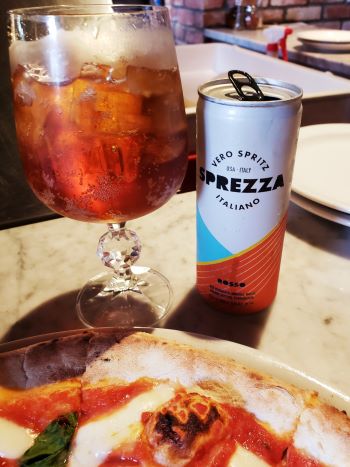
I’ve mentioned the delicious canned Sprezza spritz-style drinks made up here in WA before, and I’m sure I’ll do it again, because they are awesomely awesome. The Blanco variety is delish, and so so swell in summer, and there’s a newer Rose’ that is dreamy, but today I’m sipping the Sprezza Rosso side of the trio. Made from Mancino Rosso vermouth, Scrappy’s Orange bitters (hence the Washington connection if you were wondering), and sparkling mineral water, it delivers a swirl of effervescent rhubarb, burnt orange, and caramel with an ending brisk bitter kiss. Bellissimo! And – which you might expect given its Italian connection – Sprezza Rosso goes perfectly with a good slice of pizza. So, that’s what we’re having today, amici!
Sprezza Rosso
Ice cubes
1 can Sprezza Rosso
Orange twist
1. Couldn’t be easier: fill a wine glass three-quarters up with ice cubes. Pour the Sprezza over the ice and in the glass. Twist the twist, and drop it in. Take a bite of slice, take a sip of Sprezza.
I’ve been dipping my terrified toes into more 1800s, early 1900s ghost/supernatural stories lately, specifically those written by J.S. Le Fanu, an Irish writer born in 1814. Not going to say I feel as ghastly good towards his works I’ve read so far as a I do to M.R. James, but ol’ J.S. can spin a scary yard. He was one of the (if not the) writers of horror tales who took the genre from Gothic chain-rattling to more psychological other-worldness, if that makes sense (and he was a somewhat troubled person himself, it seems, so the terrors really have that personal feel lots of the time). The stories I’ve been reading are all in a scarily swell collection called The Tiled House, put out by Collins Chillers (I need to track more of the anthologies in that line down, as it seems there are some ghoulishly grand ones), and includes the story the below spirits – the boozy ones – are featured within.
A night or two after the departure of my comrade, I was sitting by my bedroom fire, the door locked, and the ingredients of a tumbler of hot whisky-punch upon the crazy spider-table; for, as the best mode of keeping the
Black spirits and white,
Blue spirits and grey,
with which I was environed, at bay, I had adopted the practice recommended by the wisdom of my ancestors, and “kept my spirits up by pouring spirits down.”
–J.S. Le Fanu, “Strange Disturbances in Aungier Street”
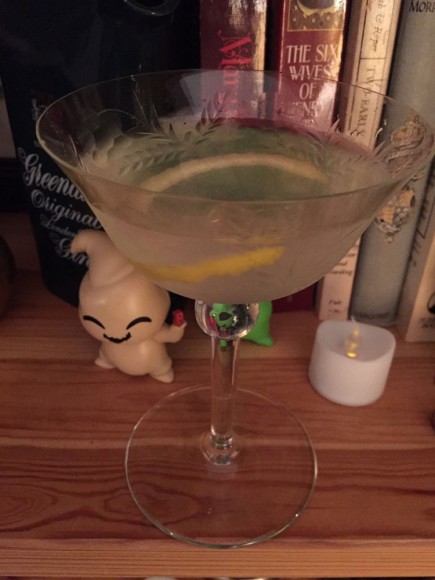
Well, I apologize – I really should have had this cocktail up on February 29, as that was leap day and this is a leap year and this drive, or drink, is leaping (with flavor! And in the name). It’s not the Leap Year, which is another drink, but somewhat related, and, well, just would have been good to have on or nearer to the actual leap day, though I suppose I’m still having this drink within a month of it, and darn it, the drink’s still good (and related in little ways to other drinks like the Sidecar and various other gin and Cointreau and vermouth and lemon drinks, so if you like that or those drinks, then you will be fond of this I’ll bet, maybe even leaping over things to have it), and sometimes that can weigh even more than an appropriate story, though as I’ve told you time and time again, good stories make good drinks even better. So, maybe pretend it’s still leap day? Having a couple of these tangy, botanical, citrusical, drinks might help with the leaping, or lead to both leaping and jumping. Maybe skipping too! Which would be fun.
The Leaping Drive
Ice cubes
2 ounces gin (I used Washington-made Kur gin, and it served me well)
3/4 ounces Blanc vermouth (I used Dolin, and it was a reliable delight)
I’ve had only one other Magdalen Nabb Cocktail Talk, even though I’ve now read four of her books starring Marshal Guarnaccia, a persistent marshal in the Carabinieri (the second police force in Italy, one that grew out of the military and has a sometimes helpful, sometimes less relationship with the Polizia di Stato). The books take place in Florence, a city I’ve visited and loved lots, so I should really have a few more of Cocktail Talks from said books – here’s hoping the future leads to that very occurrence, especially as I find myself very fond of the Marshal, whose steady, non-flashy, neighborhood cop-y sense and regular Italian sensibility are very enticing in a way. Not to mention that he interacts with barmen serving Campari, which I always like to read about.
“Let’s hope not. I don’t want any shoot-outs with terrorists taking place in my bar, thanks.”
And he, too, began to scan the innocent-looking tourists.
“Rubbish! That sort of thing only happens in Rome . . .”
But both them touched the metal edge of the counter to ward off evil, and the barman, dropping ice-cubes into three Camparis for an outside table, kept an eye on the Marshal’s broad back.
Here we have another British Library Crime Classics Cocktail Talk. What are the British Library Crime Classics, I can hear you ask? I’m glad you did ask, friend! These are rediscovered novels and short story anthologies brought back from the mists of time for our modern-day reading pleasure. I’ve read a few of the novels, but even more of the short story collections, which are marvelously done (the editor is a chap named Martin Edwards, who also writes his own mystery novels, and does so much editing I doubt he sleeps). The most recently read one for me was called Murder At the Manor: Country House Mysteries, and as with all of them, it’s a delight in the main, with stories from a host of authors known and unknown – really, these are dandy ways to discover authors from the past you may have missed. For me, that includes J.J. Bell, journalist and author, who it seems wasn’t as well known for his mystery output as perhaps he should have been (perhaps more known for comic fiction). The quote below from his story “The Message on the Sun-Dial” features a not-so-savory man named Bolsover. You might not like him by the story’s end, but you have to admire his ability to drink at lunch.
He lunched leisurely at an unusually early hour. He preceded the meal with a couple of cocktails, accompanied it with a pint of Champagne, and followed it with a liqueur. He felt much better, though annoyed by an unwanted tendency to perspire. On his leaving the restaurant, the tendency became more pronounced, so much so that he feared it must be noticeable, and once more he took a taxi, telling the man to go Kensington way.