December 27, 2016
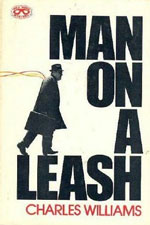 Just for fun recently, I re-read Charles Williams’ Man on a Leash. It might not have even been that long since I read it the first time – I know I had a Spiked Punch post about it not that long ago. Go read that so you can get some background. You back? Good. Anywho, decided to re-read it when in one of those Williams moods, and came across another quote, ideal for Cocktail Talk-ing. Check it out – bet you agree.
“No,” she said. “I’m glad you came; I wanted to talk to you. She led the way down the short vestibule into the living room. “Come on into the kitchen,” she said, “while I fix the drinks. It’s Carmelita’s day off.”
The kitchen was in front, on the opposite side of the living room, with a separate dining room in back of it. There was a door at the far end of it, probably to the garage. She opened the refrigerator for ice cubes. “Martini, vodka and tonic, Scotch?”
“Vodka and tonic would be fine,” he said.
She began assembling the drinks, the old ebullience and blatant sexiness subdued now, though the simple sheath she wore was still overpowered by the figure that nothing would ever quite restrain. Her legs were bare, as usual.
–Charles Williams, Man on a Leash
December 20, 2016
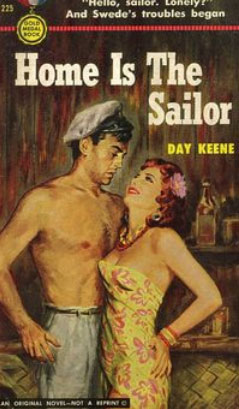 As a longtime reader (you are, right?) of this here weblog, you probably know that I have a fondness for the pulp-y writer Day Keene, who churned out an incredible amount of stories and novels in the classic pulp era. It’s not always easy to track down his books (though some story collections now available help), but there is a reprint from the swell folks at Hard Case Crime of one novel, Home is the Sailor. A typically fast-paced Keene read, it follows the travails of a sailor who wants to do right, but runs into the wrong bar and the wrong lady. It’s well worth tracking down, not only for this quote, which happens south of the border:
The Mexican license bureau was closed. I’d expected that. There was a bar on the main drag with a faded sign that proclaimed it to be the longest bar in the world. I parked Corliss at a table and bought her a rum Collins to work on. Then I brushed off my rusty Spanish and buttonholed the first cop I met on the street.
–Day Keene, Home is the Sailor
November 22, 2016
 See, I told you (in Part I) that I’d probably have a second quote from Hal Masur’s (aka Harold Q. Masur) lawyer-y pulp-y book from last century, You Can’t Live Forever. And here we are! Check out the below, and know that I can predict the future.
It was a nice quiet bar on a side street off Park Avenue, cool and dim and silken, a high-class oasis with retiring waiters and a hushed atmosphere. The chairs were softly pliant to make you comfortable and the pretzels crisp and dry to keep you thirsty. Enclosed booths ringed the room and smoke wove a gauze-like web that hung motionless in the still air.
We were on our third pair of Martinis and were calling each other by our first names. Conversation so far had been limited to that polite badinage used between two people on mutual fishing expeditions. I was in rare form.
— Hal Masur, You Can’t Live Forever
Tags: bar, Bars, Cocktail Talk, Hal Masur, Harold Q. Masur, Martini, polite badinage, You Can’t Live Forever
Posted in: Bars, Cocktail Talk, Gin, vermouth
November 15, 2016
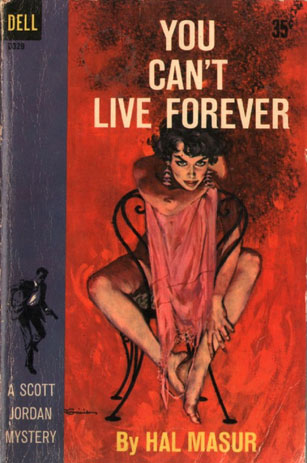 It’s been too long since I’ve had any quotes from the lawyer-y pulp-y writer Hal Masur (also known as Harold Q. Masur), who writes about one Scott Jordan – a lawyer (you might have guessed that), who also likes a good drink, dames, bars, and isn’t afraid to roughhouse it up. Just what you’d want in a 1940s and 50s pocket-y book leading man. I recently re-read the Masur classic (well, in its way) You Can’t Live Forever, which has a great cover, and which is a rollicking read. Heck, I may need to have two Cocktail Talk posts from it! But let’s start with the below, which has Scotch and cigars.
He hung a humidor of long Havana fillers under my nose. He let me see the label on a bottle of Macnish.He poured generously and put a brief squirt from a syphon of bubble water on top. Ice cubes dropped and a swizzle stick clinked. He put the glass into my hand and a silver lighter broke into flame at the end of my cigar.
— Hal Masur, You Can’t Live Forever
October 25, 2016
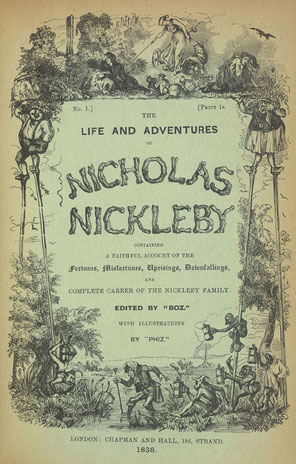 Well, it did end up being a full month of Nicholas Nickleby Cocktail Talk posts! I’m sure Dickens himself would be happy, and I’m sure happy about it, and hopefully you are, too (and if this makes no sense, please read Part 1, Part 2, and Part 3 of our tour through the drinks, and drinking quotes, from Nicholas Nickleby). This final quote comes from a charmingly crazy older man who is the Nickleby family’s neighbor for a while. And while this last Nicholas Nickleby Cocktail Talk is the shortest, it contains one of my very favorite lines.
He did not appear to take the smallest notice of what Mrs. Nickleby said, but when she ceased to speak he honoured her with a long stare, and inquired if she had quite finished.
“I have nothing more to say,” replied that lady modestly. “I really cannot say anything more.”
“Very good,” said the old gentleman, raising his voice, “then bring in the bottled lightning, a clean tumbler, and a corkscrew.”
— Charles Dickens, Nicholas Nickleby
October 18, 2016
For our third Nicholas Nickleby Cocktail Talk (don’t miss Part I and Part II), we’re going to have a quote that starts at least with some words from one of the most fun, most jolly, but also most hard-to-read secondary characters perhaps in all of Dickens, John Browdie, the big Yorkshoreman with the serious accent to match. He likes his eating and drinking and joshing with his wife as much as anyone, as well as liking our main hero, and working to ensure he’s kept with a full glass.
With these words, John Browdie opened the door himself, and opening his eyes too to their utmost width, cried, as he clapped his hands together, and burst into a hearty roar:
‘Ecod, it be the godfeyther, it be the godfeyther! Tilly, here be Misther Nickleby. Gi’ us thee hond, mun. Coom awa’, coom awa’. In wi ‘un, doon beside the fire; tak’ a soop o’ thot. Dinnot say a word till thou’st droonk it a’! Oop wi’ it, mun. Ding! but I’m reeght glod to see thee.’
Adapting his action to his text, John dragged Nicholas into the kitchen, forced him down upon a huge settle beside a blazing fire, poured out from an enormous bottle about a quarter of a pint of spirits, thrust it into his hand, opened his mouth and threw back his head as a sign to him to drink it instantly, and stood with a broad grin of welcome overspreading his great red face like a jolly giant.
— Charles Dickens, Nicholas Nickleby
October 11, 2016
We’re going to jump right in and continue Cocktail Talking with Mr. Charles Dickens and Nicholas Nickleby, in honor of me recently re-reading it. If you missed our Nicholas Nickleby Cocktail Talk Part I, be sure and go back to read it. For this one, we’re going to head to one of the villains of the piece, and one of the great names that Dickens is so famous for: Mr. Squeers, one of the worst headmasters (vaguely, at least) in fiction, and one who is fortifying himself with “raw spirits” in the below quote.
It’s pretty nigh the time to wait upon the old woman. From what she said last night, I suspect that if I’m to succeed at all, I shall succeed tonight; so I’ll have half a glass more, to wish myself success, and put myself in spirits. Mrs Squeers, my dear, your health!’
Leering with his one eye as if the lady to whom he drank had been actually present, Mr Squeers–in his enthusiasm, no doubt–poured out a full glass, and emptied it; and as the liquor was raw spirits, and he had applied himself to the same bottle more than once already, it is not surprising that he found himself, by this time, in an extremely cheerful state, and quite enough excited for his purpose.
What this purpose was soon appeared; for, after a few turns about the room to steady himself, he took the bottle under his arm and the glass in his hand, and blowing out the candle as if he purposed being gone some time, stole out upon the staircase, and creeping softly to a door opposite his own, tapped gently at it.
— Charles Dickens, Nicholas Nickleby
October 4, 2016
Published originally in 1838 (that’s when it started publication, at least, as it was a serial as many books were back then), Nicholas Nickleby hasn’t yet been featured in a Cocktail Talk post, which is a little surprising, since I’ve had a fair amount of Dickens Cocktail Talking. While it’s not my favorite Dickens, and maybe is considered second tier, that just means it’s amazing. It’s a little more romantic in a way then many Dickens books, and has a more Trollopean ending (if that makes sense), but I sorta like that. It’s a long read, too, which for many today in our rush-rush world is tough (wimps), but well worth reading, and sticking with, as it really starts to roll and then you get completely involved with our eponymous hero and his family, and enemies. But while it’s here, of course, is because like most Dickens (all, probably, would be safe) books, there’s a fair amount of times in pubs, at punch bowls, and just folks sipping this and that. Enough so that I’m planning a number of quotes from it here, maybe even the whole month! Let’s see how it goes, shall we? Dickens would be happy about it, I think (he’s probably one of the most, be-fun-to-have-a-drink-with authors throughout history). I’m going to start with one from a fair of sorts, where there’s a tent with a rouge-et-noir table with a loud barker, bringing people in to play with the promise of bubbly and more.
‘Gentlemen, we’ve port, sherry, cigars, and most excellent champagne. Here, wai-ter, bring a bottle of champagne, and let’s have a dozen or fifteen cigars here–and let’s be comfortable, gentlemen–and bring some clean glasses–any time while the ball rolls!–I lost one hundred and thirty-seven pound yesterday, gentlemen, at one roll of the ball, I did indeed!–how do you do, sir?’ (recognising some knowing gentleman without any halt or change of voice, and giving a wink so slight that it seems an accident), ‘will you take a glass of sherry, sir?–here, wai-ter! bring a clean glass, and hand the sherry to this gentleman–and hand it round, will you, waiter?–this is the rooge-a-nore from Paris, gentlemen–any time while the ball rolls!–gentlemen, make your game, and back your own opinions–it’s the rooge-a-nore from Paris– quite a new game, I brought it over myself, I did indeed–gentlemen, the ball’s a-rolling!’
— Charles Dickens, Nicholas Nickleby