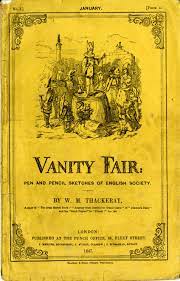
We continue along our Vanity Fair-ing, with Cocktail Talks and drinks, right here! Oh, because I like you, I’m gonna remind you that you need to be sure and catch the Vanity Fair Part I and Vanity Fair Part II Cocktail Talks, to read up more about the book itself (just a wee bit, cause if you want to go deep, there are better sources), and catch some sips of Champagne and other delights, including the mysterious (today) Rack Punch! Then come back here and get some rum-shrub, after the theater and oysters. Everybody’s doing it!
In the company of this gentleman they visited all the principal theatres of the metropolis; knew the names of all the actors from Drury Lane to Sadler’s Wells; and performed, indeed, many of the plays to the Todd family and their youthful friends, with West’s famous characters, on their pasteboard theatre. Rowson, the footman, who was of a generous disposition, would not unfrequently, when in cash, treat his young master to oysters after the play, and to a glass of rum-shrub for a night-cap. We may be pretty certain that Mr. Rowson profited in his turn by his young master’s liberality and gratitude for the pleasures to which the footman inducted him.
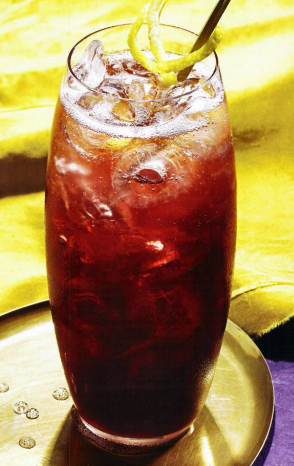
We’re in that time straddling summer and fall (though I fully realize fall doesn’t start specifically until the 22nd), which means days that can shade summery but then delve into a crisp fallness pointing to the colder days to come. To make the straddling smooth, it’s preferable that you have a drink that does the same, and if it’s a regal one, too, well, all the better! The Lord Charles fits that bill, with its full-bodied red-wine works-in-winter keep-you-warm Malbec base, mingling with simple syrup, citrus-y lemon juice, smooth dry sherry, and bubbly club soda, that which, with some ice, brings this drink into a level of refreshingness that summer (if you personify) would certainly appreciate. You’ll dig it, and it will dig you (if you think drinks dig people, which maybe they do, why not), and help you do that straddling we talked of. Enjoy!
1. Fill a cocktail shaker halfway full with ice cubes. Add the Malbec, simple syrup, lemon juice, and sherry to the shaker. Shake well.
2. Fill a highball glass three-quarters full with ice cubes. Strain the Malbec mixture over the ice cubes. Fill the glass with club soda, almost to the rim.
3. Twist a lemon twist over the glass and drop it in. Stir briefly. Enjoy the seasons.
Please, I implore you, read the Vanity Fair Cocktail Talk Part I, so you can hear more about the book, where I land on it, and on what seven glasses of Champagne does to you. Here, we’re not going to get too deep into the book proper, as we have a long Cocktail Talk below, and it’s a good one, funny in a tipsy way, full of eating and drinking, featuring some of the book’s main characters, and highlighted by Rack Punch. Rack Punch! A curious thing, Rack Punch. It’s hard to pin down. I mean, I’m sure a genius cocktail historian like David Wondrich would know without looking up from his drink, but I can’t bother him. It’s either punch made with Batavia Arrack (rum-ish spirit made with sugar cane and a bit of fermented red rice), used in many tiki recipes or Arak, the grape-based anise spirit from the Levant area of the Eastern Mediterranean. You look it up and you’ll see Rack Punch using either one or the other (and even one spot that spells it Arrack but talks about it as if it was Arak!). My feel, my lean, as you might say, is it was made with Batavia Arrack. As it’s rum-y, that would match the time, and I don’t think Arak had made the inroads to Britain that rum and relatives had at the time. Also, the basic punch – sugar, lemon or other citrus, water, maybe some spices – would just pair better with it, as opposed to the anise-side, in my view. Both could be delicious, but that’s my take (btw, both spirits are delicious. The below Cocktail Talk is delicious, too).
The two couples were perfectly happy then in their box: where the most delightful and intimate conversation took place. Jos was in his glory, ordering about the waiters with great majesty. He made the salad; and uncorked the Champagne; and carved the chickens; and ate and drank the greater part of the refreshments on the tables. Finally, he insisted upon having a bowl of rack punch; everybody had rack punch at Vauxhall. “Waiter, rack punch.”
That bowl of rack punch was the cause of all this history. And why not a bowl of rack punch as well as any other cause? Was not a bowl of prussic acid the cause of Fair Rosamond’s retiring from the world? Was not a bowl of wine the cause of the demise of Alexander the Great, or, at least, does not Dr. Lempriere say so?—so did this bowl of rack punch influence the fates of all the principal characters in this “Novel without a Hero,” which we are now relating. It influenced their life, although most of them did not taste a drop of it.
The young ladies did not drink it; Osborne did not like it; and the consequence was that Jos, that fat gourmand, drank up the whole contents of the bowl; and the consequence of his drinking up the whole contents of the bowl was a liveliness which at first was astonishing, and then became almost painful; for he talked and laughed so loud as to bring scores of listeners round the box, much to the confusion of the innocent party within it; and, volunteering to sing a song (which he did in that maudlin high key peculiar to gentlemen in an inebriated state), he almost drew away the audience who were gathered round the musicians in the gilt scollop-shell, and received from his hearers a great deal of applause.
Vanity Fair, Vanity Fair, what to do with you? I’m talking here about the book by Thackeray, of course, not the magazine. I’ll leave that to people who have read the magazine, and here we’ll stick to the book, which I recently re-read. And it took me a while, I will fully admit. I’ll also admit that the book is a classic, no matter how long it took. I mean, it’s so rich with stuff, in a way, and such a view into a certain milieu of the times, which is in some ways reflection of ones modern (maybe more than some ways). But it’s also a novel that to me reads completely (well, maybe not every single moment), or nearly completely, as if written in the sarcasm font, to bring it modern again. And if Mr. Thackeray, with respect, just scorns every character. Which means – very funny. Very realized characters. Now, he brings it together at the end in a friendlier way, and manages one of the best last lines ever, and when I was done, I was happy to have re-read it, and no doubt many Thackeray scholars if they read this post would school me! Understandably so. So, let’s change the narrative as they say. And instead let me say that I had forgotten how many swell Cocktail Talking scenes he brought into the book. We need to have at least two, maybe four. It makes sense, as Thackeray was known to enjoy, love, adore the clubs of the time (think port, not pulsating music), and not be ashamed to hit the late night brandy dens, etc. I’m all for it! And here we are! Our first Cocktail Talk. With Champagne! Seven glasses! And cherry brandy! And more!
“I think she’s going,” said the Rector’s wife. “She was very red in the face when we left dinner. I was obliged to unlace her.”
“She drank seven glasses of champagne,” said the reverend gentleman, in a low voice; “and filthy champagne it is, too, that my brother poisons us with–but you women never know what’s what.”
“We know nothing,” said Mrs. Bute Crawley.
“She drank cherry-brandy after dinner,” continued his Reverence, “and took curacao with her coffee. I wouldn’t take a glass for a five-pound note: it kills me with heartburn. She can’t stand it, Mrs. Crawley–she must go–flesh and blood won’t bear it! and I lay five to two, Matilda drops in a year.”
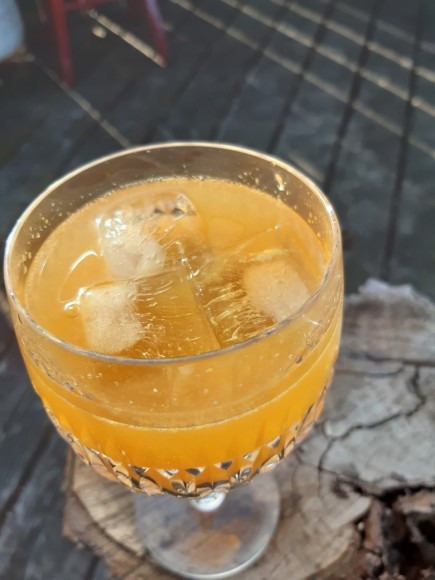
Here’s a nice number that straddles somehow the summer, while still having a base that seems more fall-ish (rye, specifically Woodinville Whiskey Co. delicious rye. If you can get their rye finished with toasted applewood staves, do that. Do it now). Probably cause of the ice and soda and sorta tiki-ish St. Elizabeth’s Allspice Dram and the citrus from some fresh oj, and some local robust and fruity cherry brandy (the real stuff, not the sugary stuff that calls itself cherry brandy — I used Oomrang cherry brandy, which is yummy), but whateves. It’s a dandy treat, even here in August. I originally created it during the lockdown year of 2020, which you might remember, and which you might like to forget. The drink’s heft – while still staying light-ish on its feet mind you – might help with that! Even though that time was tough, there were I’m sure good things to come out of it, so maybe let’s not forget it completely. Like this drink, for example! Well worth remembering and having again.
1. Fill a cocktail shaker or mixing glass halfway full with ice cubes. Add the rye, allspice dram, brandy, and oj. Shake well.
2. Add one big ice cube or a couple decent-sized ice cubes to a chalice of some glittering kind (no need to turn into savages). If none is at hand, an Old Fashioned, big one that is, can work.
3. Strain the drink through a fine strainer into the glass. Top with the club soda. Stir carefully to combine.
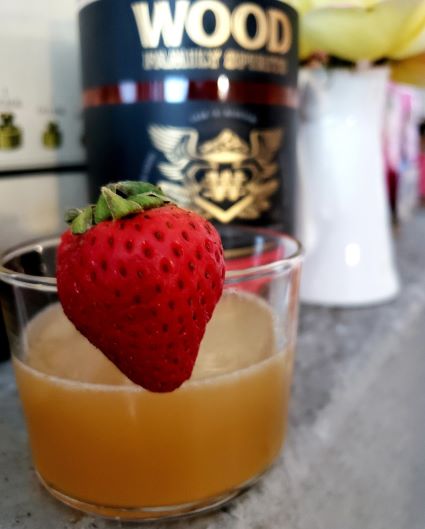
I’m sure you understand this: some days, you, or one, just wakes up in the morning thinking, “Today, I wanna make a drink from Jacques Straub’s recipe collection classic called, simply enough, Drinks (oh, you can get a Drinks reprint if you don’t happen to have it or want to pony up for an original)! Then, all the day long you think about it, unless you decide to have a breakfast drink, or a lunch drink. If so, good for you, champ! Still waiting on the invite. But if not, by the time HH (happy hour, natch) comes around, you have that little book (perfectly sized for dress shirt pockets, making it easy for bartenders to carry) out, and are turning until you come to The Hancock Sour, and then boom! Drink-making time.
But what bourbon? For me, this time, it’s Wood Family Spirits Columbia bourbon. Admittedly, a bottle recently came in the mail (don’t hate me! I do feel lucky about it), excitingly enough! If you don’t know, Wood Family Spirits is a distillery based in Hood River, Oregon. The family in the area traces back to pioneers in the middle 1800s, so they have lots of history in the PNW, and a desire to deliver well-made spirits here. In Columbia bourbon, they’re doing just that. Made in Tennessee using 80% corn, 10% barley, and 10% rye, it’s aged in brand new charred oak barrels (aging takes place in OR) and blended to “bottle in bond” strength. Which equals a robust 100 proof, that gives it a reassuring umph. It has a lovely aroma – caramel, spices (cinnamon, clove) – then a rich mouthfeel while you’re savoring the vanilla, caramel, sweetness mingling with the oakiness and highlighted by more of that cinnamon and clove and rye spicy goodness.
Wood Family Spirits Columbia bourbon’s full layered taste means it can be swigged solo happily, but also that it can stand up nicely in a drink like The Hancock Sour, one we’re bringing back from days of yore, and one that packs a decent amount of lime. In typical classic sour fashion, this might have had even more lime in the past (the recipe calls just for the juice of one lime), but 3/4s-of-an-ounce worked best for me. So, lime, sugar, bourbon, sounds like a regular sour, right? But there’s an intriguing twist – a hint of rum! That’s right, two spirits! The recipe doesn’t call out a specific rum, but I found a Diplomatico Reserva Exclusiva dark rum was perfect. Its complexity and sweetness added just enough hints to elevate this treat to another realm (if you haven’t had it, this rum delivers caramel, nuts, orange peel, vanilla, nutmeg, and allspice in a lovely combo). The other slightly sideways add to our sour is a splash of soda, which, funnily, helped everything come together without thinning it out. The original recipe said to garnish with “fruits of the season,” so I went strawberry, but I could see orange, cherries, even blackberries being nice and working with the lime.
One final note: I have no idea who Hancock is, or was, or if this drink even refers to a person. And, though in a way I wish I did, it doesn’t change one iota the deliciousness this sour delivers. Try it, and then next time remember to invite me to breakfast drinks!
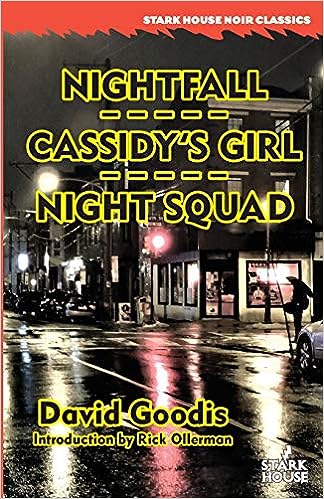
My re-read of a couple David Goodis charmers (“charmer” in the sense of reads that pull you in, sure, but also in the sense of some con artist types, which would fit into the Goodis globe), as detailed recently in the Nightfall Part II Cocktail Talk, continues as I just re-read Night Squad. He likes the night, our David! It’s another classic of the noir-y genre, with a shady-ish character who has, as they say, gone through some stuff. And is vaguely on the side of light, while walking in the darkness. Woo, that’s heavy. The books isn’t as melodramatic, but does have some serious and seriously eff’d up moments and tales. And the weirdest drink ever, which I detailed in an earlier Cocktail Talk (don’t miss the Night Squad Cocktail Talk Part I and the Night Squad Cocktail Talk Part II – the weird drink in the latter). This moonlit gem centers around an ex-cop (kicked off for being on the take), who drinks a lot, has a lot of regrets, and gets involved working both for the head hood in the rotten part of the town and the most mental cop troop all at once. Brother, he gets into it! Luckily, as the quote shows, he knows how to think properly.
The gin came; he put it away in one fast gulp and ordered another. There were times when he drank slowly and chased the gin with water. But this ain’t one of them times, he told himself, downing the second gin and ordering a third. This is a time for heavy thinking, which means, of course, heavy drinking. And I got the notion it’s gonna take a lotta gin to set your mind straight
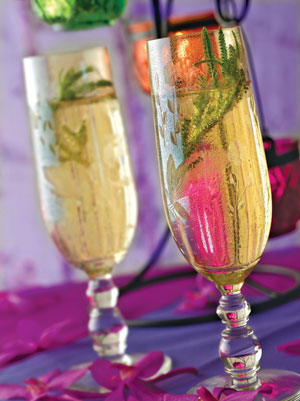
While I wouldn’t say our front yard in the north Seattle area is the prettiest – I tend to shade towards the scraggly when it comes to the grass, for one, cause over-watering is a problem, ya’ know – it is blessed with an abundance (or over-abundance as neighbors might say) of lovely, bee-utiful, lavender. When it flowers in summer, the air smells delish, the flowers hide the dead grass, and the bees are buzzing happily. But what, if anything, to do with it? I mean, pretty for pretty-ness’ sake is swell! All for it. Art for art’s sake, too. And making bees buzz jollily is a state of being we should aim for, cause bees rule. But, but, it’s also quite fun to utilize a little of that lavender in making lavender simple syrup (recipe below), which can then be mixed with gin and Prosecco into this very cocktail, the Lavanda (which sounds like a sultry dance, but isn’t. Not saying you can’t have a few of these and dance btw. Cause that, that you should do). The combo is classy in a summertime way, fragrant in a floral way, and makes an ideal accompaniment to a summer’s late afternoon or evening. Thinking more, what a crowning glory of a drink this would be at a summer wedding. You should get married! You can serve this – I have lots of lavender to spare.
1. Add the flowers from the top of one lavender sprig, gin, and lavender simple syrup to a cocktail shaker. Using a muddler or wooden spoon, muddle well.
2. Fill the cocktail shaker halfway full with ice cubes. Shake like dancer.
2. Strain into a flute. Top with chilled Prosecco, and garnish with the second lavender sprig.
First Note: To make lavender simple syrup, add 1/4 cup chopped fresh lavender, 2 cups sugar, and 1 1/2 cups water to a medium-sized saucepan. Heat over medium-high heat until it reaches a low boil, stirring regularly. Once it reaches that low boil, reduce the heat to medium- low and keep the syrup at a simmer, still stirring, for 5 minutes. Remove from the heat and let cool completely.
Second Note: For gin here, you could go traditional London style (like, Broker’s gin, which wouldn’t be a bad choice), as the juniper plays with lavender well. But you could also go something less traditional,