October 13, 2009
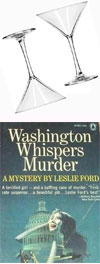 Sometimes, even in a book (or comic book) you’re not especially fond of (or, haven’t grown fond of yet, because some books and comics, like cats, sneak up on you. At first, you’re all “take-it-or-leave-it” and then all-of-a-sudden you can’t put the book or comic or cat down), a quote just jumps up and makes you happy. Or, at least, this happened to me this morning while I was reading the Leslie Ford book Washington Whispers Murder. I’ve picked up a couple of Mrs. (Miss? Ms? Madame?) Ford’s books because, well, I liked the covers. And I’m a sucker. Or, sucka, if you prefer. Though I haven’t read one yet I can honestly say I dig. But what I do dig is a pitcher of Manhattans made for me when I come over to visit. Which is why I liked this quote (and cause I know you like the same–the Manhattans, that is–I figured you might like the quote, too).
Her pale blue eyes widened inquiringly as she looked at the Manhattan pitcher he’d picked up. If he’d been a magician, and the Manhattan he poured then a chinchilla rabbit, and she a child of five, her eyes couldn’t have shone with greater or more enchanted wonder.
—Washington Whispers Murder, Leslie Ford
September 25, 2009
 A quick break from the Chow tips (check ‘em out below, if’n you haven’t seen them), but only enough so I can slip in a quick quote from a book by A.A. Fair, called Some Women Won’t Wait (amen), with only a quick introductory graph, which I am writing quickly (but lovingly), so I can skedaddle out to the Friends of the Seattle Library Booksale (the most wondrous of events). So, quick (he says): A.A. Fair is, actually, Erle Stanley Gardner, who wrote 3 billion Perry Mason mysteries, and who I don’t tend to like (though, oddly, quickly, I love the Perry Mason TV series), but this book I found fun, probably because there’s lots of drinking, and a mysterious woman with eyes the size of orange slices drinking on the cover. I’m not saying I get easily swayed, but . . .. Anyway, check this out, go buy some books, and then make a big boozy punch and slide into the weekend.
The Royal Hawaiian Hotel was saturated with an atmosphere of deep, quiet luxury. The royal palms furnished dappled shade; the air was a combination of ocean tang and the scent of flowers.
I wandered through the lobby and a couple of shops before I found Bertha Cool seated at a table out on a lanai overlooking the ocean.
There was a planter’s punch in front of her, and Bertha was just a little flushed, her eyes just a little watery, her lips pressed in a tight line.
I took a good look and decided that Bertha was just a little bit high and very, very mad.
— Some Women Won’t Wait, A.A. Fair
September 8, 2009
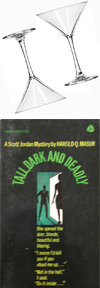 Hey, happy Mon-Tuesday. Just hold off before calling me calendarily challenged. I know today is really Tuesday, and that there is no Mon-Tuesday day. But as it’s the day after a Monday holiday, all of us working slobs (those who work the regular work-week at least) going back to work feel like it’s a Monday, cause it’s the first day of the week with the good times that entails (sing it now, good times, any time you need a favor), but it’s actually Tuesday. Hence the Mon-Tuesday. What does this mean in the world of boozing and spiking of punches? That it’s a fine time for a quote by Hal Masur (who in his full name is Harold Q. Masur, as seen in this post about Suddenly a Corpse), from a book in his Scott Jordan series. Scott’s a lawyer, see, when that meant more than a bad film adaptation and a southern accent. What it means is he drinks hard, rumbles with jerky DAs, snuggles up with any number of hourglass figures, and then solves mysteries and murders. The kind of lawyer a boy or girl can admire, and aspire to being (or hiring). You know, as it is Mon-Tuesday, here are two quotes from Tall, Dark and Deadly: one martini one, and one bar one. Enjoy them, and then go litigate yourself something cold and strong (whatever that means).
“Thirsty Scott?”
“Parched. I’d like a martini, very dry.”
She went to a portable bar. “One martini, coming up.”
“May I help?”
“I know the formula,” she declared loftily. “Gin, vermouth, and cyanide.” She prepared the ingredients in a chrome shaker, applying the vermouth with an atomizer, and substituting a twist of lemon peel for the cyanide. I drank. It was very dry indeed and the gin left me a trifle lightheaded.
“Another?” she asked?
“Not unless you can handle me.”
“Does that mean I have to get you drunk?”
“Helps. I’ve very shy.”
I entered and perched on a bar stool. The place was humming with activity. Regardless of the hour or the temperature, it seems that a large number of citizens continuously suffer from parched throats. In order to accommodate this drought the city has spawned a thousand watering holes that serve no water. This one was indistinguishable from its cousins.
I ordered Canadian ale and got a glass of Milwaukee stout.
—Tall, Dark and Deadly, Hal Masur
August 28, 2009
 It’s Friday, which means yippes, hallelujahs, wowie-zowies, and more exclamations of general merriment, as we communally breathe out one big happy weekend-is-here yelp. Not that all of us hate our weekdays (not at all), but the weekend’s usually more fun, with its sleeping in, and staying up late, its revelries, drinks, and merriment. However (and here’s where that ol’ other shoe sometimes drops), the weekend can also mean things like mandatory work parties and other “parties” which might be funnish, but which you don’t seem to have a choice about attending. Which is why I’m sending you out to your weekend with this quote about parties from Anthony Trollope, taken from his most famous (or top five, at least) book, Barchester Towers, the second book in the Barchester series, the first Trollope I read (I think I’ve got them all now, or darn close, now), and nothing short of a masterpiece of English drawing room comedy. Maybe I like another Trollope or two better, but I’ve read Barchester Towers at least three times, and every time I’ve wanted to skip every other facet of life until I finished it. Which is saying something. While this quote is specific to “morning” parties, it goes somewhat to all parties one feels they have to attend, or, for that matter throw.
Morning parties, as a rule, are failures. People never know how to get away from them gracefully. A picnic on an island or a mountain or in a wood may perhaps be permitted. There is no master of the mountain bound by courtesy to bid you stay while in his heart he is longing for your departure. But in a private house or in private grounds a morning party is a bore. One is called on to eat and drink at unnatural hours. One is obliged to give up the day which is useful, and is then left without resource for the evening which is useless. One gets home fagged and désoeuvré and yet at an hour too early for bed. There is no comfortable resource left. Cards in these genteel days are among the things tabooed, and a rubber of whist is impracticable. All this began now to be felt.
— Barchester Towers, Anthony Trollope
July 21, 2009
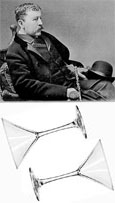 As captain of industry Ed Skoog said in a recent blog post for the Seattle PI (which used to be a paper, but which now is a website, or something like that, as the song says), “summertime is poetry time.” Well, maybe that’s a paraphrase, but it was close, and when I was drinking with him last week he at least mumbled that exact phrase. Which is why I wanted to put up this poem called “The Menu” for you, dear Spiked Punch reader, to make your summertime complete. And, cause I like the rhyme of “the days” and “mayonnaise.” Thomas Bailey Aldrich, the author, is dead. But he had a rollicking time of it before March 19, 1907, from what little I know, and from reading this poem, which is pretty darn celebratory of the drinking-and-eating-with-pals-makes-life-better theory, a theory I have signed on for myself. With that said, have a pal or two over, make some treats of the liquid and edible variety, and read this out loud. It’s a hoot. Hoot, hoot. Or maybe I’ll just record myself reading it? Unless you send me pictures of writers or pets drinking. That’s a threat.
The Menu
I beg you come to-night and dine.
A welcome waits you, and sound wine–
The Roederer chilly to a charm,
As Juno’s breath the claret warm,
The sherry of an ancient brand.
No Persian pomp, you understand–
A soup, a fish, two meats, and then
A salad fit for aldermen
(When aldermen, alas, the days!
Were really worth their mayonnaise);
A dish of grapes whose clusters won
Their bronze in Carolinian sun;
Next, cheese–for you the Neufchatel,
A bit of Cheshire likes me well;
Cafe au lait or coffee black,
With Kirsch or Kummel or Cognac
(The German band in Irving Place
By this time purple in the face);
Cigars and pipes. These being through,
Friends shall drop in, a very few–
Shakespeare and Milton, and no more.
When these are guests I bolt the door,
With Not at Home to any one
Excepting Alfred Tennyson.
–Thomas Bailey Aldrich, The Menu
July 14, 2009
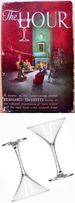 Poor Martini (I’m talking the real honest-to-Betsy-straight-up-gin-vermouth Martini here. None of your “ini”-added-to-anything-even-liquid-shoe-polish drinks that aren’t, after all, a Martini, but just a drink some joker was too lazy to come up with a real neato creative name for). Yes, the most popular drink in the world, and perhaps the most popular icon in the last 100 plus some odd years (maybe Mickey? But he’s a kid’s game.) And yet, still slogged off in the most ridiculous manner (hence the “ini”-on-anything-makes-a-name disgust). Well, don’t let ‘em get you down Martini. We still love you, and to prove it, everyone reading this will have a Martini tonight (that means you and you and you, and maybe you, too), and I’ll type up this Bernard DeVoto quote, which extols your loveliness (Mr. DeVoto will have a Martini tonight as well, in that great next world bar):
You can no more keep a Martini in the refrigerator than you can keep a kiss there. The proper union of gin and vermouth is a great and sudden glory; it is one of the happiest marriages on earth, and one of the shortest-lived.
–Bernard DeVoto, The Hour
PS: I like mine this a-way, by the way: 2-1/2 ounces gin, 1/2 ounce dry vermouth, lemon twist.
July 7, 2009
 Maybe you’re feeling a little dark, or loveless, or like you might want to get involved in a little small-time grift that might end up in a pool of bullets or blood or bourbon (ah, the three B’s). You could blame the holiday weekend and go on with your head down and your eyes tearful. You could go out and get involved with a dangerous person in a typhoon romance consisting of violence and betrayal. Or, you could just go read a little James M. Cain and live vicariously. To help you head down the last path (I am ready to help, my noirish pals), here are two quotes from his book Love’s Lovely Counterfeit. It’s probably not the best Cain, but still better probably than what you’re currently reading (well, I gotsta be honest), and it does have a little Midwestern politico and gangster flair I’m fond of, mighty fond I could say. If you need more than a read to flip-flop your mood, well, scroll down for some drinking ideas.
Ben, however, seemed neither surprised nor unduly upset. He righted the glasses, flipped a cherry in each, and poured the Manhattans. Setting one beside her, he said, “Here’s how,” and took a sip of his own, put it down. Then he took an envelope from the inner pocket of his coat and handed it to her. “Your share.”
“… Of what?”
“Of what we’re doing.”
He squashed his cigarette, looked at the palms of his hands. They had pips of moisture on them. He had the dizzy, half-nauseated feeling of a man who has been rocked to the depths by a woman, and knows it. He got up, crossed in front of her, went into the alcove for a drink. When he had downed a hooker of rye he looked and she was still there.
–James M. Cain, Love’s Lovely Counterfeit
June 30, 2009
 Following up on our Ed Skoog-drinks-and-almost-pokes-his-eye-out (thanks for the worry, too, PhiSmi–it’s nice to know folks like you are looking out for the eyes of poets like Ed) post below, I decided to turn this into Ed Skoog week (a week being two posts here at the ol’ Spiked Punch). With that, here’s the first stanza in a poem Ed had in LitRag magazine, issue 5, in Winter 1999, almost 10 years ago. Jeezus. He doesn’t necessarily like the poem anymore (cause poets are like that), but hey, this is my blog, and I’ll do what I want. So there. And I do think this stanza is such a perfect dip into the personality/personalities of that moment when you’ve left the bar after being there a bit to walk out into the night. And I like bars, and poems, and you, which made me think you might like reading it, too. We’ll see (and, this gives me a chance to give a fat shout out from fat me to LitRag magazine, which I used to put out for the screaming masses with D-Rock back in the day, as the kids say).
We waver and our shadows waver
along the alley, walking home drunk
past blurred and dulled angles,
call it the parson’s late night amble
or the clock-gong’s pave of morning,
this moment on the broad plaza
between the Mississippi’s tankers
and Rome’s outpost in the old town,
the scent of old robes rising
as if they were bread loaves
which are baking somewhere, so are
the bars open still, intensely
compressing the night before
for a few more drops of that spell
that holds a body inside four walls
that do not form the corners of home.
–Ed Skoog, Gaslight, LitRag 5