Okay, a warning: I’m going to talk about the following release party a lot. But can you blame me? In future mentions, I’ll probably provide some recipes and such from the book I’m about to mention, but for now, a drum roll for the down-and-dirty party details. But what is the party? It’s a release party for Ginger Bliss and the Violet Fizz: A Cocktail Lover’s Guide to Mixing Drinks Using New and Classic Liqueurs, my new book, and is an afternoon affair happening at the Rob Roy, 2332 2nd Avenue, Seattle, WA, on Saturday, October 8th, from 2 to 4 pm. I’ll be selling and signing books and genius bartender Andrew Bohrer (he of the Cask Strength blog) will be making Bitter Handshakes and Bruja Smashes (drinks of his featured in the book) and other drinks. It should be fun and a good excuse to have a good cocktail in the afternoon–so come on down, have that drink.
To woo you into stopping by, let me tell you that Ginger Bliss and Violet Fizz not only is bubbling over with liqueur info and history, party talk, and general boozy silliness, but features around 200 recipes broken into chapters arranged by flavor profile (A Liquid Citrus Circus, for example). The recipes range from lesser-known classics to more modern sure-to-be classics from top pro and home bartenders (many of whom I’ll mention more on this very blog as we get nearer the date). Need even more information? Well, check out the Ginger Bliss and Violet Fizz video. It’s time for you to join the GBVF Army!
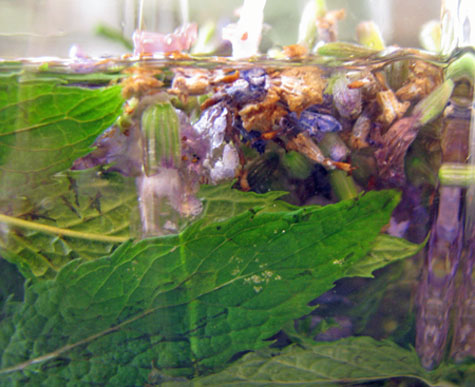
I feel somewhat bad (I mean, not all-the-way bad, as if I’d spilled a Shoreditch Sombrero cocktail, but still sorta bad) cause I don’t have a super accurate and detailed recipe for today’s What I’m Drinking. Usually, I try to give you (and I do mean you) the opportunity to drink along with me by providing said recipe, but as this drink came about somewhat randomly I somewhat forgot to write down the measurements of what’s in it in a precise and helpful manner. Heck, I didn’t even come up with a snazzy name, and I pride myself, darnit, on the snappy-ness of my drink names (maybe I should have gone with Lant? Lavmi? Mive? LMG? Moving Lavender Gogh?). I suppose there’s still time. With all that said, here are the basics. I took a bunch of fresh lavender from the garden (the lavender was really the impetus for this liqueury drink, cause we have a lovely lavender plant), the flowers of course, about two cups, and added it to a sturdy glass container with about a cup and half fresh mint (we’ve also been lucky in the mint department this year), muddled them up a bit, then added a 750 milliliter bottle of grappa that I wasn’t sure I’d be sipping, stirred, and sealed:
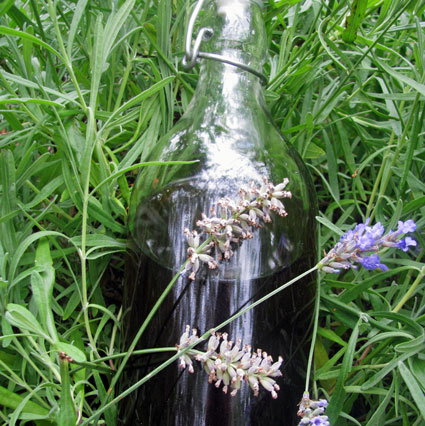
I let that kick its heels for a couple weeks in my cool and dry storage room, stopping by to chat it up and swirl it around every day or so. Then I added (if memory serves) about a cup-and-a-quarter’s worth of simple syrup. I didn’t want it to be as sweetened as most liqueurs, but wanted to take the edge off the grappa a bit. You dig me? Then back down to that cool, dry spot away from the sun for a few weeks. Then I strained it a couple times through cheese cloth (those lavender pips can be tricky), bottled it, and Nat took this lovely pic:
It has a slightly floral taste, underlined with the mint and some other herbaceous-ness, but enough of a kick that it won’t be called a sissy anytime soon. I’ve been sipping it solo the last few nights but am tempted to try mixing it up with some flavorful gin or other choice items. Its flavor is singular enough that it may be tough to find the right match, but I’m game (as long as I don’t get away from the sipping solo, too, that is). If anything works out nicely, I’ll report back, okay?
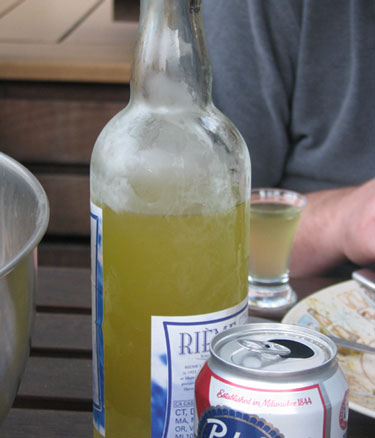
Spent an afternoon on pal Jeremy Holt’s (he’s the co-author of Double Take, the finest book ever about serving vegetarians and meat-eaters together, as you may or may not know, and a virtuoso chef and cocktail- and booze-maker) back deck recently, reveling in one of the few sunshine-y summer days we’ve had so far here in Seattle. And naturally, as it was summer, he brought out some of his homemade limeoncello for us to sip. See, I think of limeoncello as the sun-god of liqueurs, and think some chilled limeoncello when there’s sun out is wonderful thing. Jeremy’s recent batch was perfect, lemon-y with a kick and a smidge of sweetness. I don’t think it was exactly as the recipe in Luscious Liqueurs, but if you want to make your own, the recipe in that book will get you there. The limeoncello we had went down easy and was a good combo with a few cold PBRs:
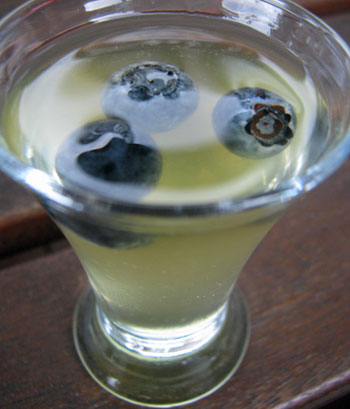
and was fantastic with a few fresh blueberries:
Here’s hoping we get at least a few more worthy summer days—and that Jeremy doesn’t run out of limeoncello.
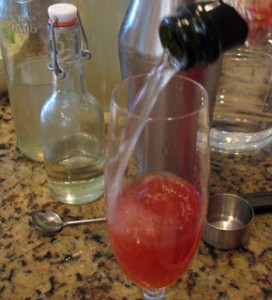
I love this bubbly-and-bitter-belle-of-the-ball. First, it’s a variation on the Negroni (which is, of course, a fav) that subs in Prosecco for gin. Second, I originally had it and heard about it when staying in Florence at a spot called the Hotel Casci (not far from the Duomo, don’t you know), and pal Jeremy was there as well (we were drinking and playing Quiddler after a day of touristing). Third, it means “wrong” due to its Negroni-less-ness, if that makes sense, and I think having a drink called “wrong” is genius. Fourth, well, it tastes great–can’t go wrong with Campari, sweet vermouth, and Prosecco. Fifth, it (like La Rana D’Oro below) was a featured drink at a recent charity event that I slung drinks at (for my ma, if you didn’t know). Sixth, it’s also featured in my book Champagne Cocktails (which, if you don’t have, please buy, cause I need to be able to buy more sparkling wine). And seventh, well, seventh just adds up all the earlier six reasons to expand my love of this drink to epic–epic–proportions.
Serves 2
Ice cubes
3 ounces sweet vermouth
3 ounces Campari
Chilled Prosecco
2 orange twists, for garnish
1. Fill a cocktail shaker halfway full with ice cubes. Add the vermouth and Campari. Shake well.
2. Strain the mixture equally into two flute glasses. Top with Prosecco and garnish with the orange twists.
A Variation: You could use the Italian sparkling wine Moscato d’Asti or Asti Spumante here and be happy about it.
A Second Note: I could see the rationale behind serving this in a cocktail glass in the Negroni’s honor. I could also see the rationale behind calling this a sparkling Americano. But it doesn’t mean I’m going to do either of them.
I recently was slinging cocktails for an Italian-themed charity event (it was for my mom’s HeartWork, if you’re interested), and the drinks were so popular (I say, humbly) that I wanted to post a couple. And, I had a few myself, so I thought they’d fit right into the What’s I’m Drinking group. But here, in this picture, it wasn’t me drinking, but Kent, one of the fantastic piano players who were tickling the ivies for the event. And what he was drinking was the La Rana d’Oro. Sounds continentally intriguing, yes? Really, though, between us, it was just an older drink called the Golden Frog, which I’d Italian-ized (in name, anyway). The drink is packed with Italian punch no matter what language the name is in, however, boasting both Galliano and Strega, two golden and delicious Italian liqueurs. It has a bit of a kick, but hey, what would you expect from a frog? Kent sure seemed to like it:
Ice cubes
1-1/2 ounces vodka
1-1/2 ounces Galliano
1/2 ounce Strega
1/4 ounce freshly squeezed lemon juice
1. Fill a cocktail shaker halfway up with ice cubes. Add the vodka, Galliano, Strega, and lemon juice. Shake well.
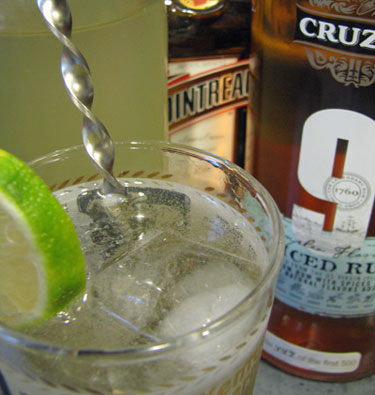
Hey, I’m gonna come right out and admit two things: first, I tend to think most “flavored” rums (or other pre-flavored spirits) taste as if some chemicals had mated with some sleazy grains and had a bottle as their baby; second, I recently received the bottle of Cruzan 9 Spiced Rum used in the below recipe via the US post. With that said, I’m going to come right out and admit another thing: I’d like the new Cruzan 9 Spiced Rum even if I didn’t get it for free. It had a clean taste, with strong vanilla overtones backed by hints of cinnamon, nutmeg, and other spices (the full spice line up is listed on the bottle as: vanilla, nutmeg, cinnamon, ginger, cloves, mace, allspice, pepper, and juniper berry). I tend to like the Cruzan line up of rums for mixing (not unilaterally or anything, but they’re reliable), so it makes sense that they could put together a tasty spiced rum. Okay, on to the Bubbly Colonial:
After deciding that the Cruzan 9 Spiced wasn’t going to make me feel ooky, I started to think about what to make with it (a naturally progression). Recently (the day before, honestly), I’d made some lime-mint simple syrup, and that seemed like it should go well with the rum, as there are loads of precedence for these island flavors getting along. So, that was the start. I wanted something bubbly, as it was a rare sunny Seattle day and I figured I should take advantage of it by pretending I lived somewhere where summer means something, temperature-wise. So, tall, rummy, bubbly, all good. Then I decided a hint of orange might be nice, so I added a smidge of Cointreau. The combination ended up being mighty fine, with lots of spice hints (including a touch of coconut–I’m not sure where it came from? Island magic, perhaps?) and citrus tang. Oh, I added a full lime wheel as a garnish. That extra fresh juice brought a ton to the table.
Ice cubes
2 ounces Cruzan 9 Spiced Rum
1/2 ounce lime-mint simple syrup (see Note below)
1/4 ounce Cointreau
Chilled club soda
Lime wheel, for garnish
1. Fill a highball glass halfway full with ice cubes. Add the rum, syrup, and Cointreau. Stir thrice.
2. Fill the glass almost to the rim with club soda. Stir again, slowly but seriously, working to bring everything together. Squeeze the lime wheel into the glass, and then drop it in.
A Note: To make the lime-mint simple syrup, I added two whole lime peels, 4 ounces freshly squeezed lime juice, 3 cups sugar, 2-1/2 cups water, and 2 cups fresh mint to a medium-sized sauce pan, which I then put on the stove over medium-high heat. Let it just come to a boil, simmer for five or so minutes, and then let everything steep in the pan for at least an hour. Strain and use to your heart’s content.
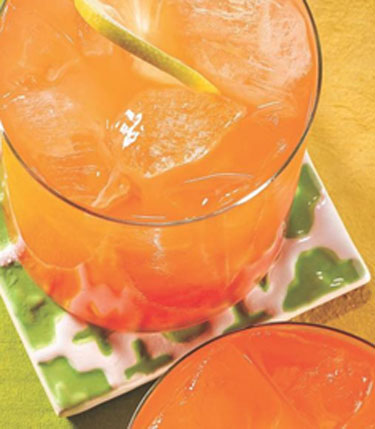
The ol’ Seattle weather recently hasn’t been what you’d (you or anyone, really, unless that other person is someone who revels in dreary wetness) call awesome lately (and by lately, I mean, to all reports, since last August). You might think this rain-cloud-rain pattern would drive me to drink only straight shots of rot-gut (or at least straight shots of almost-rot-gut). But no, fair friend, no. When the weather trots out its worst repeatedly during a time when the very month name should signal clear skies and sunshine (like May, for instance) I go for summertime mixes. A: I’m not going to let that weather tell me who the boss is. I know who the boss is (Tony Danza. And then me). B: I figure if I drink like there’s sun in the sky then maybe, just maybe, I’ll influence said weather to follow my lead. Here’s hoping, at least. Which is why I’m sipping the summertime queen of the jungle, the Ognam (which is straight of out Dark Spirits, don’t you know. Wait, you don’t? Well go buy the book and find out). It was created by wife Nat and has a tropical refreshing vibe (sure, I said vibe, what of it?), and can, if anything can, change the weather:
Ice cubes
1 1/2 ounces brandy
2 1/2 ounces mango juice
1/2 ounce Aperol
Chilled club soda
Lemon slice for garnish
1. Fill a highball or comparable glass with ice cubes. Add the brandy, mango juice, and Aperol. Stir well.
2. Fill the glass almost to the tippy top (Ognam insists on words like tippy top. Don’t infuriate Ognam.) with club soda. Stir again, well. Squeeze the lemon slice over the glass and drop it in.








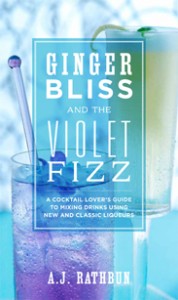 Okay, a warning: I’m going to talk about the following release party a lot. But can you blame me? In future mentions, I’ll probably provide some recipes and such from the book I’m about to mention, but for now, a drum roll for the down-and-dirty party details. But what is the party? It’s a release party for Ginger Bliss and the Violet Fizz: A Cocktail Lover’s Guide to Mixing Drinks Using New and Classic Liqueurs, my new book, and is an afternoon affair happening at the Rob Roy, 2332 2nd Avenue, Seattle, WA, on Saturday, October 8th, from 2 to 4 pm. I’ll be selling and signing books and genius bartender Andrew Bohrer (he of the Cask Strength blog) will be making Bitter Handshakes and Bruja Smashes (drinks of his featured in the book) and other drinks. It should be fun and a good excuse to have a good cocktail in the afternoon–so come on down, have that drink.