October 26, 2010
 Chester Himes is one fantastic and fantastically varied writer. He’s written novels a plenty, known for their rigorous politics, but never getting bogged down by them, more rollicking stories, and pure polemics. But he’s probably best known for his series of Harlem crime books, which star two unforgettable police detectives, Coffin Ed Johnson and Grave Digger Jones. These books, for me, manage what most “crime” books don’t, which is to create a universe so complete and entertaining and real that the mysteries or crimes become, not secondary, but only a part of the whole, instead of the only thing tying a book together. The fact that many characters hit a variety of bars and have drinks a’poppin’ doesn’t hurt either. This quote is from The Crazy Kill, and if you don’t always want your drinks ice-cold, you’ll appreciate it (really, you’ll appreciate it no matter what I’ll bet).
When Johnny sat down the waitress came with the menu, and PeeWee brought in a big glass pitcher of lemonade, with slices of lemons and limes and big chunks of ice floating in it.
‘I want a Singapore Sling,’ Dulcy said.
Johnny gave her a look.
‘Well, brandy and soda then. You know good and well that ice-cold drinks give me indigestion.’
–Chester Himes, The Crazy Kill
October 18, 2010
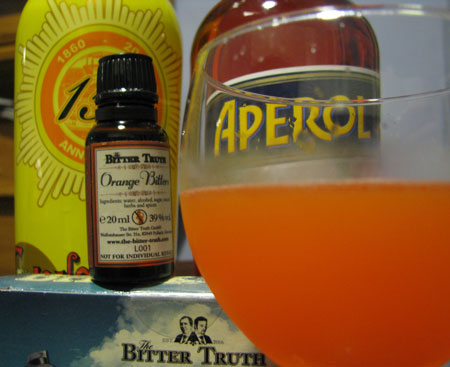
 When we moved to Italy (and, for the almost last time, if you haven’t yet, check my blog Six Months In Italy out to find information on that), we naturally had to make stopping by a grocery store one of the first things we did. Since we’ll be here awhile, we (and our bank accounts) can’t treat it like a vacation and go out to eat every night. And since wife Nat and I both dig being at the stove, it’d be silly not to cook at home, too. And, we couldn’t go without stocking up our liqueur supply either, to start to create a little home bar. I’m sure it’ll expand quickly, but for this starter trip, we solely picked up bottles of our two favorites: Aperol (Nat) and Strega (me). Of such bold beginnings will cocktail history be made. For now, though, what was made and is being made is a drink I call the “Stock-in-Trade.” Cause it uses what we have in stock, and it’s what we’ll make for the Italians to trade for cheese. That at least sounds fun.
One note: I forget to mention in the Six Bar Tools I Took to Italy post below that I also brought what will become (and has become already, really) essential for the Italian home bar, a little traveler’s set of The Bitter Truth bitters. Pal Debbi gave it to me before I left, and it contains little bottles of celery bitters, creole bitters, Bittermens mole bitters, old time aromatic bitters, and orange bitters, which are utilized in the below recipe. The Stock-In-Trade may shade a tad much on the sweet side for some, but it’s a solid sunshine-day recipe, with herbal hints coming at the end of each sip.
Ice cubes
1-1/2 ounces Aperol
1 ounce freshly squeezed orange juice
1/2 ounce Strega
1 dash Bitter Truth orange bitters
1. Fill a cocktail shaker halfway full with ice cubes. Add the Aperol, orange juice, Strega, and bitters. Shake well.
2. Strain into a cocktails glass, or a pretty wine glass if that’s what’s handy.
October 16, 2010

Before leaving for Italy (detailed on my blog Six Months In Italy), I went through and re-read almost all the Easy Rawlins books by Walter Mosley. I think Mosley is one of the finest writers living today, and think the Easy Rawlins books are the best Mosley books (and too often talked about only as detective fiction, which is silly as they transcend genre by the end of the first page, if not the first sentence, of the first book, Devil in a Blue Dress). These books are, like Dickens in a way, imaginative tour de forces due to their ability to summon up a specific time and place (LA is the place for Easy Rawlins, with the times starting in the 50s and moving on up) so completely you become completely immersed in it, and in the characters, which feel real in their motivations and feelings and actions and thoughts, as real as people who walked the earth at any time in history. So, if you haven’t read Mosley, get after it. Black Betty is a book in the middle part of the Easy Rawlins collection, and this quote is one of the best I’ve read about whiskey, the soul of it and the underlying personality whiskey carries with every sip.
There are few things as beautiful as a glass bottle filled with deep amber whiskey. Liquor shines when the light hits it, reminiscent of precious things like jewels and gold. But whiskey is better than some lifeless bracelet or coronet. Whiskey is a living thing capable of any emotion that you are. It’s love and deep laughter and brotherhood of the type that bonds nations together.
Whiskey is your friend when nobody else comes around.
And whiskey is solace that holds you tighter than most lovers can.
–Walter Mosley, Black Betty
October 10, 2010
This is somewhat of a (or almost exactly a) duplicate of a post on my Italy blog, which is called Six Months In Italy. But I figure the Spiked Punch readers may not have found that blog yet, and may be interested in the bar tools I lugged in my luggage recently. Oh, as a backdrop—I’ve moved to Italy, to be closer to local Amaros, Strega, Fernet Branca, and the other Italian boozes I love. Which is why this blog has been even lighter than normal lately. I just got here (here now being middle Italy. For gosh sake, go read the Italy blog if you want to know more or I’ll go on all day), and these are the tools I brought with me.
Oh, by the way, it’s not that I think I couldn’t make slurpable drinks during the next seven months without the following seven drink-making devices (at least I think I could), but I’d just feel so naked behind the bar (or at the counter). And not in the good “making-drinks-naked way.” So, here’s a look at some of what was in my suitcase.
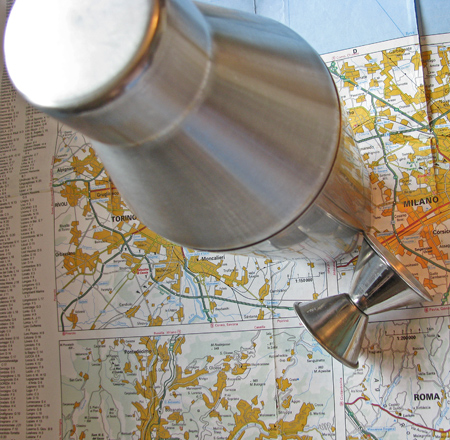
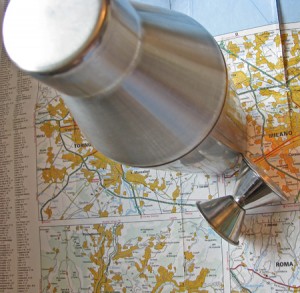
1 and 2: Cocktail Shaker and Jigger
This is my most-utilized cocktail shaker, the WMF Manhattan stainless steel cobble-style shaker. I love both how it fits me, and how it has a little elegance in its lines. It also packs up nice, and since I’ve used it almost every day for the last 10 years, isn’t something I’d leave behind. The jigger alongside it keeps me honest on measuring, and also keeps the shake company.
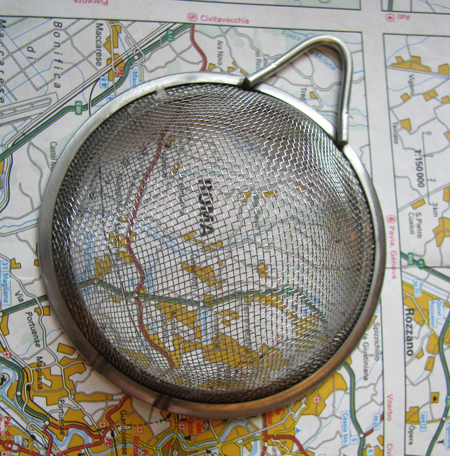
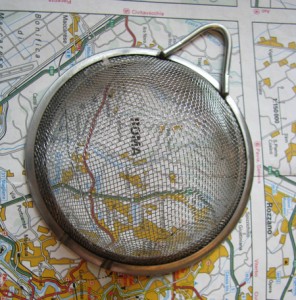
3: Fine Strainer
A good fine strainer for drinks that contain fresh juice (which should be the only juice you use naturally). I wanted to bring a juicer to go with, but decided at the last minute that squeezing would work as long as I took the fine strainer to ensure no chunky-ness gets into the drink (or my teeth).
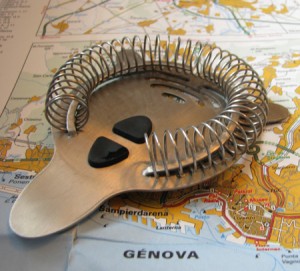
4: A Hawthorne Strainer
This is the Oxo strainer, very portable, and a necessary extra just in case the built-in strainer on my shaker gets overwhelmed by the amount of drinks being made, or the fruit in them, or anything else. Can also work if I decide to use another shaker when out and about. A generally handy item to have, and small enough to not worry about packing.
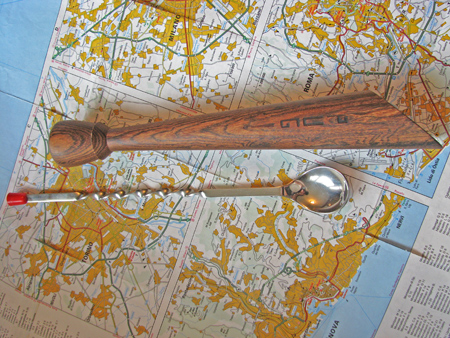
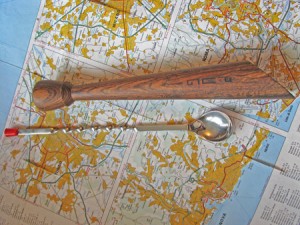
5 and 6: Pug Muddler and Stir Spoon
This and all Pug muddlers was made by hand with care by a gentleman named Chris Gallagher. It’s made from Mexican Rosewood (or Bocote), and is a substantial and beautiful thing, which between us, I paid probably more than I should have for—but look at it! Pug muddlers aren’t available in stores, but you can email Chris directly if you want one (and you should), at jcgallagher08 @ hotmail . com (removing the spaces). The stir spoon is one of many I have, but needed for stirring drinks.
7: Ice Cube Trays
I can admit it: I am addicted to these decently-sized perfectly square ice cubes. I can’t be completely happy without them (okay, okay, that’s going overboard. But I am awfully fond of them, and how them both melt slowly and crack perfectly when smacked with the Pug Muddler, making them the ideal ice for the home bartender). Mine are made in the the Tovolo Perfect Cube silicone ice cube tray.

October 1, 2010
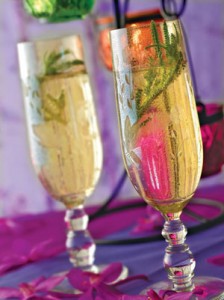 Though it’s been orderable for a few weeks, in my mind today’s the real release date for the new bubbly book, Champagne Cocktails: 50 Cork-Popping Concoctions and Scintillating Sparklers. Why today, you ask? It’s because tonight is the effervescent evening celebrating the book’s release, with an event happening at Seattle’s rollicking-ist kitchen store, Dish It Up. If you’re in Seattle, you may even be able to still sign up (though it may be full–but hey, why not take a chance). In honor of the book and event, here’s a recipe from the book that I’ll be serving tonight at the event, a recipe for the Lavanda. Doesn’t that have a mysterious name, like a forbidden dance? The drink itself is somewhat mysterious too, or at least mysteriously delicious, thanks to the lavender simple syrup–and the gin and Prosecco of course.
Serves 2
Ice cubes
4 lavender sprigs
3 ounces gin
1-1/2 ounce lavender simple syrup (see note)
Chilled Prosecco
1. Add the flowers from the top of two lavender sprigs, the gin, and the lavender simple syrup to a cocktail shaker. Using a muddler or wooden spoon, muddle well.
2. Fill the cocktail shaker halfway full with ice cubes. Shake like a dancer.
3. Strain equally into two flute glasses. Top each with chilled Prosecco, and garnish each with a lavender sprig.
A Note: To make lavender simple syrup, add 1/4 cup chopped fresh lavender, 2 cups sugar, and 1 1/2 cups water to a medium-sized saucepan. Heat over medium-high heat until it reaches a low boil, stirring regularly. Once it reaches that low boil, reduce the heat to medium- low and keep the syrup at a simmer, still stirring, for 5 minutes. Remove from the heat and let cool completely.
September 24, 2010
 For the last poem in In Their Cups week 2010 (celebrating the release and release party this Sunday for In Their Cups and the drinking poems contained therein, as if you didn’t know), I wanted to highlight one of the two poems in book by Ed Skoog (I should mention though, that he also has translations in the book from three languages–you’ll have to look to find out which languages). Without Ed, In Their Cups would have been called “Cups with Holes” and been awfully leaky, cause he not only let me put poems and translations of his own in the book, but helped me track down more poems that made the cut and are in the book, gave advice on ordering of poems and sections, drank a lot with me during the putting together of the book, and was generally helpful in every way you can think of plus a few more you’d forgotten.
If you don’t know already, Ed is one of the best poets anywhere alive today–buy his book Mister Skylight and you will be changed–but is also a drink maker of some renown, a drink consumer of much renown, and a sweet banjo player to boot who can sing the high lonesome like few others (even after a few–let’s say 5-to-10–shots). If you ever are going into a bar for the long haul (which I’m guessing you will be, probably soon), bring him along. Or at least bring this poem of his about New Orleans’ Saturn Bar, a truly divine dive, along with you as an Ed sub.
The Last Saturn Bar Poem
Around the art barn, Mike Frolich’s bar-tab
bartered paintings hang the hell that rose with him
from the Gulf of Mexico floor too fast, torturing
blood with air: maniac fish, demon in a diving bell,
and then from cadmium sunset through marsh comes
the boat bearing forward in grand roving the name
O’Neal, our bartender. Theirs are the dreams we enter,
entering the Saturn Bar’s owly heat re-tooled for unlovely
loss, the rattled corner leaning away from Chartreuse, neat,
and when I’m able to dream jukebox damaged warbling,
a Saturn-like-thing opens within me, but this is the last
Saturn Bar poem–I’ll try, I’ll try–to stop singing
shadows of St. Claude and Clouet on security camera
pavement grays we keep talking about with increasing
reluctance, ready to move on to fresh bewilderments,
spiraling neon, neon that lights up my nameless shot.
—The Last Saturn Bar Poem, Ed Skoog
Tags: Bars, Cocktail Talk, drinking poems, Ed Skoog, In Their Cups, The Last Saturn Bar Poem
Posted in: Bars, Cocktail Talk, drinking poems, Drinking Writer, Ed Skoog, In Their Cups
September 23, 2010
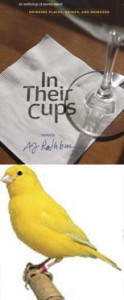 Continuing on with our week of poems from In Their Cups (in honor of the upcoming release reading which you already know lots about, and have told your friends about, and that hottie you see at the bus station) comes the poem with maybe my favorite title in the book: “Oh, For a Bowl of Fat Canary.” It’s by John Lyly, a writer in the late 1500s who had a way with words and drinks, and seems like someone you (and me) would want to spend a rowdy evening with, drinking and becoming jolly. “Canary” does not mean he was boozy enough to eat birds though. “Canary” was actually a type of sack from the Canary islands (with sack being an old term for a fortified white wine). Now, that makes it all a bit less unfriendly to our feathered friends.
Oh, For a Bowl of Fat Canary
Oh, for a bowl of fat Canary,
Rich Palermo, sparkling Sherry,
Some nectar else, from Juno’s dairy;
Oh, these draughts would make us merry!
Oh, for a wench (I deal in faces,
And in other daintier things);
Tickled am I with her embraces,
Fine dancing in such fairy rings.
Oh, for a plump fat leg of mutton,
Veal, lamb, capon, pig, and coney;
None is happy but a glutton,
None an ass but who want money.
Wines indeed and girls are good,
But brave victuals feast the blood;
For wenches, wine, and lusty cheer,
Jove would leap down to surfeit here.
—Oh, For a Bowl of Fat Canary, John Lyly
September 21, 2010
 In Their Cups week continues here at Spiked Punch, with another poem from the raddest collection of drinking and drinkers poems I’ve ever been associated with up to date (if you missed it, it’s a week celebrating In Their Cups because of a certain reading this Sunday). For today’s pick, I’m going with a poem celebrating one of my favorite drinks, and the drink to have the first Saturday in May–the Mint Julep of course. This poem about the legendary birth of the Mint Julep is by Charles Fenno Hoffmann, who was a New York writer, editor, and critic in the 1800s. If you’ve ever had a truly well-made Mint Julep (on May 1st or any other day), you’ll understand why he’d write such a ringing and singing and immortalizing number about the drink (and if you haven’t had a Mint Julep that matches the below, maybe we need to get you a better recipe or point you to a different watering hole).
The Mint Julep
‘Tis said that the gods on Olympus of old
(And who the bright legend profanes with a doubt?)
One night, ’mid their revels, by Bacchus were told
That his last butt of nectar had somehow run out!
But determined to send round the goblet once more,
They sued to the fairer immortals for aid
In composing a draught which, till drinking were o’er,
Should cast every wine ever drank in the shade.
Grave Ceres herself blithely yielded her corn,
And the spirit that lives in each amber-hued grain,
And which first had its birth from the dew of the morn,
Was taught to steal out in bright dewdrops again.
Pomona, whose choicest of fruits on the board
Were scattered profusely in every one’s reach,
When called on a tribute to cull from the hoard,
Expressed the mild juice of the delicate peach.
The liquids were mingled while Venus looked on
With glances so fraught with sweet magical power,
That the honey of Hybla, e’en when they were gone,
Has never been missed in the draught from that hour
Flora, then, from her bosom of fragrancy, shook,
And with roseate fingers pressed down in the bowl,
All dripping and fresh as it came from the brook,
The herb whose aroma should flavor the whole.
The draught was delicious, and loud the acclaim,
Though something seemed wanting for all to bewail,
But Juleps the drink of immortals became,
When Jove himself added a handful of hail.
— The Mint Julep, Charles Fenno Hoffmann