January 19, 2016
 If you love the sound of my voice as much as I do (hahaha, I kid, I kid), and missed me on Seattle’s jolly Happy Hour radio right before the holidays, then you’re in luck! It’s still available for your listening pleasure – so tune in, metaphorically, to hear me on Happy Hour radio (you’ll also be able to hear about some swell local wine from the W-A), and the dulcet tones of host Christopher Chan.
September 22, 2015
 I know, it’s September. That doesn’t mean it’s cold yet. But, but, but, I can feel the cold in the mornings when I walk the best dogs in the world around one of the best blocks in the world, feel that cold behind my ears, people! Which means I want to warm up a bit, and one of the good ways is with some rums from Washington State! Don’t believe me? Read this rummy piece I wrote for the sweet Seattle magazine, called 6 Washington Rums that Bring the Beach to You. Really, you should drink some rum while reading. Though you haven’t read it yet, so you may not know which rums to drink? Hmm, this is a conundrum. I may have to have more rum to think it over.
September 1, 2015
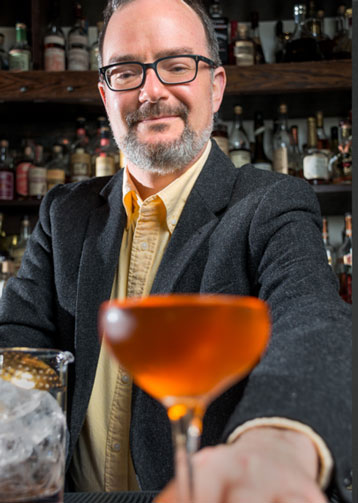 Paul Clarke is a swell guy. I once compared him to an Anthony Trollope quote and he never complained (it was quite a good quote!). He writes a blog, and has since time began, more or less, called The Cocktail Chronicles, which I read a lot, but was always too shy to comment on – and he still says “hello” when I see him at local Seattle bars. He also is now editor-at-large for the insightfully-tipsy Imbibe, and has written for most of the good mags, online and off. Through all that, he’s been a witty, learned (in the best ways, like, say Dr. Johnson, but with drinks instead of dictionaries), educating, tasteful, and bespectacled voice throughout the cocktail resurgence and renaissance. And now he has a book! It’s called The Cocktail Chronicles (which is logical, as it feels a very thorough extension, in a way, of the blog): Navigating The Cocktail Renaissance with Jigger, Shaker, and Glass, and it’s darn good. It has enough history-of-booze-and-drinks to satisfy the history buffs, and enough humor to satisfy the humor buffs. And enough drinks for a whole year’s worth of parties, and then a few more on top.
If you, like me, are a home bartender who actually, you know, likes to read, you’ll love this, and find much to make your evenings more enjoyable. If you’re a pro bartender, then, well, I consider you a failure of sorts if you don’t devour this book as part of your professional education (oh, buy one of mine, too, cause I need new shoes). If you can’t tell, I think it’s a darn fine book. And I didn’t even mentioned the design, which has a certain 1920s style all its own, with fine drawings and layouts and balance as opposed to over-wrought stylized foodie shots. Which is refreshing.
Not sold? Hmm, maybe you should read the below excerpt, a drink recipe for the Blood and Sand. You’ll understand my enthusiasm once you do, trust me.
The below is from Paul Clarke’s The Cocktail Chronicles: Navigating The Cocktail Renaissance with Jigger, Shaker, and Glass
BLOOD AND SAND
Spoiler alert: the recipe includes neither.
Some legacies deserve permanence, while others could use a little cleanup.
On the permanence side there’s Rudolf Valentino, the actor who, in 1922, starred as an ill–fated matador in Blood and Sand. In 1926, just a few years before the advent of talkies would destroy the careers of many of his co- stars, Valentino shared that Blood and Sand was his favorite of his films; a few days later, he was dead from peritonitis, leaving only the legacy of a dashingly handsome star who would never age, and whose voice would never be heard.
The Blood and Sand cocktail, however, has a less–illustrious legacy. Its print debut was in 1930 as an equal–parts recipe in the Savoy Cocktail Book, but following its revival during the cocktail renaissance, the Blood and Sand began to suffer from its own imperfections. Fact of the matter, the Savoy’s Blood and Sand just isn’t all that great. Oh, it can be nice when made well, but “nice” isn’t the same thing as “holy hell, that’s scrumptious.”
But craft bartenders like to tinker, and many have taken a crack at the Blood and Sand’s formula. Some boost the whisky’s profile by increasing its volume in the drink as well as by utilizing smokier, burlier styles. Others tweak the orange juice’s insipid contribution, either swapping in the juice of blood oranges or adding lemon to the mix; and others just chuck three of the ingredients down the sink and drink the whisky on its own without all the fanfare.
Nothing against straight Scotch, but the Blood and Sand’s legacy is one worth preserving. Tip one to Valentino, and don’t view the recipe specs with anything resembling rigidity.
BLOOD AND SAND
1 oz. blended Scotch whisky
1 oz. orange juice
3/4 oz. sweet vermouth
3/4 oz. Cherry Heering
Glass: cocktail
Garnish: cherry
Method: Shake ingredients with ice to chill; strain into chilled glass. Garnish.
Tips: Give the whisky’s power a jolt by bumping the Scotch to 11/2 oz. and dropping everything else to 3/4 oz., or keep the above proportions and instead swap a blended malt like Great King Street or a single malt like Highland Park 12 for the blended Scotch. You can also add a teaspoon of lemon juice to give it a little more pep, or substitute blood–orange juice for the OJ. And if you put a slice of orange in the shaker before mixing, it’ll give the cocktail an added—and welcome—dimension.
August 4, 2015
 It’s time to take another turn through recent Bar Hop columns written by me for the swell Seattle magazine. Whether you live here, or are visiting (and if so, welcome!), be sure to check out the below to see where you might want to drink:
*See all Seattle magazine pieces by me
July 7, 2015
 Hey hey party people! Guess what day it is? A great day! One of the days when I post right here, right now, a bunch of swell pieces I’ve recently done for the swell Seattle magazine, just in case you missed them when they came out. Which I know you probably wouldn’t do, but hey, just in case, I’m here for you. Check them out:
• 6 Seattle Bartenders Tell You What to Drink This Summer
• Letterpress Distillery Releases Arancello
• Herb & Bitter Public House set to Open in Early June
• Seattle Cider Co. Releases Harvest Series & More Distillery News
• 3 Standouts at No. 6 Cider Taproom
• Andrew Friedman on His New Bar Good Citizen
• Poems + Drinks at 5 Seattle Bars
• 6 Washington Rums that Bring the Beach to You
*See all Seattle magazine pieces by me
Tags: Bars, cocktail catch up, Cocktail News, Distillery, Good Citizen, Herb & Bitter Public House, No. 6 Cider Taproom, Poems + Drinks, Seattle Bars, Seattle Magazine, Washington Rums
Posted in: Bars, Cocktail News, Seattle Magazine
June 2, 2015
I recently received the Uncommon Goods’ Molecular Mixology Cocktail Kit in the mail – without even ordering it! I know, I’m lucky (and trying not to be smarmy about, too). It’s an interesting combo kit in a way, with three boxes covering fun ways to science-up three classic drinks, the Margarita, Mojito, and Cosmopolitan.

Each box contains recipes for three different molecular mixology takes on the drinks, including making “caviar” bubbles, tasty foam, and what I’d call liquid “spheres,” as well as the food additives and some of the tools needed to make the drinks. It’s like a little chemistry kit that just needs booze (and sometimes some mixers and stuff) to take your drinking into another realm, a sorta futuristic feeling place that’s still awfully jolly (oh, I suggest when you get your molecular mixology on, you do it with friends. It’s even more jolly. Of course this is pretty much true with all drinking)!
Oh, wait, before I get in to my experimenting with the kit, I suppose a little about UncommonGoods might be, well, good. Heck, instead of me trying to talk it out, let me tell you what they say:
UncommonGoods is a retailer that endeavors to feature unique designs and handcrafted gifts created in harmony with the environment and without harm to animals or people. We make it our mission to support and provide a platform for artists and designers; in fact, half of what we sell is made by hand. Most of the products we carry are created right here in the USA, and about one-third of our entire collection incorporates recycled and/or upcycled materials.
And now you know! And now we can get to the drinks. I took on (with the help of wife Nat) the Margarita sphereification first (and, I’ll admit, it’s the only one so far, though I look forward to more), cause in some past molecular drinking, I always love the sphere-ing. Really!
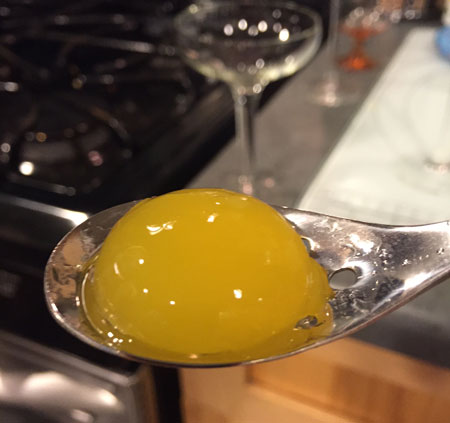
The kits come with nice little recipes books. I’m not gonna walk through every step, cause that’d get long. But will give the highlights. You mix a little calcium lactate with some water, orange liqueur, and mango, freeze it into spheres (in the handy sphere freezing tray), mix some water and sodium alginate, drop the frozen spheres in it, then rinse them with water, and top them with tequila, coconut milk, and lime. Boom!

The instructions were by-and-large pretty good (it would have been nice to have a general idea how long the spheres will take to freeze, as the instructions just flow as if that doesn’t take time – but that’s pretty easy to figure out). I wasn’t a huge fan of the tequila-and-coconut milk combo as it was, honestly. But I loved making more of an actual “deconstructed” Margarita (as they call it in the book), just with tequila, lime, and the orange liqueur (I used Gran Gala) mango spheres:
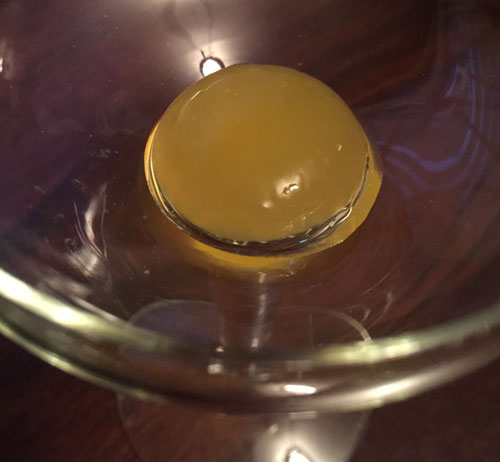
I love, love, love slurping the tequila and lime and sphere, and then breaking the spheres open in my mouth (hah, that sounds bad – but tastes so, so good). The whole process creates this little skin around the orange liqueur/mango liquid combo, and when you bite down, all that flavor is a blast. A blast! Very swell stuff.
I can’t wait to try more, both the other recipes for the Marg and the other two cocktails, but also playing around with my own recipes using some of the science-y stuff that came along. Neato!