May 23, 2011
 If you haven’t read Part 1 of our Branca Distiller tour, well, do so now. It talks lots about company history, the Collezione Branca, the Branca philosophy of novare serbando (renew but conserve), and much more. Go read it. Okay, are you back? Now we’re ready for Part 2, in which we actually get to walk around the distillery and see where the magic happens. Still with our tour guides Elisa, Marco, and Valeria, we last stopped at the Carpano area of the museum, where we learned more about Branca’s purchase of Carpano Antica (and the full Carpano family of vermouths), had a quick drink of Carpano Antica, and then got ready to hit the distillery proper. But first, as we’re walking into delicate areas, we had to suit up (attractive, aren’t we?):
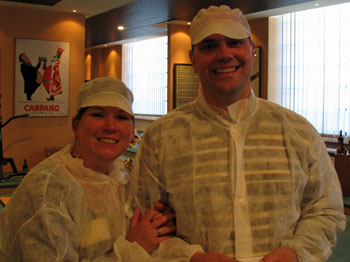
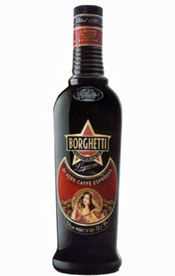
Check out the wonderful Carpano ad in the background, too. Yet another piece of Branca-related advertising I wish I had framed in my house. After suiting up, we started by going through a few doors into the Borghetti coffee liqueur room. Now, here’s where I have to admit one downside for you, dear readers, in this Part 2 of the tour post. We couldn’t, in most areas of the distillery, take pictures. As mentioned in Part 1, having delicious liqueurs, vermouths, and amaros means that folks are always wanting to know how you make them. Which means even someone as un-spy-ish as me (though I could be a spy, I suppose–I have that look, right?) can’t snap snaps. Borghetti, if you don’t know (and you might not, as it’s sadly not readily available in the States) is the coffee liqueur made by the Branca company. It’s a staple in Italy (all the everyday bars/cafes we’d visit had it, usually in both big bottles and in these small, 3-inch-ish, portable bottles), and I’m not 100% sure why we don’t have it in the U.S., as it’s scrumptious. Normally, I’m not either a big coffee liqueur fan or a big coffee drinker (a lot of coffee liqueurs taste ickily chemical to me), but I really love the Borghetti, and after seeing where it’s made, I know why. It only contains coffee (freshly roaster and made there), liquor, and a natural sweetener. Walking into the room where it’s made is somewhat like walking into the best coffee roaster inside Willy Wonka’s chocolate factory, as there’s a perfect sweet/coffee aroma—which matches Broghetti’s taste. Here’s what the bottle looks like, if you want to scoop some up on your travels:
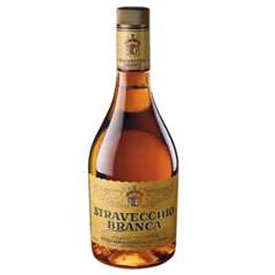
From there, we saw where the ingredients in Fernet Branca are treated during production (where the secret processes mentioned in Part 1 happen), including the big iron pot (pictured in Part 1) where the spices and more are stirred up. Amazing stuff, really, as it’s partially mechanized, but still there are always workers in attendance, watching over the process. We next went to perhaps my favorite part of the whole tour (well, just hanging out with our awesome tour guides was my favorite part, but this coming up was a close second), the cask where Stravecchio Branca spends time before bottling. Stravecchio Branca is the brandy made by the Branca company, and is another item I wouldn’t mind seeing more of over here (again, it’s in most bars/cafes in Italy and is a really good, full-bodied brandy). Here’s the bottle if you ever want to try some and you see it:
But the cask (or flask, as they referred to it as) in question we could take pics of, but we didn’t have a wide enough angle lens to do it justice. See, it’s the biggest cask in Europe, and was built over a two month time period way back in 1892. And it’s massive and astounding to stand in front of:
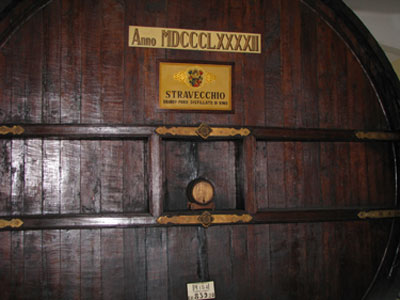
Stravecchio was originally called “Vieux Cognac,” but they had to change the name due to the Cognac rules (about it having to be made in the Cognac region of France, that is). Today, the brandy spends some time in other casks, but each batch spends a least some time in this massive cask–which is never empty, as some is always left in to ensure that the brandy stays consistent (a nice little touch). On the back of the ginormous cask, there’s a chart that tells how full it is (somewhat like the little marks made on the wall as kids get taller), alongside a little chalkboard notepad (which is alongside my head):
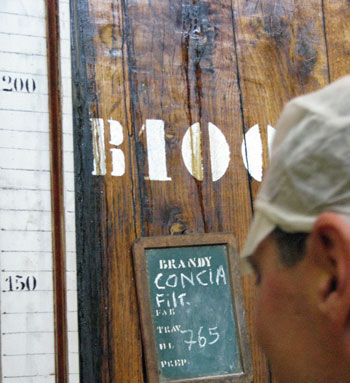
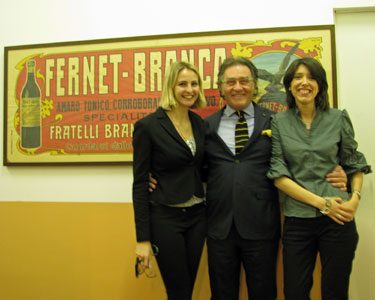
My favorite part of the photo (and another reason why I loved this cask so much) is right above the “B100” where the cask looks like it’s sweating. This is a slight oozing out that happens, about which Marco said, “it is crying.” He even wiped some off on a fingertip to taste, and encouraged us to do the same–which I, naturally did. It was super-brandy-charged, and I dug it so much I went back for more (hey, I have a hard time seeing anything cry). After the Stravecchio, we wandered down into the cellars, where we viewed wooden cask after wooden cask, rows of them (all lovely, by the way), first more brandy (they start here in smaller casks before moving to the biggest cask in Europe), then the wooden casks Fernet Branca is aged within. Fernet Branca has to be aged at least a year, and the brandy for three, so you can imagine that there are tons of casks (not to mention that Branca Menta is also made with aged Fernet Branca, on to which is added pure peppermint oil, sweetening, and love). All these hundreds of casks, the giant cask, the production facilities upstairs, the museum from Part 1, and the offices live in this one building, in the center of Milan, a bustling city. There’s something almost otherworldly about it, especially when wandering through the building’s many rooms and passages. One could easily get lost down here—you’d never go thirsty, luckily. Also luckily, we didn’t have to worry about getting lost, because we were with our friendly and knowledgeable (and fun) tour guides. Check them out, aren’t they great:
After seeing the casks, and saying our goodbyes, we walked out in Milan craving a little Fernet Branca or Branca Menta. Of course, we had a four-and-a-half hour drive ahead of us, so the cravings just became sharper, until we were back in our home Italian neighborhood, where we could indulge our Branca thirst at Bar Fizz. Thanks again Fratelli Branca Distillerie, we had a great time.
Tags: amaro, Borghetti, Branca Menta, Carpano Antica, Fernet Branca, Fratelli Branca Distillerie, Italian Liqueurs, Italy, Milan, Punt e' Mes, Stravecchio brandy
Posted in: Brandy, digestif, Fernet Branca, Italy, Liqueurs
May 20, 2011
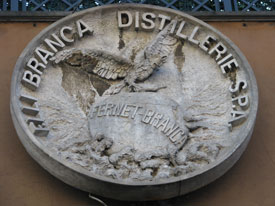 Back in April (when still living in Italy), wife Nat and I took the road north from our Italian pre-tirement home, driving up to Milan so we could make a visit to the Fratelli Branca Distillerie, where Fernet Branca and many other delicious drinkables are made. When we showed up in the morning for our tour, we weren’t sure at all what to expect—a little talking, a little walking around the building, we just didn’t know. But it ended up being an amazing day, where we learned a ton and had some fun (huge props to Laura Baddish for helping to set it up, too). Once past the guards (serious liqueurs always need guards at the gates, cause secret formulas are too tempting to weaker minded individuals), we were met by three swell Italian folks: Elisa, Marco, and Valeria. Marco gave most of the tour, with tons of expert translating (his English is better than our Italian, but not by enough to carry on in-depth conversations) and more touring by Elisa, with Valeria filling in the cracks.
The tour started in the Collezione Branca, which is a museum created by the Branca family, a museum in the distillery (the aromas of Fernet Branca and other drinks waft up as you wander the museum), collecting Branca historical items, memorabilia, and more. It really serves as a tangible history of the company in many ways, and was full of intriguing artifacts. Right at the beginning are portraits of those family members who were there at the beginning, with a picture of Bernardino Branca in the middle:
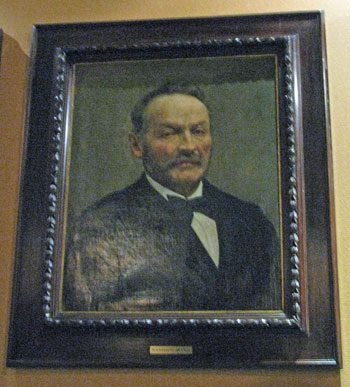
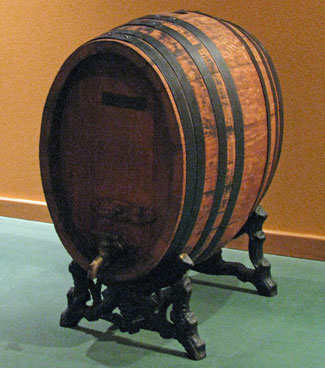
Bernardino was the original creator of the famous Fernet Branca, developing the formula with Dr. Fernet, a Swedish doctor, to assist malaria and cholera patients. With this aim, it was first tested in hospitals (where it was shown to help patients) and first sold in local farmacias, or pharmacies (quick aside: Italian pharmacists have a lot more leeway than those here in the States, in prescribing and diagnosing). The first cask that Bernardino made this herbal health mixture in is also in the museum, and lives right under his portrait:
When walking through the museum, we learned more about the Branca family, which still runs the company today (the head of the company, Count Niccolo Branca, is the 5th generation of the family to make Fernet Branca). The family focus isn’t just with the Brancas, either, as our tour guide Marco is the 4th generation of his family to work at Branca (he’s been there since 1972). This lengthy dedication and devotion is quite remarkable, and shows in the end results: the liqueurs. There are lots more interesting family stories, such as those about Maria Scala, who married the third son of Bernardino and eventually became one of the first women in charge of a large company, and who originally developed the focus on continually creative Branca advertising—the company has always been on the forefront of advertising and advertising trends. One of my favorite, and a somewhat obscure, piece of marketing is this Branca suitcase:
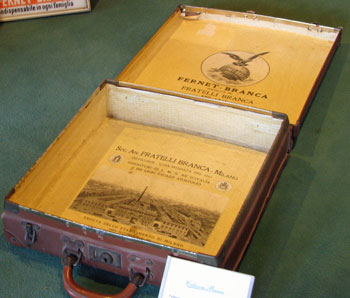
I would carry one of those in an instant (if you have one you’re tired of, please let me take it off your hands). The museum also has loads of production implements from the past, and some that were used in the past but are still utilized today, which points towards the Branca philosophy of novare serbando, or renew but conserve. For one example, Marco showed us these giant iron pots for herb maceration and heating, which are still used today, though the stirring is done mechanically instead of by hand:
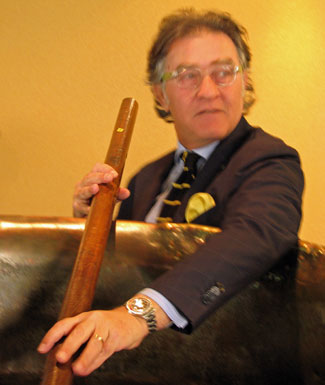
The pots were at one point stirred with both iron and wood stirrers (depending on the spices), and as the iron sticks were “cleaning” the pots, many thought that Fer-net came from some rendition of “clean iron.” Which is, I have to say, a great story. Fernet Branca gets its signature bitter, herbal, rich taste from an wide assortment of herbs, roots, spices, and other ingredients, and there’s a giant, mind-blowing, round table in the museum where you can see the complete layout of ingredients:
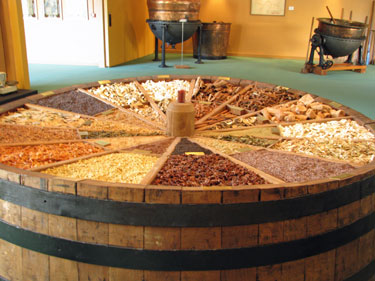
I knew (hey, I’ve done a little research before) that there were around 40 ingredients, and that the list included such far-reaching items as gentian root, rhubarb, myrrh, cinchona bark, galanga, saffron, and others, but I learned while there that all the products used are completely natural, and that all the suppliers have to sign a code of sorts, that says the products were obtained in a non-exploitive way. Another (and this was fascinating to me, but hey, I’m interested in odd things) fact I learned is that the real secret in the secret recipe for Fernet-Branca is how the ingredients are treated in production. Only the family knows, and the Count himself still does the treating (which means he has to go to the other distillery, in Argentina, regularly). Cool, isn’t it? After spices, we got to see tons of hip old Fernet-Branca ads, including the first one to use the eagle-over-the-world logo:
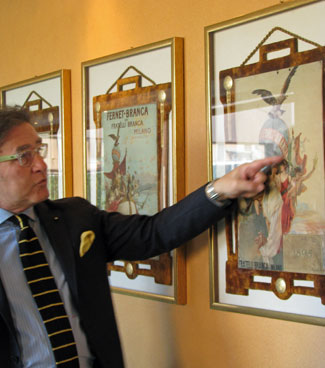
This logo was created in 1895, due to the large amount of Fernet Branca imitations being shuffled out of back alleys—always look for the eagle bringing the Branca over the world to ensure you get the real thing. There are a number of side rooms along the museum’s main path, where you can get a better picture of how Branca workers worked back in the day (as they say), with an herbalist’s room, chemist’s room:
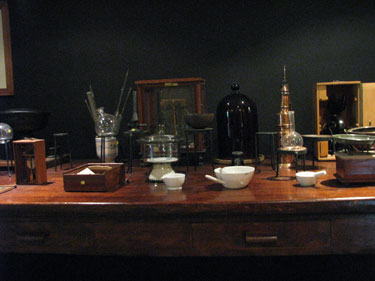
and more. The museum is persistent in remembering not just what was made, but those who made it—not to mention that the museum itself was built by current workers at the plant. Again, there’s that whole atmosphere of devotion to people and product, to stories and to history. After looking over the production process, the spices, and hearing about the history contained within, we walked into a room full of bottles, whole tables of old Fernet Branca bottles, and bottles of other products brought out by the company, including older bottles of Branca Menta (a minty-er and sweeter version of Fernet Branca released in 1965), bottles of Carpano Antica (Branca bought the Carpano company years ago in a particularly astute moment—Carpano Antica being the first Italian vermouth, and one still made partially by hand, and the Carpano company also making Italian vermouth Punt e’ Mes), and more bottles. There’s even a whole cabinet of Fernet Branca impersonators (I suppose success always leads to imitation):
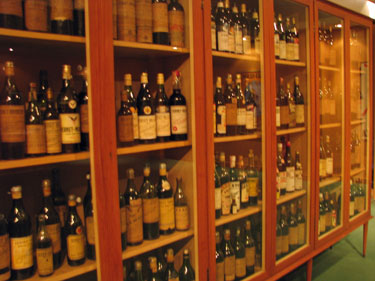
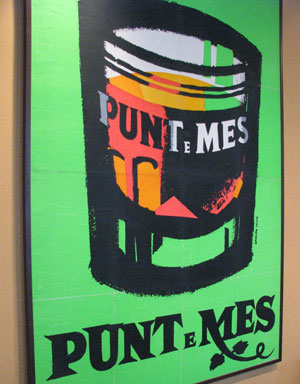
Then we stopped in the bar room (of course the museum was going to have a bar at some point), talked a bit more about advertising, had some Carpano Antica (which I loved even before stopping, and which I was happy to have a glass of even at 11:30 AM), and saw a host of happening ads for the non-Fernet-Branca-Branca brands. If the tour ended now, I would have been more than happy–but we still had the actual distillery to see! Which I’ll talk more about in Part 2, so come on back. Oh, first, check out this sweet and colorful Punt e’ Mes ad (one of about, say, 96, that I wished I had on my walls at home):
Tags: amaro, Branca Menta, Carpano Antica, Fernet Branca, Fratelli Branca Distillerie, Italian Liqueurs, Italy, Milan, Punt e' Mes
Posted in: Cocktail Art, digestif, Drinks on the Road, Fernet Branca, Italy, Liqueurs
May 16, 2011
 First, an apology for the lack of posting. Moving back to Seattle from the I-tal has been a process, and has left me with little umph for blogging. Or, after reading (re-reading really, as I’ve read it at least once, and probably twice, before) Graham Greene’s somewhat funny/somewhat serious Cuban spy-and-not novel Our Man in Havana, I’ve been too inclined to have a daiquiri at noon for blogging. I like that take on things much better, so let’s go with that excuse, and start a rumor of me being a two-daiquiris-at-noon fella. Heck, maybe I’ll even inspire you to start. If I don’t, hopefully this quote does (or starts you collecting miniature bottles of whiskies):
‘Eighteen different kinds of scotch,’ the stranger said, ‘including Black Label. And I haven’t counted the Bourbons. It’s a wonderful sight. Wonderful,’ he repeated, lowering his voice with respect. ‘Have you ever seen so many whiskies?’
‘As a matter of fact I have. I collect miniatures and I have ninety-nice at home.’
‘Interesting. And what’s your choice today? A dimpled Haig?’
‘Thanks, I’ve just ordered a daiquiri.’
‘Can’t take those things. They relax me.’
—Our Man in Havana, Graham Greene
May 5, 2011
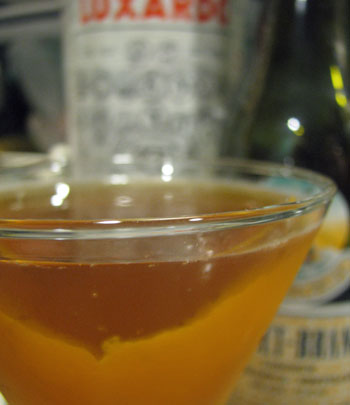
Well, we’re back (from Italy, that is. If you didn’t know it, wife Nat and I and our two dogs have been enjoying our Italian pre-tirement for the last seven or so months. Interested? Read more about it). Re-entry into life into Seattle hasn’t been rough, but neither has it been a box of chocolates filled with booze. To ease the edges, and to help remind me of things from here I missed, when there, without forgetting what I loved there, I whipped up the following cocktail last night, and think I’ll be whipping up a few more over the next couple of days. See, bourbon is hard to track down in the I-tal, and so I wanted the drink to be serious on the bourbon side. But, I miss (already) having loads of Italian liqueurs in every café and bar, so I wanted hints of Italy surrounding the bourbon. Which led to the Welcome Back, Weary Traveler:
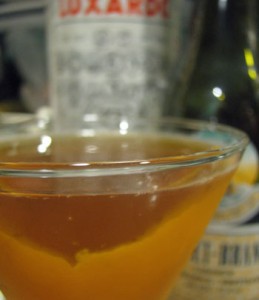
2-1/2 ounces bourbon (I used Blanton’s, but others may suffice)
1/2 ounce Luxardo Maraschino
1/4 ounce Fernet Branca
Orange twist, for garnish (I like’d a wider orange twist here)
1. Fill a cocktail shaker or mixing glass halfway full with cracked ie.
2. Add the bourbon, maraschino, and Fernet Branca. Stir well.
3. Strain into a cocktail glass or a stewardesses hat. Twist the twist and drink as happily as you can manage.
Tags: Blanton's, bourbon, cocktail recipe, Cocktail Recipes, Dark Spirits, drink recipes, Fernet Branca, Luxardo Maraschino, Recipes, What I'm Drinking, Whiskey
Posted in: Almost Drinkable Photo, Italy, Liqueurs, Recipes, What I'm Drinking, Whiskey
April 26, 2011
 The following two quotes, the last of those from the Raymond Chandler book Pearls Are A Nuisance, which I talk about more in Take 1, below Take 2, which is below this post right here and now. These quotes are from the final story in the collection, “The King in Yellow” and include one about drinking light and one about drinking heavier. Not a bad way to end up, though I think Mr. Chandler would be more happy with the latter, were he still around to drink with (sadly, not the case).
The red-haired girl said: ‘The drink’s on me. I was with him.’
Steve said: ‘Coke with a dash of bitters,’ to the waiter.
The waiter said, ‘Madame?’
‘Brandy and soda. Light on the brandy, please.’ The waiter bowed and drifted away. The girl said amusedly: ‘Coke with a dash of bitters. That’s what I love about Hollywood. You meet so many neurotics.’
The maid came back with a copper ice bucket. She pulled a low Indian-brass tray-table between them before the davenport, put the ice bucket on it, then a siphon, glasses, and spoons, and a triangular bottle that looked like good Scotch had come in it except that it was covered with silver filigree work and fitted with a stopper.
Dolores Chiozza said: ‘Will you mix a drink? in a formal voice.
He mixed two drinks, stirred them, handed her one. She sipped it, shook her head. ‘Too light,’ she said. He put more whisky in it and handed it back. She said, ‘Better,’ and leaned back against the corner of the davenport.
—Pearls Are A Nuisance, Raymond Chandler
April 22, 2011
 You can read a little Raymond Chandler screed below, as well as more about the book this quote is take from, or you can just slip down a little less and get straight to the goods. This is from the second story in the collection, “Finger Man,” a story that stands as one of the first appearances of a well-known hard-boiled detective, Mr. Philip Marlowe, and may be the only time (that I can remember) he’s drinking tequila. Which I heartily approve of, by the way.
‘You don’t play?’ the bartender asked me.
‘Not on Tuesdays. I had some trouble on a Tuesday once.’
‘Yeah? Do you like that stuff straight, or would I smooth it out for you?’
‘Smooth it out with what?’ I said. ‘You got a wood rasp handy?’
He grinned. I drank a little more of the tequila and made a face.
—Pearls Are A Nuisance, Raymond Chandler
April 20, 2011
 I like (as maybe detailed before on this blog) Mr. Raymond Chandler, though some noir revisionists aren’t as high on him as, say, Dashiell Hamnett. I say pooey on them—why not read both authors, as well as the many others writing in the pulpy pulp era (at least the other good ones, of which there are many). I’ll admit there are one or two Raymond Chandlers that don’t rise as high as, say, The High Window, but I’ve gotten at least a kick and usually more from every book of his, which is why I was jazz’d recently to find, in Italy of all places, a copy of a Chandler book called Pearls Are A Nuisance, which collects three short stories of his that I hadn’t read (at the time this paperback was published, the book was only available in this British version). In honor of the find, and of Mr. Chandler’s usually hard-drinking leading men, I’m going to have three Cocktail Talks with quotes from the book, one day for each story in the book. These first two are from the title story, with one being the beginning of a drinking bout (around the narrator getting his, um, tail kicked), and the next a charming description of the after-effects.
A wet towel began to slap at my face. I opened my eyes.
‘Listen, kid. You got two strikes and no balls on you. Maybe you ought to try a lighter bat.’
‘Brandy,’ I croaked.
‘You’ll take rye.’ He pressed a glass against my lips and I drank thirstily. Then I climbed to my feet again.
At five o’clock that afternoon I awoke from slumber and found that I was lying on my bed in my apartment in the Chateau Moraine, on Franklin Avenue near Ivar Street, in Hollywood. I turned my head, which ached, and saw that Henry Eichelberger was lying beside me in his undershirt and trousers. I perceived that I was also as lightly attired. On the table near by there stood an almost full bottle of Old Plantation rye whisky, the full quart size, and on the floor lay an entirely empty bottle of the same excellent brand. A cigarette had burned a hole in the brocaded arm of one of my easy chairs.
—Pearls Are A Nuisance, Raymond Chandler
April 18, 2011
Living in Italy (as I am of this writing, at least), I’ve picked up a small addiction–to mirtillo juice (mirtillo=blueberries), which I like to have in the morning with my croissant. It’s a health kick (or seems to be) and has a great taste and color. Recently, however, thanks to my pals/landlords Andrew and Marianne (proprietors of the wondrous Amici Villas), I’ve discovered the grown-up sibling of my beloved mirtillo juice, the fantastic mirtillo liqueur. See, Andrew and Marianne picked up a bottle for me not too long ago, and it’s delicious, not too sweet and bursting with flavor, and I’ve been digging it solo and mixed. It’s especially good in the below drink, named after Andrew and Marianne’s lovable pup, Oscar, who is frizzante, just like this slightly sparkling sparkler. To round out the somewhat Italian experience (or, Italian-British, much like the above-mentioned Andrew and Marianne, cause gin’s involved, too), and to bring the frizzante, I combined the mirtillo with Donini wineries (read more about Donini here) Brigante (a bianco frizzante):
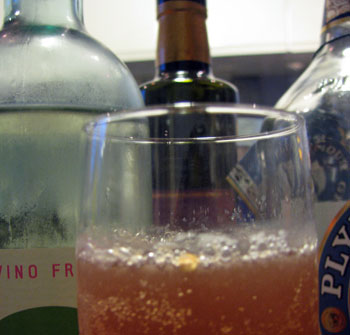
Ice cubes
1 ounce gin
3/4 ounce mirtillo liqueur
1/4 ounce freshly squeezed lemon juice
2 ounces Brigante (or other frizzante white wine)
1. Fill a cocktail shaker halfway full with ice cubes. Add the gin, mirtillo, and lemon juice. Shake well.
2. Strain into a Champagne flute, add the Brigante, and stir briefly. Sip and enjoy.