June 11, 2010
 Though this book was eventually (and is, I suppose) better known as The Gracie Allen Murder Case, and made into a movie of the same name (starring, wouldn’t cha know, Gracie Allen), I love it that my copy is still called The Scent of Murder. Called such because at least three characters work in a perfume factory. I also love that the crime solver is named Philo Vance (played in the movies of course by William Powell, who plays a cocktailing and high class mystery solver better than anyone), and that he’s a bit of a dandy, though tough, too, but with a thoroughly rich, East-Coast-or-English, knows-his-wines-and-colorful-waistcoats-way about him. Really, though people die, this is a somewhat lightly and bubbly read. All that alone would lead to me wanting to drop this quote down for you. However, the real reason is that I think it should inspire you to sip some Chartreuse this weekend (I can’t think of better advice to give).
We had finished our coffee and were sipping our Chartreuse when Sergent Heath, looking grim and bewildered, appeared at the door leading from the main dining room to the veranda, and strode quickly to our table.
–S.S. Van Dine, The Scent of Murder
May 28, 2010
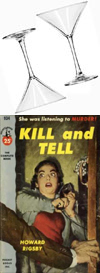 After the longish (or just plain long) Tom Waits post below, I thought I’d slip in a short couple of quotes from a book that almost echoes Waits (a book which is definitely the inspiration for the “ethics” scene in the Coen brothers’ film Miller’s Crossing, too), in that there are some shady and weird characters and everyone ends sad, dead, or drunk–a book called Kill and Tell. The first one’s about going into a bar, and the second about drinking at home (cause I wanted to cover the bases).
The bar was a fine old piece of imitation mahogany, and there was a fine old imitation Irishman in a white coat behind it.
We lifted our glasses to each other; the wine was cool and dry. I kept refilling our glasses while we ate, and when Jake brought the coffee Catherine asked him for some brandy. We were celebrating; each of us understood that.
“I think I’m drunk,” she told me.
“I’m drunk, too,” I said.
—Kill and Tell, Howard Rigsby
May 18, 2010
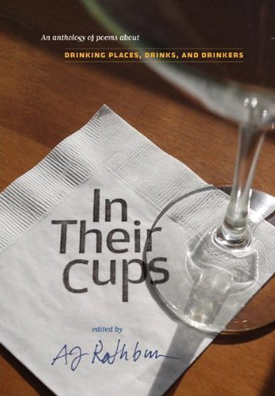 Maybe, just maybe, you live on a block of drinking poetry readers. If so, you’re lucky (and maybe sleepy, too, as poetry and drinking combined lead some to stay up all night). If not, or even (and maybe moreso) if so, then I want to let you know about the book that will change your life, and have you drinking and reading poems for days. The trick is (and this is how you can be a trendsetter, instead of a trend follower) that the book isn’t even out yet, but is pre-orderable, so you can be the first person you know to get it. It’s called In Their Cups: An Anthology of Poems About Drinking Places, Drinks, and Drinkers. I’d tell you about it in detail, but A: I edited it, so am bias’d, and B: I want to save some of my gushing for when it comes out proper, and C: the wonderful poet Richard Jackson already said this about it:
“Souls of poets dead and gone,” goes the line from Keats, but AJ Rathbun’s wonderful In Their Cups brings them back, at least for a few more drinks, and we too are invited in. And what company we enjoy: we can imagine classic poets as diverse as Catullus and Du Fu speaking to polar opposite modernists like Cesare Pavese and Appollinaire, perhaps interrupted here and there by diverse contemporary voices such as Mark Halliday and William Olsen. Rathbun has created a unique imaginary world here, adding a couple of his own fine poems to the conversation, where we can hear, with Richard Hugo, the “dusty jukebox crackling” on every page. This is a book you’ll want to raise a glass to.
Now, don’t be scared if you don’t cozy up with poets on an every day basis—you’re going to love it. I promise. Read it with drink in hand, and you’ll probably never put it down, until you fall down. Which is saying something.
PS: Want to see an actual poem that’s in the book to get you going? Check out here, and here.
May 15, 2010
 Ohh, that title just makes me shudder: Death at the Bar. Perhaps the worst thing possible (well, okay, that’s a bit much—there are, in life, much worse things, but this is just a drinks blog, so give me some leeway), especially if it was a jolly evening. Which, in this book, by Ngaio Marsh (Ngaio is pronounced /ˈnaɪoʊ/ if you were wondering, and is a lady), isn’t 100% true, as the evening at the bar (a little English town bar called the Plume of Feathers. Which is fantastic, especially as it’s not a disco), is a tad contentious, with old fiesty relationships, and reds (in the commie way), and an arrogant lawyer, and more.
But it’s still a pretty good night (as the below quote points out, though it also has a bit of foreshadowing), until they decide to play darts. Because one of the characters is killed . . . by a dart. Or is he? You’ll have to read the darn book to find out, because I’m no spoiler.
Watchman had already taken three glasses of Treble Extra and, although sober, was willing to be less so. Parish, suddenly flamboyant, offered to bet Able a guinea that the brandy was not Courvoisier ’87, and on Abel shaking his head, said that if it was Courvoisier ’87, damn it, they’d kill a bottle of it there and then.
—Death at the Bar, Ngaio Marsh
April 6, 2010
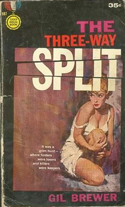 It’s still early for many on the West Coast (and, depending on when you read this, whichever coast you’re on, wherever you are, it may be early for you, too), especially those who are drinkers and/or criminals. I know a lot of the former, but really none (that I know about, unless you mean those that are criminally talented or something) of the latter, except those I meet in books like The Three-Way Split, by Gil Brewer, which is about a guy trying to live a simple life with some amazingly hot waitress he’s met and some treasure buried at sea he knows about, but due to his deadbeat-and-illegality-loving dad, he ends up roughed up by thugs, who also try to get the treasure. The story echoes your own life I’m sure. How does it turn around and reconnect with morning, and it being early on the West Coast? It’s the quote, below, which is about coffee and rum—a favorite breakfast for many.
He banged two pint mugs on the table, poured in steaming coffee until they were two-thirds full. Then he brought down one of those bottles of rum, black as tar, popped the cork, and filled the mugs to the brim.
He filled the plates and we ate. The rum was like a hot rasp running across the tongue.
— The Three-Way Split, Gil Brewer
March 30, 2010
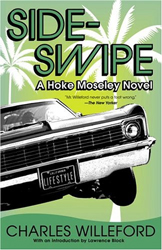 The last week or two, I reread all the Hoke Moseley books by Charles Willeford. If you don’t them, or Mr. Willeford’s work, and you know how to read, then change your reading patterns. Or get out. That’s how I sound after reading them, but it’s not how they sound, because they’re not as fake tough (and some of the less-detective/etc ones not at all), but what I like to think of as naturalistically insane. Very matter of factly crazy somehow. Hoke Moseley is a Miami detective, who deals with some criminals but also ends up taking care of his teenage daughters and his pregnant partner (well, she’s not always pregnant, as she has a baby in one of them) and various random Floridians. He drinks Early Times mostly (though isn’t opposed to other options) and has false teeth. This isn’t really saying much really about the books, but this might help: I think if I could have one more book written of any series, I might choose to have one more Hoke Moseley book written by Charles Willeford. If that tells you anything (I wonder what other people would pick with this option? What would you choose?) This quote is from Sideswipe, the 3rd of 4 Moseley books.
Frank was in his den, watching a lacrosse game on cable, and Helen was in the living room. She sat at her fruitwood desk, addressing envelopes and enclosing mimeographed letters requesting donations for the Palm Beach Center for Abused Children. She was on the last few envelopes when Hoke joined her in the living room. He poured three ounces of Chivas Regal at the bar, added two ice cubes, and gave himself a splash of soda. Helen looked over her shoulder and smiled. “I’m about finished Hoke. Could you fix me a pink gin please?”
“Tanqueray or Beefeater?”
“It doesn’t make any difference when you add bitters, so I’d just as soon have Gordon’s.”
Because it did make a difference, Hoke poured three ounces of Tanqueray into a crystal glass, added ice cubes, and put in a liberal sprinkling of Angostura bitters. He took a cocktail napkin from the stack and put the napkin and drink on the edge of the desk where Helen could reach it.
“Thank you,” Helen sipped her drink. “This is Tanqueray.”
“There is a difference then.”
—Charles Willeford, Sideswipe
PS: The other Willeford books (not in this series) are also darn fine. Especially The Pick Up (one of the great, and the first book by him I read), and Cockfighter (which was of course made into the fine, fine movie starring the best actor ever, Warren Oates).
March 2, 2010
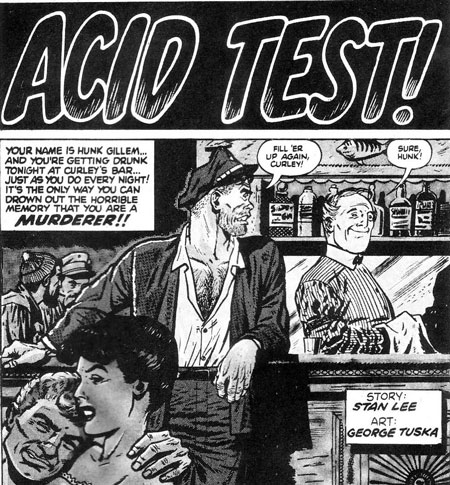
Okay, that’s just a catchy headline in most situations, because in most situations I like my bars safe and booze-y and full of cozy chums. But for some reason, the below panel, from a knockout Stan Lee / George Tuska comic called “Acid Test!” printed in the October 1973 issue of Tales of the Zombie #2, (though originally presented in the July 1953 issue of Menace #5 under the title “Nightmare!”–huge props to the amazing pre- and post-code horror comics site The Horrors of It All, which is where I found this, and where I visit every day to get my chill on) made me think of how some days you go to a bar to forget, or try to forget, the murdering you’ve done. That’s all right, too (even if for most of us it’s symbolic murder, one hopes). Especially when the bartender below is such a dead ringer for bartending pal Andrew B. Or is it bartending pal Andrew F? Now that I look at it, a bit of both. The fact that the bartender turns out to be a certain famous evil-doer has nothing to do with it, naturally.
February 19, 2010
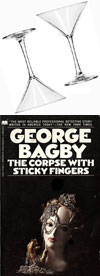
Listen, just because I like, or sorta like, or have read all the way through, a book, doesn’t mean I have to agree with the quote provided here on the Spiked Punch. Sometimes, I just want to use a quote for education purposes, or to disagree with, or because I think it’s just the rootin-tootin-est. The below falls somewhere in there, but for sure it: comes from a book with a great name (The Corpse with Sticky Fingers), comes from a book written by George Bagby, and illustrates a rule I like to live by (by stating the opposite. See, this is the educating part), which is that you never turn down a pink gin when jump music is on. The inspector might, but me? Never. Even when on the job. Especially when on the job. So, now you know.
She shut the door behind us and turned up the radio. Jump music jumped at us. She made a vague gesture in the direction of the bottle of gin.
“How about a pink gin?” she said
“Not on the job, thank you,” said the inspector.
— George Bagby, The Corpse with Sticky Fingers