December 8, 2010
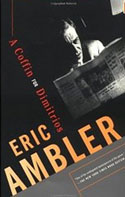 Isn’t the name here ominous? Well, the book, by Eric Ambler, is less so, though Dimitrios is a rough character. This mystery-international-intrigue novel actually isn’t as cliff-hanger-ish as it wants to be, but it does globe trot across some interesting southern-European, Northern African, Easter European locales, and they drink it up somewhat along the way, which I have no problem with—heck, I don’t even have too much problem with the lack of mystery, as long the scenery is so jumping. Here are two quotes that round out this book’s particular bar:
‘Will you have a drink?’ said Latner. The Russian’s eyes flickered open and he looked round like a man regaining consciousness. He said: ‘If you like. I will have an absinthe please. Avec de la glace*.’
She had had a Mandarine Curaçao in front of her and now she had drunk it down thirstily. Latiner had cleared his throat.
—A Coffin for Dimitrios, Eric Ambler
*If you wondered, this means “with some ice.”
November 26, 2010
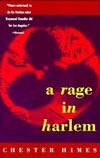 Last month, I hit up booze-y quotes from two Chester Himes books, The Crazy Kill and The Heat is On. If you missed those, go on and read them, and then come back. Back? Okay. Today, though, I have a quote from perhaps the best known Himes book containing the two most dangerous police detectives, Coffin Ed Johnson and Grave Digger Jones, A Rage in Harlem. It’s a fantastic read, full of the details of Harlem that make all of Mr. Himes detective books come alive, and was also made into a movie that’s well worth tracking down. This quote not only makes me miss some of my local bars (not that any were this rowdy), but also introduced me to a phrase for booze I love: ruckus-juice. If any bartenders are reading this, please have a drink called “ruckus-juice” on your drinks menu next time I come in to your establishment. I will tip big.
There were more bars on his itinerary than on any other comparable distance on earth. In every one the jukeboxes blared, honey suckle blues voices dripped sticky through jungle cries of wailing saxophones, screaming trumpets, and buckdancing piano notes; someone was either fighting or had just stopped fighting, or was just starting to fight, or drinking ruckus-juice and talking about fighting.
—A Rage in Harlem, Chester Himes
October 30, 2010
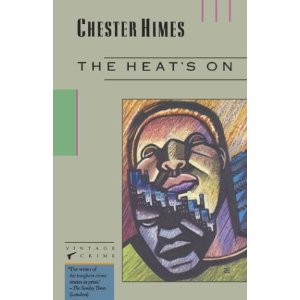 My Chester Himes quote from a couple days ago has spurred me to want to put up a couple more from his Harlem series starring the two toughest-named detectives ever: Coffin Ed Johnson and Grave Digger Jones. In The Heat Is On, Grave Digger almost buys it, which almost has Coffin Ed taking out half the city. But by the end, Grave Digger is okay, and Coffin Ed is going out for a calmer.
Leaving the hospital they ran into Lieutenant Anderson, who was on his way to see Grave Digger, too.
They told him how he was, and the three of them went to a little French bar over on Broadway in the French section.
Coffin Ed had a couple of Cognacs to keep down his high blood pressure. His wife looked at him indulgently. She settled for a Dubonnet while Anderson had a couple of Pernods to keep Coffin Ed company.
–Chester Himes, The Heat Is On
October 26, 2010
 Chester Himes is one fantastic and fantastically varied writer. He’s written novels a plenty, known for their rigorous politics, but never getting bogged down by them, more rollicking stories, and pure polemics. But he’s probably best known for his series of Harlem crime books, which star two unforgettable police detectives, Coffin Ed Johnson and Grave Digger Jones. These books, for me, manage what most “crime” books don’t, which is to create a universe so complete and entertaining and real that the mysteries or crimes become, not secondary, but only a part of the whole, instead of the only thing tying a book together. The fact that many characters hit a variety of bars and have drinks a’poppin’ doesn’t hurt either. This quote is from The Crazy Kill, and if you don’t always want your drinks ice-cold, you’ll appreciate it (really, you’ll appreciate it no matter what I’ll bet).
When Johnny sat down the waitress came with the menu, and PeeWee brought in a big glass pitcher of lemonade, with slices of lemons and limes and big chunks of ice floating in it.
‘I want a Singapore Sling,’ Dulcy said.
Johnny gave her a look.
‘Well, brandy and soda then. You know good and well that ice-cold drinks give me indigestion.’
–Chester Himes, The Crazy Kill
October 16, 2010

Before leaving for Italy (detailed on my blog Six Months In Italy), I went through and re-read almost all the Easy Rawlins books by Walter Mosley. I think Mosley is one of the finest writers living today, and think the Easy Rawlins books are the best Mosley books (and too often talked about only as detective fiction, which is silly as they transcend genre by the end of the first page, if not the first sentence, of the first book, Devil in a Blue Dress). These books are, like Dickens in a way, imaginative tour de forces due to their ability to summon up a specific time and place (LA is the place for Easy Rawlins, with the times starting in the 50s and moving on up) so completely you become completely immersed in it, and in the characters, which feel real in their motivations and feelings and actions and thoughts, as real as people who walked the earth at any time in history. So, if you haven’t read Mosley, get after it. Black Betty is a book in the middle part of the Easy Rawlins collection, and this quote is one of the best I’ve read about whiskey, the soul of it and the underlying personality whiskey carries with every sip.
There are few things as beautiful as a glass bottle filled with deep amber whiskey. Liquor shines when the light hits it, reminiscent of precious things like jewels and gold. But whiskey is better than some lifeless bracelet or coronet. Whiskey is a living thing capable of any emotion that you are. It’s love and deep laughter and brotherhood of the type that bonds nations together.
Whiskey is your friend when nobody else comes around.
And whiskey is solace that holds you tighter than most lovers can.
–Walter Mosley, Black Betty
September 24, 2010
 For the last poem in In Their Cups week 2010 (celebrating the release and release party this Sunday for In Their Cups and the drinking poems contained therein, as if you didn’t know), I wanted to highlight one of the two poems in book by Ed Skoog (I should mention though, that he also has translations in the book from three languages–you’ll have to look to find out which languages). Without Ed, In Their Cups would have been called “Cups with Holes” and been awfully leaky, cause he not only let me put poems and translations of his own in the book, but helped me track down more poems that made the cut and are in the book, gave advice on ordering of poems and sections, drank a lot with me during the putting together of the book, and was generally helpful in every way you can think of plus a few more you’d forgotten.
If you don’t know already, Ed is one of the best poets anywhere alive today–buy his book Mister Skylight and you will be changed–but is also a drink maker of some renown, a drink consumer of much renown, and a sweet banjo player to boot who can sing the high lonesome like few others (even after a few–let’s say 5-to-10–shots). If you ever are going into a bar for the long haul (which I’m guessing you will be, probably soon), bring him along. Or at least bring this poem of his about New Orleans’ Saturn Bar, a truly divine dive, along with you as an Ed sub.
The Last Saturn Bar Poem
Around the art barn, Mike Frolich’s bar-tab
bartered paintings hang the hell that rose with him
from the Gulf of Mexico floor too fast, torturing
blood with air: maniac fish, demon in a diving bell,
and then from cadmium sunset through marsh comes
the boat bearing forward in grand roving the name
O’Neal, our bartender. Theirs are the dreams we enter,
entering the Saturn Bar’s owly heat re-tooled for unlovely
loss, the rattled corner leaning away from Chartreuse, neat,
and when I’m able to dream jukebox damaged warbling,
a Saturn-like-thing opens within me, but this is the last
Saturn Bar poem–I’ll try, I’ll try–to stop singing
shadows of St. Claude and Clouet on security camera
pavement grays we keep talking about with increasing
reluctance, ready to move on to fresh bewilderments,
spiraling neon, neon that lights up my nameless shot.
—The Last Saturn Bar Poem, Ed Skoog
Tags: Bars, Cocktail Talk, drinking poems, Ed Skoog, In Their Cups, The Last Saturn Bar Poem
Posted in: Bars, Cocktail Talk, drinking poems, Drinking Writer, Ed Skoog, In Their Cups
September 23, 2010
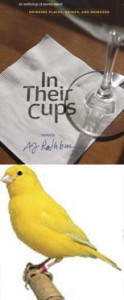 Continuing on with our week of poems from In Their Cups (in honor of the upcoming release reading which you already know lots about, and have told your friends about, and that hottie you see at the bus station) comes the poem with maybe my favorite title in the book: “Oh, For a Bowl of Fat Canary.” It’s by John Lyly, a writer in the late 1500s who had a way with words and drinks, and seems like someone you (and me) would want to spend a rowdy evening with, drinking and becoming jolly. “Canary” does not mean he was boozy enough to eat birds though. “Canary” was actually a type of sack from the Canary islands (with sack being an old term for a fortified white wine). Now, that makes it all a bit less unfriendly to our feathered friends.
Oh, For a Bowl of Fat Canary
Oh, for a bowl of fat Canary,
Rich Palermo, sparkling Sherry,
Some nectar else, from Juno’s dairy;
Oh, these draughts would make us merry!
Oh, for a wench (I deal in faces,
And in other daintier things);
Tickled am I with her embraces,
Fine dancing in such fairy rings.
Oh, for a plump fat leg of mutton,
Veal, lamb, capon, pig, and coney;
None is happy but a glutton,
None an ass but who want money.
Wines indeed and girls are good,
But brave victuals feast the blood;
For wenches, wine, and lusty cheer,
Jove would leap down to surfeit here.
—Oh, For a Bowl of Fat Canary, John Lyly
September 21, 2010
 In Their Cups week continues here at Spiked Punch, with another poem from the raddest collection of drinking and drinkers poems I’ve ever been associated with up to date (if you missed it, it’s a week celebrating In Their Cups because of a certain reading this Sunday). For today’s pick, I’m going with a poem celebrating one of my favorite drinks, and the drink to have the first Saturday in May–the Mint Julep of course. This poem about the legendary birth of the Mint Julep is by Charles Fenno Hoffmann, who was a New York writer, editor, and critic in the 1800s. If you’ve ever had a truly well-made Mint Julep (on May 1st or any other day), you’ll understand why he’d write such a ringing and singing and immortalizing number about the drink (and if you haven’t had a Mint Julep that matches the below, maybe we need to get you a better recipe or point you to a different watering hole).
The Mint Julep
‘Tis said that the gods on Olympus of old
(And who the bright legend profanes with a doubt?)
One night, ’mid their revels, by Bacchus were told
That his last butt of nectar had somehow run out!
But determined to send round the goblet once more,
They sued to the fairer immortals for aid
In composing a draught which, till drinking were o’er,
Should cast every wine ever drank in the shade.
Grave Ceres herself blithely yielded her corn,
And the spirit that lives in each amber-hued grain,
And which first had its birth from the dew of the morn,
Was taught to steal out in bright dewdrops again.
Pomona, whose choicest of fruits on the board
Were scattered profusely in every one’s reach,
When called on a tribute to cull from the hoard,
Expressed the mild juice of the delicate peach.
The liquids were mingled while Venus looked on
With glances so fraught with sweet magical power,
That the honey of Hybla, e’en when they were gone,
Has never been missed in the draught from that hour
Flora, then, from her bosom of fragrancy, shook,
And with roseate fingers pressed down in the bowl,
All dripping and fresh as it came from the brook,
The herb whose aroma should flavor the whole.
The draught was delicious, and loud the acclaim,
Though something seemed wanting for all to bewail,
But Juleps the drink of immortals became,
When Jove himself added a handful of hail.
— The Mint Julep, Charles Fenno Hoffmann