January 30, 2012
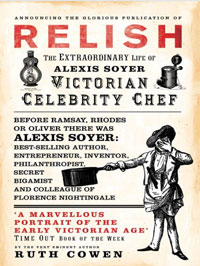 If you’re interested in cooking, in living well, use a gas stove, have eaten while in the military, have worn a beret or enjoy wearing colorful clothes, like French, English, or other European cuisine, have a healthy (or unhealthy) interest in celebrity chefs or celebrities in general, are curious about kitchen inventions, have been known to knock back a bit of bubbly regularly, are wondering where the first American-style cocktail bar was in London, have a thing for Dickens’ era history, or just want to learn about an awfully interesting fella, I strongly suggest you read Roth Cowen’s Relish: The Extraordinary Life of Alexis Soyer, Victorian Celebrity Chef. It’s quite a rollicking read as far as biographies go, because Soyer was quite a rollicking character. A famous chef in Paris by the time he was 20 (called “The Enfant Terrible of Monmartre”), Soyer really became a hit after political uprising sent him to England (he’d made one amazing, and amazingly described, banquet for the wrong people when the right people were uprising). He eventually became head chef at the famous Reform Club, where he designed the most modern kitchen ever seen, including being one of the first to use gas stoves instead of coal, along with a bunch of other culinary-minded inventions and innovations. Eventually, he did a host of things (I’m not going to mention them all–really, read the book) consumerist and philanthropic, published cookbooks, had his name on condiments, had a hugely fantastic failure of a, well, restaurant isn’t really the word, but at least is related, made and lost lots of money, became well-known, and then died in his late 40s. For the amount of work he did for the poor and military of the U.K., you’d think he’d be better revered, but he hasn’t been (though maybe the last few years have been kinder). As you can tell, I was pretty struck by Soyer when reading the book, so much so that I’ve decided to have a week of quotes from the book (which may mean three posts, maybe more), some by him, and some about him. Starting with one from earlier in his life, and then moving on–all to try and entice you to learn more about the great Soyer.
…he was particularly skilled at mimicking the comic turns of whichever show was playing. He had a musical ear and sang, by all accounts, nearly as well as Levasseur, one of the most admired bass singers in France. A dandy with a penchant for outlandish costumes, a terrible flirt, a skiller storyteller and an impish practical joker, Alexis had even considered switching careers to try his luck on the stage.
By two in the morning he would be at the Provence Hotel, the Ceder Cellars, or Evan’s Late Supper Rooms in Covent Garden–also frequented by Thackeray–where customers descended a flight of stone steps to a smoky basement called the Cave of Harmony, which was in fact a large raucous music hall and café serving simple, alcohol-absorbing meals of fatty chops, sausages, grilled kidneys in gravy, Welsh rarebit, and baked potatoes. Here the exclusively male clientele would stay until the early hours, cheering and heckling the professional glee singers and comic acts while knocking back the cheap booze–stout, pale ale, punch, grog, hot whisky and water.
January 23, 2012
 As the political, um, talk is reaching its election-year-in-January proportions (talk which I’m sure by the actual election will reach astronomical asinine-ness), I thought I’d throw in a Cocktail Talk quote from Graham Greene. It’s not, however, specifically about politics, but it seems relevant. It’s not, either, from one of my favorite books by Mr. Greene (who is of course super-fan-tabulous), but from a perhaps lesser novel called Travels with My Aunt. The fact that it’s one of his books makes it better than most books on the top seller list, however. But, to get back to politics. And booze. The reason this quote seems so perfect for an election year goes back to a thought I once had (and if anyone says “the one thought you ever had,” well, good point), that if we could see those fight’n politicians after a few glasses of bubbly we could probably find out more about them then listening to any ol’ debate. Which leads to this quote, which I might use as a slogan if I ever run for office:
Champagne, if you are seeking the truth, is better than a lie detector.
–Graham Greene, Travels with My Aunt
January 11, 2012
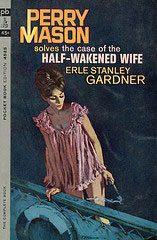 As I mentioned once in a Cocktail Talk post over two years ago (amazing that I’ve been writing this blog for so long, now that I mention it), I’m not a huge Perry Mason book fan, meaning those (and there were tons) written by Erle Stanley Gardner. I am a gigantic Perry Mason television show fan, however. Which points I suppose to how wacky I am, or some such. But the books just seem a tad too smart about themselves, while the show seems just the right pitch of genius and atmosphere. However, I do still pick up the occasional Perry Mason book, mostly because many of the original pocket book covers are joys to behold. Take the one pictured here–lovely lady, in negligee, with smoking pistol, on a boat. Gawd, that’s wonderful. And this book I liked more than others, too, as it seemed a little less in hand at times to me, and had the full contingent of Perry Mason favorites: dashing detective Paul Drake, saucy and swell secretary Della Street, and cuddly losers (at least when facing Perry) Lieutenant Tragg and DA Hamilton Burger. And, the following little gem of an exchange:
Drake said, “Here’s a car with three of my operatives now. What do we do first?”
“Put them out the way I said, so they can watch the apartment, the garage, and the windows.”
“Okay, then what?”
“Then,” Della Street interposed with firm determination,“we get a cup of hot coffee and it there’s any brandy in the car, we spike it with brandy. My chattering teeth are chipping off.”
“That,” Mason agreed, “is an idea.”
–Erle Stanley Gardner, The Case of the Half-Wakened Wife
January 8, 2012
 In an earlier Cocktail Talk post, I had a quote from Qiu Xiaolong’s book Death of a Red Heroine (which I highly recommended then and still do now), and talked a bit about the author and his main character in the series, Shanghai poet and Chief Inspector Chen (though Chen’s second-in-command Detective Yu gets a lot of deserved face time on the page, too, with chapters often switching off with the two as alternating protagonists). So, for more background, go read that post. Cause here I just want to get straight into this quote, which is from a book in the series called A Case of Two Cities, which takes place not only in late 20th century Shanghai but also Los Angeles and St. Louis. This quote is actually Chen remembering “a short poem by Wang Han, an eighth-century Tang dynasty poet,” and would have made a dandy addition to In Their Cups: An Anthology of Poems About Drinking Places, Drinkers, and Drinks had I known of it.
Oh the mellow wine shimmering
in the luminous stone cup!
I am going to drink
on the horse
when the army Pipa starts
urging me to charge out.
Oh, do not laugh
if I fall dead
drink in the battlefield.
How many soldiers
have really come back home
since time immemorial?
–Wang Han, quoted in Qiu Xiaolong’s A Case of Two Cities
December 3, 2011
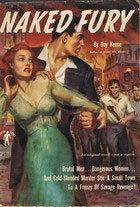 I probably shouldn’t start off by lying, so I’m going to tell the truth (which happens at least 69.7% of the time): even if the book I’m quoting wasn’t written by Day Keene, I probably would have picked it up if I saw it in the pocket book section of the mystery section of a bookstore, cause it’s called Naked Fury. That’s tough stuff. But since it was by Day Keene, and since I’ll purchase anything by him, well, the choice was easy. Keene’s oneof the classic (in my mind) hardboiled pulpy writers, who turned out books that slapped the pavement as hard as it needed to be slapped, usually outside of a bar that we modern folks can only dream about in our lurid dreams. Naked Fury is no exception, as it follows around a big-in-size-if-not-in-smarts party/neighborhood boss who is being set up and such around his boozing. Good stuff, I think. And the fact that I know pretty well how he feels in the below quote (even though I might sub in something for the lobster) makes me like him even more.
Morning was hot and slightly sour in Big Dan Malloy’s mouth. He lay on his back for long minutes listening to the intimate feminine splashing in the bathroom, wondering why he ever combined Champagne and Lobster Thermidor.
–Day Keene, Naked Fury
November 19, 2011
 It’s rare, in the mystery book genre, to find a protagonist that drinks. Oh, wait, you see that all the time. What’s really rare is a protagonist that writes poetry, or reads poetry, or reads at all, really. However, in Qiu Xiaolong’s wonderful Death of a Red Heroine, the main character, Chief Inspector Chen is a writer as well as a cop, and is always sprinkling in lines from classic Chinese poems into his conversations and thoughts. And, the mystery itself is good, while the setting and surroundings (late 80s China) are describing in a manner that’s both poetic and immersive. Add in a sidekick (Detective Yu) who’s got some sass in him and a whole host of intriguing surrounding characters (there’s even one called Overseas Chinese Lu) and intricate food descriptions and the following quote and you’ll be able to guess that I strongly suggest you read the book, for gosh sakes.
Behind him, across Zhongshan Road, stood the Peace Hotel with its black-and-red pinnacled roof. He had fantastized about spending an evening there in the jazz bar, in Wang’s company, with the musicians doing a great job with their piano, horns, and drums, and the waiters, starched napkins over their arms, serving Bloody Marys, Manhattans, Black Russians . . .
—Death of a Red Heroine, Qiu Xiaolong
November 9, 2011
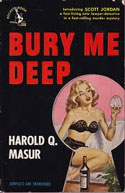 It’s been over two years since I had a quote up here from Harold Q. Masur (though, between us, I’m guessing he hasn’t noticed), who I like cause books I have by him fit into my pockets, and because his characters don’t shy away from the sauce, and cause in the below quote he mentions three delicious boozes, and because he isn’t pulp enough to be distracting, and isn’t so light as to float away into a land of cotton candy and unicorns. Though, honestly, that doesn’t sound bad, either. Anyway, this is from a book called Bury Me Deep, and it involves a lawyerly type chasing around a drunken literary type and a girl. Which, honestly, doesn’t sound much different than some afternoons I had way back when (except the lawyerly type part).
A marble-eyed waiter with a pushed-in face and a malevolent twist to his mouth came over, snapped a napkin, nodded. I ordered bourbon for myself, Dubonnet for Dulcy, and Bob ordered a bottle of Napoleon for himself.
—Bury Me Deep, Harold Q. Masur
October 18, 2011
 Peter Lovesey is an English mystery writer, perhaps most famous for his barrel-shaped and brusque Bath detective Peter Diamond and for his Sergeant Cribb books that take place in the Victorian era. I dig both. Lovesey isn’t all flashy, and isn’t perhaps as well-known as he should be over on this side of the pond, but his plots are always incredibly well thought out, his characters are real and motivated, and once you dive into one book featuring one of his two main characters, you tend (or I did, at least) to want to read more. They don’t hit the cocktails as much as other crime solvers of the police-and-non kind, so I haven’t mentioned him much here on the Spiked Punch blog. And, funny enough when considering the above, the quote below comes from the book Rough Cider, which doesn’t contain either of the fictional gentlemen mentioned above. But Rough Cider does has a fine mystery/story, and lots of cider talk (a murder happens at a cider farmer’s, if that makes sense), and I like cider, and so now it all makes sense, right? I did learn a few things from the book, too. First (and this is gross), cider makers at one time would put legs of mutton in the cider to give it a bit of body. Hmm. Second, cider that was bad would be termed “ropy” as in the below quote. Third, never put a human skull in your cider, or it will turn it ropy (unlike if you put mutton in I guess). Did these learnings turn me off cider? Nah. But they have given me a few more things to talk about when drinking it. This quote also features one of my favorite words (hogshead) and talks about drinking from jam jars, which I’m a fan of, even outside of wartime.
One evening in October, 1944, almost a year after the tragic events I’ve been describing, a man in a public house in Frome, the Shorn Ram, ordered a pint of local cider, a drink strongly preferred in wartime to the watered-down stuff that masqueraded as beer. People didn’t object to drinking from jam jars in those days of crockery shortages, but they were still choosy about what went into the jam jars. So when a customer complained that the cider was “ropy,” it was a serious matter. The publican had just put a new barrel on, a large one, a hogshead, from Lockwood, a reliable cider maker. He drew off a little for himself and sampled it.
—Rough Cider, Peter Lovesey