May 26, 2011
The ol’ Seattle weather recently hasn’t been what you’d (you or anyone, really, unless that other person is someone who revels in dreary wetness) call awesome lately (and by lately, I mean, to all reports, since last August). You might think this rain-cloud-rain pattern would drive me to drink only straight shots of rot-gut (or at least straight shots of almost-rot-gut). But no, fair friend, no. When the weather trots out its worst repeatedly during a time when the very month name should signal clear skies and sunshine (like May, for instance) I go for summertime mixes. A: I’m not going to let that weather tell me who the boss is. I know who the boss is (Tony Danza. And then me). B: I figure if I drink like there’s sun in the sky then maybe, just maybe, I’ll influence said weather to follow my lead. Here’s hoping, at least. Which is why I’m sipping the summertime queen of the jungle, the Ognam (which is straight of out Dark Spirits, don’t you know. Wait, you don’t? Well go buy the book and find out). It was created by wife Nat and has a tropical refreshing vibe (sure, I said vibe, what of it?), and can, if anything can, change the weather:
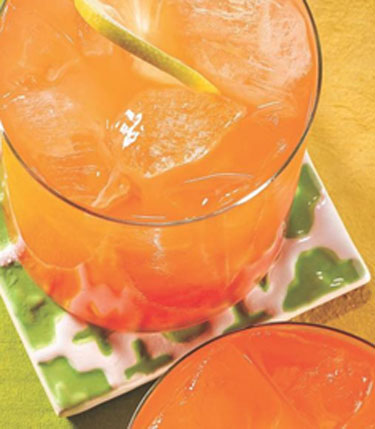
Ice cubes
1 1/2 ounces brandy
2 1/2 ounces mango juice
1/2 ounce Aperol
Chilled club soda
Lemon slice for garnish
1. Fill a highball or comparable glass with ice cubes. Add the brandy, mango juice, and Aperol. Stir well.
2. Fill the glass almost to the tippy top (Ognam insists on words like tippy top. Don’t infuriate Ognam.) with club soda. Stir again, well. Squeeze the lemon slice over the glass and drop it in.
Tags: Aperol, Brandy, cocktail recipe, Cocktail Recipes, Dark Spirits, Ognam, What I'm Drinking
Posted in: Almost Drinkable Photo, Aperol, Brandy, Dark Spirits, Liqueurs, Recipes, What I'm Drinking
May 23, 2011
 If you haven’t read Part 1 of our Branca Distiller tour, well, do so now. It talks lots about company history, the Collezione Branca, the Branca philosophy of novare serbando (renew but conserve), and much more. Go read it. Okay, are you back? Now we’re ready for Part 2, in which we actually get to walk around the distillery and see where the magic happens. Still with our tour guides Elisa, Marco, and Valeria, we last stopped at the Carpano area of the museum, where we learned more about Branca’s purchase of Carpano Antica (and the full Carpano family of vermouths), had a quick drink of Carpano Antica, and then got ready to hit the distillery proper. But first, as we’re walking into delicate areas, we had to suit up (attractive, aren’t we?):
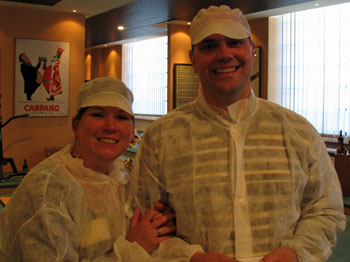
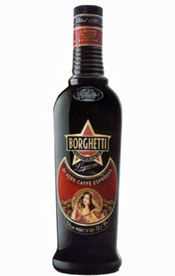
Check out the wonderful Carpano ad in the background, too. Yet another piece of Branca-related advertising I wish I had framed in my house. After suiting up, we started by going through a few doors into the Borghetti coffee liqueur room. Now, here’s where I have to admit one downside for you, dear readers, in this Part 2 of the tour post. We couldn’t, in most areas of the distillery, take pictures. As mentioned in Part 1, having delicious liqueurs, vermouths, and amaros means that folks are always wanting to know how you make them. Which means even someone as un-spy-ish as me (though I could be a spy, I suppose–I have that look, right?) can’t snap snaps. Borghetti, if you don’t know (and you might not, as it’s sadly not readily available in the States) is the coffee liqueur made by the Branca company. It’s a staple in Italy (all the everyday bars/cafes we’d visit had it, usually in both big bottles and in these small, 3-inch-ish, portable bottles), and I’m not 100% sure why we don’t have it in the U.S., as it’s scrumptious. Normally, I’m not either a big coffee liqueur fan or a big coffee drinker (a lot of coffee liqueurs taste ickily chemical to me), but I really love the Borghetti, and after seeing where it’s made, I know why. It only contains coffee (freshly roaster and made there), liquor, and a natural sweetener. Walking into the room where it’s made is somewhat like walking into the best coffee roaster inside Willy Wonka’s chocolate factory, as there’s a perfect sweet/coffee aroma—which matches Broghetti’s taste. Here’s what the bottle looks like, if you want to scoop some up on your travels:
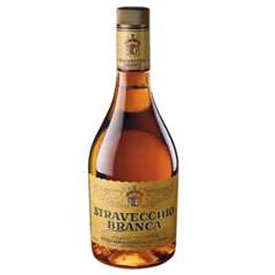
From there, we saw where the ingredients in Fernet Branca are treated during production (where the secret processes mentioned in Part 1 happen), including the big iron pot (pictured in Part 1) where the spices and more are stirred up. Amazing stuff, really, as it’s partially mechanized, but still there are always workers in attendance, watching over the process. We next went to perhaps my favorite part of the whole tour (well, just hanging out with our awesome tour guides was my favorite part, but this coming up was a close second), the cask where Stravecchio Branca spends time before bottling. Stravecchio Branca is the brandy made by the Branca company, and is another item I wouldn’t mind seeing more of over here (again, it’s in most bars/cafes in Italy and is a really good, full-bodied brandy). Here’s the bottle if you ever want to try some and you see it:
But the cask (or flask, as they referred to it as) in question we could take pics of, but we didn’t have a wide enough angle lens to do it justice. See, it’s the biggest cask in Europe, and was built over a two month time period way back in 1892. And it’s massive and astounding to stand in front of:
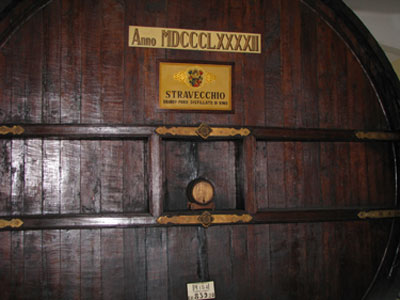
Stravecchio was originally called “Vieux Cognac,” but they had to change the name due to the Cognac rules (about it having to be made in the Cognac region of France, that is). Today, the brandy spends some time in other casks, but each batch spends a least some time in this massive cask–which is never empty, as some is always left in to ensure that the brandy stays consistent (a nice little touch). On the back of the ginormous cask, there’s a chart that tells how full it is (somewhat like the little marks made on the wall as kids get taller), alongside a little chalkboard notepad (which is alongside my head):
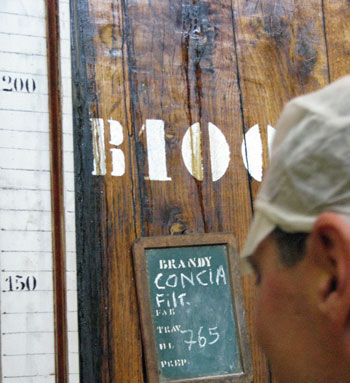
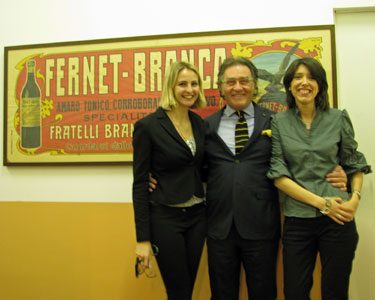
My favorite part of the photo (and another reason why I loved this cask so much) is right above the “B100” where the cask looks like it’s sweating. This is a slight oozing out that happens, about which Marco said, “it is crying.” He even wiped some off on a fingertip to taste, and encouraged us to do the same–which I, naturally did. It was super-brandy-charged, and I dug it so much I went back for more (hey, I have a hard time seeing anything cry). After the Stravecchio, we wandered down into the cellars, where we viewed wooden cask after wooden cask, rows of them (all lovely, by the way), first more brandy (they start here in smaller casks before moving to the biggest cask in Europe), then the wooden casks Fernet Branca is aged within. Fernet Branca has to be aged at least a year, and the brandy for three, so you can imagine that there are tons of casks (not to mention that Branca Menta is also made with aged Fernet Branca, on to which is added pure peppermint oil, sweetening, and love). All these hundreds of casks, the giant cask, the production facilities upstairs, the museum from Part 1, and the offices live in this one building, in the center of Milan, a bustling city. There’s something almost otherworldly about it, especially when wandering through the building’s many rooms and passages. One could easily get lost down here—you’d never go thirsty, luckily. Also luckily, we didn’t have to worry about getting lost, because we were with our friendly and knowledgeable (and fun) tour guides. Check them out, aren’t they great:
After seeing the casks, and saying our goodbyes, we walked out in Milan craving a little Fernet Branca or Branca Menta. Of course, we had a four-and-a-half hour drive ahead of us, so the cravings just became sharper, until we were back in our home Italian neighborhood, where we could indulge our Branca thirst at Bar Fizz. Thanks again Fratelli Branca Distillerie, we had a great time.
Tags: amaro, Borghetti, Branca Menta, Carpano Antica, Fernet Branca, Fratelli Branca Distillerie, Italian Liqueurs, Italy, Milan, Punt e' Mes, Stravecchio brandy
Posted in: Brandy, digestif, Fernet Branca, Italy, Liqueurs
February 16, 2011
 Another from Eric Ambler (following up the Coffin for Dimitrios below), from another of his political thrillers. Now, the political thrillers don’t get me all giddy as much as other books that sometimes share the same shelves (no-one says “dame” in a political thriller for one thing), but the Amblers (as I’m affectionately calling them) are written well, and, well, the characters tend to have lots of cocktails, drinks, and booze (in various forms). And the plots are never that bad, either. The Levanter‘s all Middle East terrorist business, and tends to roll heavy on the brandy. Much like this quote, which also demonstrates how to use cocktails to your advantage in serious discussions:
I gave him a champagne cocktail with plenty of brandy in it, which he drank thirstily as if it were water. I gave him a cigar and lit it for him. He sat back in his chair and looked around. Though he was clearly impressed, he seemed perfectly at ease. This suited me. I wanted him relaxed and in as expansive a mood as possible. All the stiffness was going to be on my side. I continued to address him respectfully as Comrade Salah, and fussed a little. As soon as he had finished his first cocktail I immediately gave him another in a fresh glass.
—The Levanter, Eric Ambler
January 14, 2011
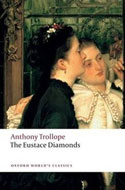 People who know me, know that I dig the Trollope (the Anthony Trollope, that is, and not some other author trying to ride the coattails of his last name—and not the trollops this time, though I don’t have anything against a hooker with a heart of gold). I have pretty much (I’m missing one) the complete Trollope collection of novels and sometimes think I could subside on a reading diet of Trollope, Dickens, and Mosley (and maybe a couple pocket books for balance). Especially fine, and worth reading and re-reading, are the Palliser novels, where he takes on a combination of politics and upper crust foibles in the age when everyone had a ladies maid, had tongues sharp as Wustofs, and wore really puffy outfits. The Eustace Diamonds is the third of six Palliser novels, and while not my fav of the bunch is pretty darn fine. Especially fine is this quote where the drink of choice is Negus, the party hit of the late middle 1800s.
‘My dear, Mr. ‘Oward’ he said, ‘this is a pleasure. This is a pleasure. This is a pleasure.’
‘What is it to be?’ asked Gager.
‘Well;–ay, what? Shall I say a little port wine Negus, with the nutmeg in it rather strong?’ This suggestion he made to a young lady from the bar, who had followed him into the room. The Negus was brought and paid for by Gager, who then requested that they might be left their undisturbed for five minutes.
That’s not the only quote, though, cause on the very same page is this gem:
‘Six penn’orth of brandy,–warm if you please, my dear,’ said the pseudo-Howard, as he strolled easily into an inner room, with which he seemed to be quite familiar. He seated himself in an old-fashioned wooden arm-chair, gazed up at the gas lamp, and stirred his liquor slowly.
–Anthony Trollope, The Eustace Diamonds
January 7, 2011
Not too long ago, I was lucky enough to be able to play around with making drinks that feature Washington State cider-maker Tieton’s ciders. Operating out of the Yakima, WA area, Tieton ciders utilize all-natural ingredients, are made with care, and are starting to be more and more widely available. The ingredients and care are evident when drinking them, too, as they boast clear, crisp taste (which is what you want in your ciders—stay away from those overly sugary messes). At first, I was a little unsure about what I’d mix up with them, but after taking a few sips my unsure-ness re-routed straight into excitement. The following are my two favorite Tieton mixes. So, head down to your store and pick up some Tieton cider (or head down to complain that they don’t yet have them) and then cocktail up.
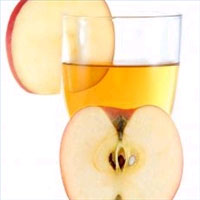 Harmony in C
Ice cubes
1-1/2 ounces dark rum
3/4 ounces Grand Marnier
1 dash Peychauds bitters
2 ounces chilled Tieton Wild Washington apple cider
Apple slice, for garnish
1. Fill a cocktail shaker halfway full with ice cubes. Add the rum, Grand Marnier, and bitters. Shake well.
2. Strain into a cocktail glass. Top with the Tieton Blend apple cider. Stir briefly and carefully. Garnish with the apple slice.
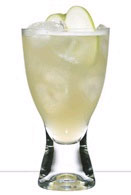 Tieton Highball
Ice cubes
1 ounce applejack or apple brandy
3/4 ounce Benedictine
2 dashes Fee Brother peach bitters
Chilled Tieton Blend apple cider
Mint sprig, for garnish (optional)
Apple slice, for garnish (optional)
1. Fill an Old Fashioned glass three quarters full with ice cubes. Add the applejack, Benedictine, and bitters. Stir briefly.
2. Fill the glass almost to the rim with Tieton Blend apple cider. Stir again, briefly. Garnish with a mint sprig and an apple slice, if desired.
Tags: Benedictine, bitters, Brandy, cocktail recipe, dark rum, Grand Marnier, Tieton Cider, What I Wish I Was Drinking
Posted in: Brandy, cider, Recipes, Rum, What I Wish I Was Drinking
July 9, 2010
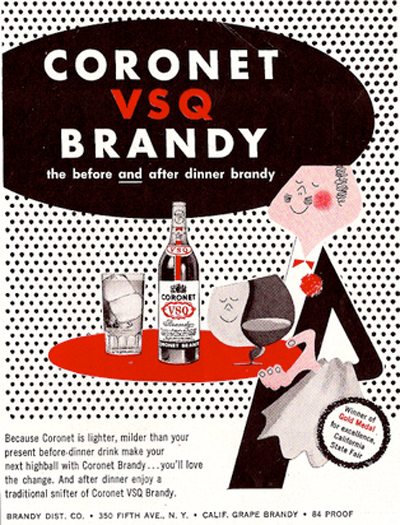
I’ll drink up some brandy, winter, spring, summer, fall, you name it. I like it most often in cocktails, but have been known to go sniftering with the straight stuff on occasion (mostly often with dolled-up brandies Cognac and Armagnac, and fruit brandies, sure). However, I didn’t until I saw the below ad realize that I was in danger of being beheaded, and then having my head turned into a snifter, when drinking brandy. And being happy about said beheading. Want to keep your own head? Stay away from even serving Coronet VSQ (cause even the smiling serving butler man’s head has been leveled off in a way that has to hurt, even if it was done with a brandy laser). Though, thinking about it from another angle, both heads/faces looks awfully happy. And it is the before and after dinner drink. Though how you’d enjoy dinner without a body is sorta beyond me. But what the heck, it is Friday. I need some laughs. Bring me the brandy.
May 28, 2010
 After the longish (or just plain long) Tom Waits post below, I thought I’d slip in a short couple of quotes from a book that almost echoes Waits (a book which is definitely the inspiration for the “ethics” scene in the Coen brothers’ film Miller’s Crossing, too), in that there are some shady and weird characters and everyone ends sad, dead, or drunk–a book called Kill and Tell. The first one’s about going into a bar, and the second about drinking at home (cause I wanted to cover the bases).
The bar was a fine old piece of imitation mahogany, and there was a fine old imitation Irishman in a white coat behind it.
We lifted our glasses to each other; the wine was cool and dry. I kept refilling our glasses while we ate, and when Jake brought the coffee Catherine asked him for some brandy. We were celebrating; each of us understood that.
“I think I’m drunk,” she told me.
“I’m drunk, too,” I said.
—Kill and Tell, Howard Rigsby