July 17, 2018
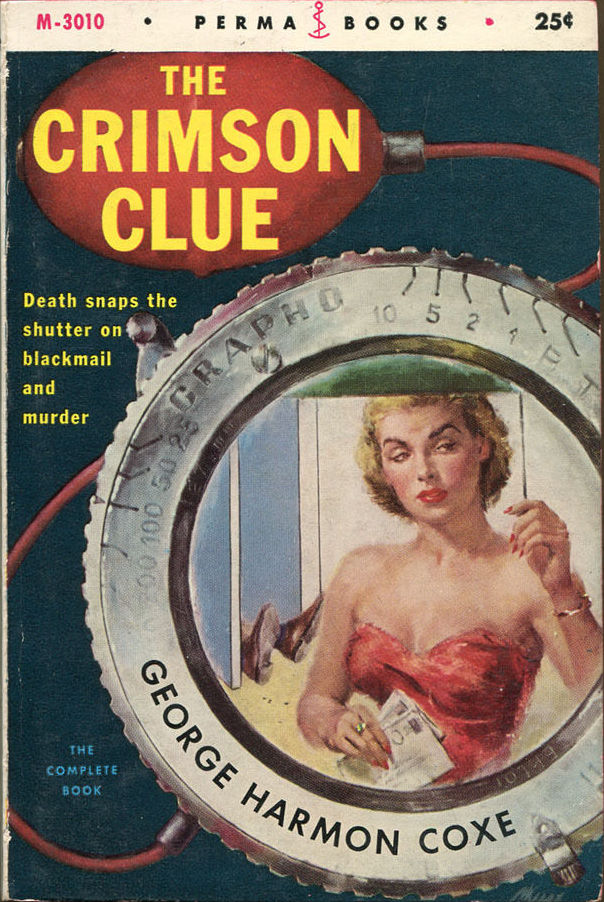
It had been a long, long stretch of days since I’ve had a Cocktail Talk post from a tale by one of our pocket-book specialists (in the 50s, that is), George Harmon Coxe – past hits here have covered his books
The Groom Lay Dead and
Murder in Havana. Those titles, along with the book we’re quoting here,
The Crimson Clue, give you insight into where his reads roll: mysteries and crimes and all that good stuff. In
The Crimson Clue, the hero is one I hadn’t seen before: a news photographer named Kent Murdock. I like the idea of a photographer shooting snaps and then solving crimes, and Kent’s a nice protagonist, and the book moves along at a persistent clip (as most pocketbooks do), has an intriguing cast (jazz musician, ex-cops, good cops, singer, rich folks doing bad things, and more), and a solid story. And, a fair amount of cocktailing and straight sipping, including the below, which asks an eternal question:
She watched him slip off his topcoat and put it on the arm of the divan, her head dipped, glance speculative. “Would you say it was too early for a drink?”
Murdock made an act out of looking at his watch and frowning over the proposition. When he looked at her she laughed.
“Bourbon?” she asked.
“That’ll be fine.”
“On the rocks, huh?”
She started for the kitchen and he asked if he could help and she said no. “On this kind of a drink,” she said, “no-body needs help. Sit down, will you? Park. Make yourself comfortable.”
— George Harmon Coxe, The Crimson Club
June 26, 2018

Just last week, I highlighted a Cocktail Talk quote from an old noir novel called
Park Avenue Tramp, which (as detailed there) was part of a Stark House Noir Classics collection that features three out-of-print noir novels all together. These collections are really worthy reads if you dig the pulps, noirs, and pocketbooks-with-saucy-covers, because they feature books not easily picked up today. In this collection, I liked all three reads, but my favorite might have been
The Prettiest Girl I Ever Killed, by Charles Runyon. A small town serial killer search, in a way, it moved fast, had a fair amount of twists and turns, tight and creative lingo and well-written prose-ing, and a female lead who showed some gumption. All good stuff! And a good Cocktail Talk quote about a country bar, which you’ll see below.
It was a little gas station and honky-tonk; the kind you see around the country with names like Burntwood Inn and Cozy Dell. This one was called Pine Cover Tavern and was crowded (there was no work in the fields because of the rain) with men in overalls and a couple of women in print dresses. We drew stares as we walked to a booth in the back. I felt wicked and daring, and though it was unlikely that any Shermanites would see me, I found that I didn’t really care if they did. I told Curt to order me a boilermaker: a glass of beer with a shot of bourbon inside it. He ordered the same for himself and drank silently for a few minutes.
–Charles Runyon, The Prettiest Girl I Ever Killed
June 19, 2018
Recently got my hands on another one of the superb (if you’re into such things, which I hope you are, so we can be friends and all that, though of course we could maybe still be friends even if you aren’t, but it’s not
quite as easy) Stark House Noir Classics collections. Often these are collections of out-of-print books by a single author, but in this one, there are three authors from the pulp-y period. All are worthy reads – your favorite is up to you – but the one I’m highlighting here is
Park Avenue Tramp, a book by Fletcher Flora (great name, too, and one I hadn’t been acquainted with before) about booze, a dangerous (in a sort-of different way) broad, a piano player, and bleakness in the best way, the way true noir books deliver it. Enough so that I was fairly, oh, downbeat for a moment when finishing this tale. Then I moved on to the next one (which is nice in these collections). A bar plays a central role, too, which is also nice, and where we get the below Cocktail Talk quote from.
She looked at him gravely and decided that he was undoubtedly a superior bartender, which would make him very superior indeed. It might seem unlikely on first thought that a superior bartender would be working in a little unassuming bar that was only trying to get along, but on second thought it didn’t seem unlikely at all, for it was often the little unassuming places that had genuine quality and character and were perfectly what they were supposed to be, which was rare, and it was exactly such a place in which a superior bartender would want to work, even at some material sacrifice. She felt a great deal of respect for this honest and dedicated bartender. She was certain that she could rely on him implicitly.
“Perhaps you can help me,” she said. “In your opinion, what have I been drinking?”
“You look like a Martini to me,” he said.
“Really, a Martini?”
“That’s right. The second you came in I said to myself that you were a Martini.”
–Fletcher Flora, Park Avenue Tramp
June 12, 2018

Picked up another of the Day Keene short story collections recently, this one called
The Case of the Bearded Bride (it’s Volume 4 of the series bringing all his stories from the old detective pulp magazines), and it’s full of the same Day Keene delicious-ness as the earlier volumes. And by that I mean, fast-paced yarns that are sometimes hard-boiled, sometimes mysterious, sometimes noir-ish, and always fun to read. The proofing here as with past volumes leaves a lot to be desired, but hey, it’s just sweet these stories are back in print. There’s a fair amount of bars and booze in them, but I picked a beer quote for this volume’s Cocktail-Talk-ing (check out past
Day Keene Cocktail Talks for more sweetness), because I don’t often beer-it up, and also because I liked this portrayal of a man just out of prison. Oh, the name of this story is a humdinger, too, “It’s Better to Burn.”
Gone were the held-back jewels he had put aside as an umbrella against the day that it might rain. Gone were the luscious blondes and the redheads. Gone was his Cadillac car. All that remained were sixty-six dollars and twenty cents and the belly that even two years in a cell had failed to diminish. He promptly steered it to the nearest bar and spent a dollar and eighty cents of his capital to fill it with beer. It had been two years since he had had a drink. Mellowed by the beer, he considered his prospects. They weren’t bright.
–Day Keene, It’s Better to Burn
June 5, 2018

I talked earlier about this little Signet pocket-sized find and where I found it in
The Sunburned Corpse, Part I, post. There, I also alluded to the rum-talk in the book, even though
that particular quote was about everything (or, some different tipples, at least) but rum. Well, that made me feel sad – this is murder in a tropical paradise after all, and tropical paradises are rum’s bosom buddies. So, a second quote from this little charmer, with rum taking the lead.
Strom went out quietly, stabbing me with his eye. Garel enjoyed the byplay but made no comment. He was content to let me relish my big moment. He brought out some special Puerto Rican rum for me, Battelito, a hot and aromatic drink that did great things for my start of mind.
–Adam Knight, The Sunburned Corpse
May 15, 2018
- Hey pals and friends and compatriots from here and there and everywhere. I’ve been having some fun on the funtastic Seattle Magazine lately, with a number of pieces talking about some swell spots here in the Emerald City and near to here. Not that I’m saying you’ve missed any of these, but just in case, check out the below:
Tags: Bars, cocktail catch up, Cocktail News, Distillery, Seattle Bars, Seattle Magazine, Washington dillstery, Washington whiskey
Posted in: Bars, Cocktail News, Cocktail Talk, Distillery, Seattle Magazine
May 1, 2018

Well, my Maigret completism still has a long ways to go, but I made another little dent recently, picking up four volumes which I hadn’t yet read at a book sale. Which probably means more
Maigret Cocktail Talk posts, lucky you, because he does like a drink (or two, even when his doctor friend warns him off the sauce), as he wanders around Paris and France, solving murders and more (though usually there’s a murder). The first of the new batch that I read was Maigret and the Madwoman, and it’s typically great, and with a sad-but-underlying, oh, sweet-worldweary-ness (can that even make sense? It felt right when typing) that Simenon delivers via Maigret like no other. Read it, on a spring day at dusk, and you’ll get what I mean. Also, you’ll get this quote – perhaps the only Tom Collins quote in a Maigret book? I feel I’ve seen another, but can’t recall perfectly.
The butler, in a white jacket, had followed them out and stood, a watchful figure, awaiting orders.
“What would you like to drink? May I suggest a Tom Collins? I know of nothing more refreshing at this time of day.”
Maigret and Marella indicated their approval.
“Two Tom Collinses, Georges, and the usual for me.”
–George Simenon, Maigret and the Madwoman
April 24, 2018
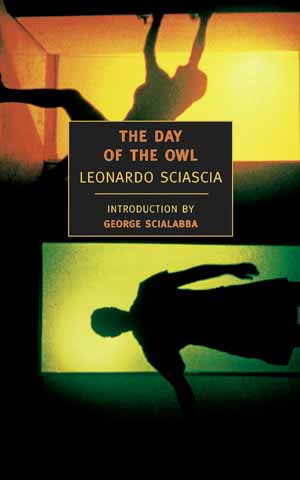
An intriguing read by an author I don’t know, an Italian author, this book’s title was too good to pass up, plus the fact that it takes place in Sicily (where the author, Leonardo Sciascia is from), and that it says on the back “in the very first rank of Italian writers,” and so, well, I had to give it a good look. It falls into the crime genre, which combined with everything else also brought me in. It’s well worth reading, too, though if you only read very straightforward crime novels, it might take you down a slightly different path – which isn’t a bad thing, me thinks. Don’t get me wrong, there is crime, a worthy police Captain, serious pacing, and the Mafia. But there’s also a lovely beauty to the prose that feels different, a way of capturing and condemning the social scene in this place and time, and a more literary lean, if any of that makes sense. Check it out if you can find it for all of the above, and for the below quote (which I think is slightly off-translation actually, but still perhaps the only Averna quote in a crime book that I’ve seen):
Pizzuco, who had invited him to a bitter vermouth at the Cafe Gulino, as so often in the past, was astounded at Parrinieddu’s refusal and abrupt flight; though not particularly bright, he wondered about it for the rest of the day. Parrinieddu, for his part, was so rattled that he spent the day attributing sinister meanings to that offer of a bitter vermouth, bitter betrayal, bitter death, over-looking the well-known fact that Pizzuco suffered from what the doctors call cirrhosis due to his fondness for Averna’s bitter vermouth – a beverage which made him proclaim his faith as a Separatist and ex-soldier of the Volunteer Army for Sicilian Independence.
–Leonardo Sciascia, The Day of the Owl